
Committee reviews draft RFP for convention center; flags budget, parking and timeline questions
Get AI-powered insights, summaries, and transcripts
Subscribe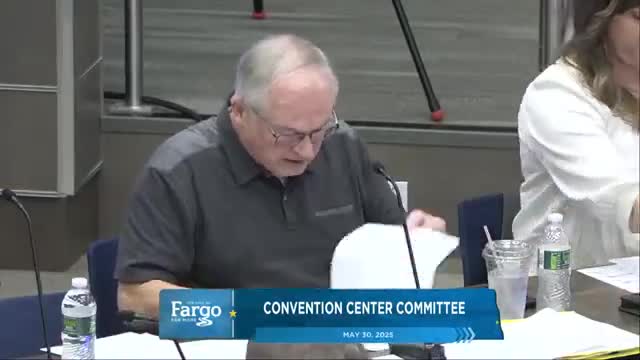
Summary
Committee reviewed a draft RFP for a proposed convention center and associated private development, discussed an estimated lodging‑tax construction fund of $37–$41 million, parking, phased construction, incentives, an arts set‑aside, and agreed to revise the draft and advance it to the City Commission for approval on an accelerated timeline.
Committee staff summarized a draft request for proposals (RFP) for a proposed convention center and associated private development and asked members for feedback on scope, selection process, schedule and budget assumptions.
Jim Gilmore, the staff author of the draft, said the document clarifies that developer budgets must cover site acquisition, site preparation, construction and furniture, fixtures and equipment. “One of the key points is … our budget will have to include land, site preparation, construction of the building and then building or furniture, fixtures and equipment,” Gilmore said as he walked through the draft.
Members discussed several substantive points:
• Budget and funding: Staff cited an initial analysis that projects the lodging‑tax construction fund at roughly $37 million to $41 million. Committee members noted that the estimate does not guarantee full project funding and that the community may face a shortfall for a facility built to the larger program size discussed; private developers might seek tax incentives or phased construction as ways to bridge gaps.
• Timeline and process: The committee reviewed two calendar options and tentatively agreed to an accelerated schedule: issue the RFP in mid‑June, accept written questions (a one‑month question window was discussed), with answers provided in about a week, and set proposals due in early August. The group discussed meeting in mid‑ to late‑August to review proposals and identifying up to five finalists for more detailed responses or presentations before forwarding recommendations to the City Commission for final decisions.
• Site and parking: The RFP will require site descriptions including size, adjacent streets, utilities and land‑use notes, but committee members asked clarifying language so proposers understand that “adequate parking” can be on‑site or in nearby/shared facilities rather than strictly contained within the proposed parcel.
• Phasing and incentives: Members discussed allowing flexibility for phased construction and for proposers to request incentives (for example, property‑tax exemptions or tax increment financing) during a later, more detailed phase, provided proponents justify the assistance with financial information.
• Arts and public art set‑aside: City Commissioner Denise Kolpak raised a request from a local artist asking whether the project would include a commission for public art. The committee asked staff and arts partners to research models (for example, a one‑percent‑for‑art set‑aside) and return with options to include in the RFP or later phases.
The committee instructed staff to revise the draft to (1) clarify what the $37–$41 million estimate represents and whether some amount is being held for operating reserves, (2) soften “on‑site parking” language to allow adjacent/shared parking, and (3) incorporate the selection criteria as an attachment. Staff said they would circulate a revised draft early next week and seek placement on the City Commission agenda; members noted the commission packet deadline could require final edits within days. The group scheduled a follow‑up meeting for the coming week to finalize language before submission to the commission.
No formal vote was recorded on the RFP text; members generally agreed to move the draft forward for city commission consideration after the edits.