Get Full Government Meeting Transcripts, Videos, & Alerts Forever!
Get email alerts on the Essential Health Benefits Benchmark Review topic
No spam. Unsubscribe anytime.
Virginia commission weighs adding coverage items to essential health benefits; $8.08 per-member-per-month limit cited
Summary
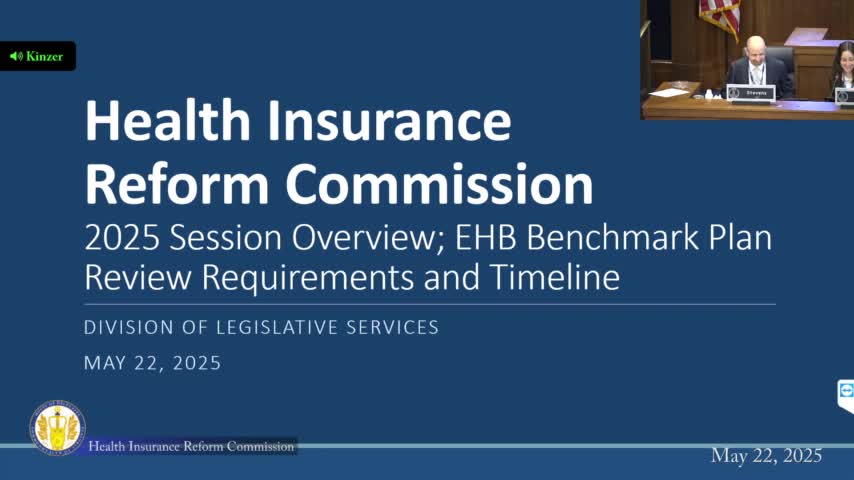
The Health Insurance Reform Commission on its May meeting reviewed a Bureau of Insurance (BOI) report that outlines options for updating Virginia’s Affordable Care Act essential health benefits (EHB) benchmark plan and estimated the fiscal room available to add benefits.
The Health Insurance Reform Commission on its May meeting reviewed a Bureau of Insurance (BOI) report that outlines options for updating Virginia’s Affordable Care Act essential health benefits (EHB) benchmark plan and estimated the fiscal room available to add benefits.
The commission was presented with a list of candidate benefits — including bariatric surgery, doula care, fertility preservation and infertility treatment, broader hearing-aid coverage, non‑pediatric routine dental, medical nutrition management and weight‑loss drugs — and told the state has about $8.08 per member per month in actuarial value available to add benefits without federal defrayal.
The review matters because the EHB benchmark sets the minimum benefits that individual and small‑group plans must cover in the ACA market. BOI policy advisor Brad Marsh told the commission the federal process requires states to compare their benchmark to a set of federal comparison plans and to ensure any additions stay between the least and most generous available plans.
Marsh said the BOI convened a stakeholder work group last summer and this winter and produced a report identifying candidate benefits and preliminary cost ranges. ‘‘There’s approximately $8.08 per member per month value available for Virginia to add benefits to the benchmark plan without having to defray the cost of such benefits,’’ Marsh said during his presentation.
BOI and its actuarial contractor provided per‑member‑per‑month estimates for each candidate. Examples cited in the report: bariatric surgery was estimated to add about $0.56 to $2.24 PMPM depending on prevalence and utilization assumptions; infertility treatment including in‑vitro fertilization was shown as a range roughly $0.20 to $5.50 PMPM depending on whether IVF and how many cycles were included; hearing aids for all ages was estimated at about $0.51 PMPM, which would eliminate a current $0.10 PMPM defrayal the state now pays for pediatric hearing‑aid coverage; and coverage of GLP‑1 class weight‑loss drugs showed a high estimate ($27 to $50 PMPM) while non‑GLP‑1 weight‑loss drug classes were estimated much lower ($0.17 to $1.03 PMPM).
Commission staff noted two practical constraints. First, BOI currently has funding to perform deeper actuarial analysis on up to five candidate benefits this summer; the General Assembly did not include a requested appropriation to raise that cap. Second, federal rules added late last year changed which services may be included in the federal comparison (for example, some dental items can now be part of the federal employee health benefits plan calculation), which affects the total generosity available.
Chair Rip Sullivan and BOI staff stressed the process: the commission must decide in June whether to apply for a new benchmark, and if so, which benefits should receive further actuarial study. BOI will present more detailed actuarial results in September; the commission expects to determine whether to recommend changes that would be routed as legislation for the 2026 General Assembly and, if enacted, applied to a CMS application for plan‑year 2028.
Commissioners raised follow‑up questions about prevalence estimates used to convert PMPM impacts into numbers of Virginians affected, how comparable actions in other states were treated as an indicator of demand, and how federal actions — including any future federal mandates — would interact with state decision‑making.
The commission did not take formal action at the May meeting; members were reminded that the next meeting is June 17 and that BOI will return with more detailed actuarial analysis before the commission must choose any benefits to pursue.
The BOI report and the Novarest actuarial summaries presented to the commission are the basis for the estimates and lists discussed; BOI staff cautioned numbers are ranges and will be refined in later actuarial work.
The commission’s choice this summer will shape draft legislation in 2026 and, if enacted, the state’s CMS application for the EHB benchmark plan for plan year 2028.