Get Full Government Meeting Transcripts, Videos, & Alerts Forever!
Get email alerts on the Tobacco Retailer License topic
No spam. Unsubscribe anytime.
Health officials ask Springfield commission to strengthen tobacco-retailer license to curb youth vaping
Summary
Clark County health officials presented data at a Springfield City Commission work session and urged enhancements to the city's tobacco-retailer license — including higher fines, proximity limits and signage restrictions — to reduce youth access to nicotine and vaping products.
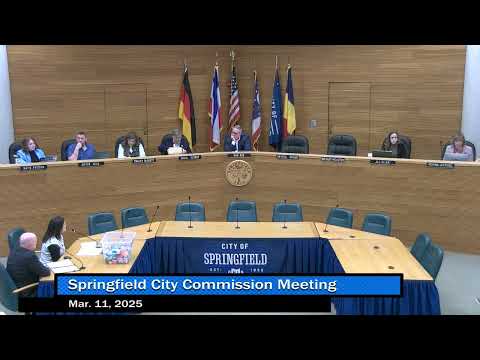
Leah Baylor, a health planner with the Clark County Combined Health District, told the Springfield City Commission at a work session that the district is seeking support to strengthen the city's tobacco-retailer license to reduce youth access to nicotine and vaping products.
Baylor said the city’s current tobacco-retailer license, passed in October 2021 and implemented in January 2022, requires retailers to purchase a $150 license and applies to e-cigarettes and related paraphernalia. She presented youth-use data, retailer counts and compliance-check results to argue for stiffer penalties and new proximity and signage limits.
"Retailers must purchase a $150 tobacco retailer license, to sell any tobacco related product, including paraphernalia," Baylor said, describing the current policy. She recommended raising fines, adding a penalty-structure, and exploring a density and proximity clause that would limit retailer locations near youth-serving organizations.
The county's 2023 youth risk behavioral survey of nearly 4,000 middle- and high-school students found that 16 percent of surveyed high-school students had tried smoking, 7.9 percent smoked before age 13, 3 percent smoked in the past 30 days, 28 percent had tried an electronic vapor product, 13 percent used one in the past 30 days, and 5.9 percent reported using an electronic vapor product 20 or more times in the past 30 days, Baylor said.
Baylor said Clark County has about 130 tobacco retailers and Springfield City alone has about 87, a concentration she said increases youth exposure. Maps shown to the commission highlighted retailer locations (red flags) and youth-serving organizations (black building icons) to illustrate clusters near schools and after-school programs.
Baylor summarized compliance-check results the health district conducted before and after fine enforcement. During the initial pilot year without fines, the department checked 84 stores and 29 failed (35 percent). After fines were enforced the following year, 86 stores were checked and seven failed (8 percent). "The fines work," she said, arguing that higher penalties would improve compliance further.
On penalties, Baylor said the district is proposing an increase in the fine to $1,000 for a violation within two years; she said the current amount in practice is $500. She also described other proposed enforcement and education measures intended to deter illegal sales to minors.
Baylor and Health Commissioner Chris Cook displayed a bin of confiscated vapes and described it as about 35 pounds of devices taken from a single high school over a six- to eight-month period. Baylor said most confiscated products contained nicotine, though THC-containing products were increasing.
Baylor also described product characteristics that worry health officials: higher nicotine concentrations (she said traditional cigarettes average about 20 milligrams of nicotine while some vaping products contain 20 to 50 milligrams), long puff counts (5,000 to 20,000 puffs), and colorful, concealable designs that she said appeal to youth. On enforcement and retail marketing, she raised signage and LED displays as recruitment tools and suggested zoning or sign-code changes as a possible regulatory path.
Commissioner Doctor Estrop, who identified himself as a former smoker, spoke in support: "Anything from my perspective that we can do to protect the young people of our community, we should take advantage of it." Cook closed the presentation with an appeal to commissioners: "I don't think I'm being overly dramatic when I say our kids are under attack. And it's our job to do anything that we can to give them every opportunity to be healthy for a very long time."
No formal change to the tobacco-retailer license was adopted at the work session; health officials asked the commission to support the proposed enhancements and signaled they would return for further discussion. Commissioners asked about enforcement details, signage and zoning authority; staff noted the city is revising its zoning and sign code, which could create a vehicle to address storefront signage. The only formal vote taken during the work session was a procedural motion to adjourn the session, which passed by roll call.