Get Full Government Meeting Transcripts, Videos, & Alerts Forever!
Get email alerts on the Charter Contracts topic
No spam. Unsubscribe anytime.
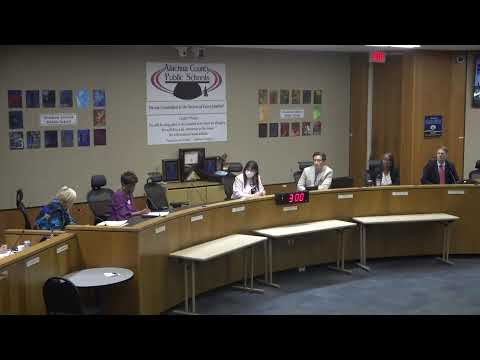
Alachua County School Board approves Newberry charter contract while appeal proceeds
Summary
The Alachua County School Board voted unanimously June 9 to approve a five-year charter contract with Newberry Charter School, while noting an active appeal and state timelines require the district to move forward.
The Alachua County School Board voted unanimously June 9 to approve the state-standard charter contract for Newberry Charter School, a five-year term set to run from July 1, 2026, through June 30, 2031, while the district continues an active appeal before the Charter School Appeal Commission.
The vote matters because district attorneys and staff said state law imposes statutory timelines for negotiating and approving conversion-charter contracts and that the state could impose a contract on the district if the board declined to negotiate. "The charter would have recourse to go to the state," attorney William Delaney said, adding the state could impose a contract if timelines are missed.
Board members spent most of their discussion on enrollment, start date, transportation and finance. Attorney Spilius said the contract uses the state standard template and that the stated term is a standard initial five-year term. Superintendent Patton and staff explained the contract becomes effective when both parties sign it but that the district will operate the campus for the 2025–26 school year.
Public comment included one speaker, Dr. Peggy Vermont, who urged the board to remove a firm start date from the contract while appeals and possible lawsuits are pending. "I would highly suggest that everything inside is taken away. Again, if there could be a motion for the start date to be to be determined, I would suggest having that at this meeting," Dr. Vermont said.
On enrollment, staff told the board the charter's initial enrollment will be determined by the district zoning boundaries "as of today," with students zoned to Newberry given priority. Board members noted the charter's application projected growth to about 900 students at the five-year mark. Staff also said conversion charters may renegotiate zone boundaries with the district every three years.
Board members raised concerns about recruitment of out-of-county students and the effect on local millage-funded revenue; a board member observed that residents could end up subsidizing students who do not pay local taxes. On funding timing, staff explained the district will "float" initial payments to the charter in July (initial transfer around July 15, with additional provisional payments by July 20, Aug. 20 and Sept. 20) before the state's FEFP (Florida Education Finance Program) funds are reflected in FTE counts.
Transportation and meal service also drew questions. Staff said Newberry's application indicates the charter will provide its own transportation and food service; the contract's transportation language contemplates that the district "may" provide transportation only if the parties reach a separate agreement. A board member noted the contract language on distance was changed from a standard beyond-2-miles threshold to a 2–4-mile range; staff explained the charter requested that change and that the charter plans to provide its own buses.
Board members stressed that negotiations and staff explanations do not change the ongoing appeal. Delaney told the board a hearing before the Charter School Appeal Commission was scheduled for July 16. Several board members said they were approving the contract under protest to preserve the district's bargaining position and to avoid having a state-imposed contract.
The board's formal action was a motion to approve the charter contract "as presented." Motion by Ms. Surdon, seconded by Dr. McNeely. The motion carried unanimously.
Board members said they will continue to pursue parallel paths: the district's appeal and the negotiated contract process required by state timelines. Several members asked staff to prioritize communication with families about zoning and transportation options for students who do not wish to attend the charter when the conversion occurs.