
Council affirms special assessments for Oscarville paving after court‑directed monetization analysis; opponents petitioned for evidentiary review
Get AI-powered insights, summaries, and transcripts
Subscribe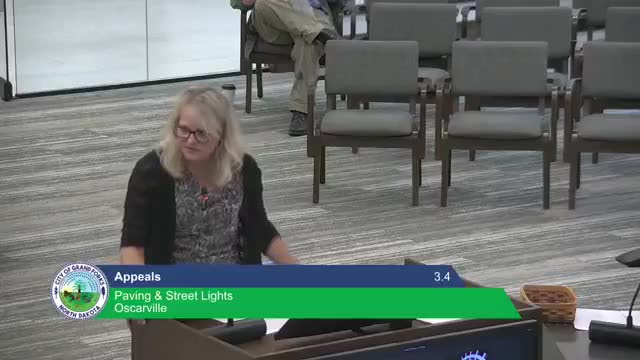
Summary
The Grand Forks City Council on June 2 affirmed special assessments for the Oscarville paving and streetlight project after staff presented a monetized benefits analysis the council concluded met the North Dakota Supreme Court’s new guidance; property owners who appealed challenged the assumptions and asked for evidentiary review.
The Grand Forks City Council on June 2 affirmed special assessments tied to Project 7539 (paving and streetlights in the Oscarville area) after hearing staff legal analysis, public comment from property owners who appealed, and council discussion about methodology to monetize special benefits.
City legal staff summarized the legal history: the council’s earlier certification of assessments was affirmed at district court but reversed by the North Dakota Supreme Court in a 3‑2 decision. The Supreme Court directed municipalities to monetize special benefits when comparing assessments to benefits and said municipalities may use present and future use or formulas — but must provide a monetary estimate of benefits on a parcel‑by‑parcel basis rather than only cost‑driven measures. City staff presented a monetization methodology that combined a conservative estimate of future development value (roughly $11.4 million for undeveloped acreage in the project area) with a calculated value tied to improved emergency response using published value‑of‑statistical‑life (VSL) estimates drawn from federal data; staff said the combined benefit estimate exceeded the project costs.
An owner‑representative who spoke at the public hearing challenged the methodology and data. He told the council the Special Assessment Commission had not exercised independent fact‑finding, disputed the use and applicability of a national VSL compilation to local response times, and asked for an evidentiary hearing to test assumptions. The speaker questioned dispatch and response‑time figures that staff used and argued the monetized benefits “don’t add up,” urging the council to reconvene with more fact‑finding.
Staff described cross‑department analysis including police, fire and assessing staff. Fire and police personnel provided comparisons of response times before and after paving; city staff said truck‑travel time to incidents was faster and that the analysis used federal data to monetize the value of reduced mortality risk in emergency responses. Staff also described an approach to allocate total monetized benefits to individual parcels using the same frontage‑based formula that had been applied to spread project costs, producing a per‑lot benefit assignment comparable to the cost allocation.
After public comment the council debated whether to postpone the decision for further evidentiary review. A motion to postpone two weeks failed on a 3–3 tie; a subsequent motion to approve the benefit determination carried by roll call. Council members who voted to affirm cited the need to follow the Supreme Court’s guidance and the city’s analytic work; those opposed or urging more review argued the assumptions used to monetize benefits required further testing and clearer evidentiary supplementation.
The council’s action affirms the Special Assessment Commission’s methodology and authorizes proceeding with the assessments as certified; opponents indicated they may pursue further legal remedies. Staff said they would be available to provide additional material and to participate in any further proceedings required by the courts or the council.