Get Full Government Meeting Transcripts, Videos, & Alerts Forever!
Get email alerts on the Homelessness Shelter topic
No spam. Unsubscribe anytime.
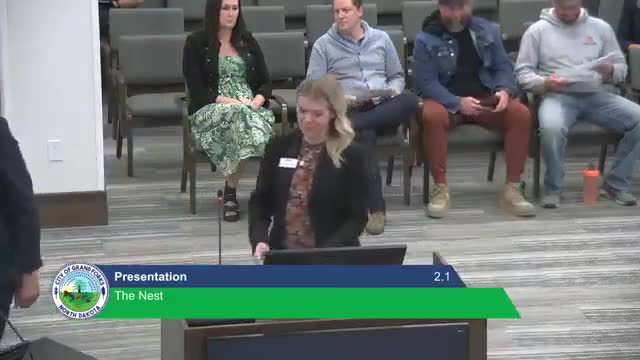
Grand Forks Housing Authority briefs council on 'The Nest,' a 16‑bed low‑barrier shelter serving 134 people
Summary
The Grand Forks Housing Authority updated the Committee of the Whole on operations, funding and outcomes for the Nest, a 16‑bed low‑barrier emergency shelter opened Oct. 2, 2024. Staff said the site has served 134 unique individuals, averages 28 days per stay and relies on a mix of city, county, state and federal funds.
The Grand Forks Housing Authority on Monday provided a detailed update to the Grand Forks Committee of the Whole on the Nest, a low‑barrier emergency shelter that opened Oct. 2, 2024, and currently operates with 16 beds.
The presentation outlined use, partners and funding as city officials pressed for data about residency, length of stay and related services.
The Nest opened in October with 12 beds and was expanded to a 16‑bed facility after renovations. Katie Jo Armbrust, Director of Program Development and Advocacy for the Grand Forks Housing Authority, said the shelter has served 134 unique individuals and that the average length of stay is 28 days. "We have had, at least 16 people, if not more, the overwhelming majority of the nights that we have been open," Armbrust said. She added that on very cold nights the facility has housed as many as 21 people.
Armbrust described the Nest as a "low‑barrier" shelter — meaning people may access services "as they are" so long as they are safe for themselves and others — and said the housing authority limits in‑building substance consumption and does not provide medical withdrawal management. "We are specifically taking on the sheltering aspect, not any type of treatment," she said, and staff work with community partners to connect residents to treatment or health services when desired.
Council members asked for additional information about origin and housing status of people using the shelter. Armbrust said most clients are from Grand Forks, Grand Forks County or North Dakota; early intake analysis showed roughly 22% from outside Grand Forks in December 2024 and a more recent snapshot showed about 31% from outside the city. Armbrust said the shelter uses the Homeless Management Information System database and performs homelessness certifications to establish whether clients meet stricter definitions of homelessness used by some funding sources.
On funding and administration, Armbrust said the Nest's operating budget is a partnership that includes the City of Grand Forks, Grand Forks County, Northeast Human Service Center and federal and state grants such as the Federal Emergency Solutions Grant and the North Dakota Homeless Grant. She said those federal grants are administered through the North Dakota Housing Finance Agency and that notice on the most recent round was expected by the end of the month.
Council members asked about outcomes and follow up. Armbrust said she did not have an off‑the‑top count of how many of the 134 clients had since attained permanent housing but offered to provide that data. She said staff conduct case management and help clients apply for housing assistance, benefits, ID documents and other supports, and that the housing authority maintains a nearly one‑year wait list for some voucher programs.
Several council members expressed concern about whether opening the Nest had drawn people from other communities and whether services are duplicative of existing nonprofits. Armbrust and other speakers said agencies serve different populations and that increased counts partly reflect better identification and data collection of people already living in the community. "The increases are more so a reflection of data actually being collected and people actually being identified as at risk of or experiencing homelessness," she said.
City staff and council members requested follow‑up data: a breakdown of how many of the 134 served have since moved into permanent housing, law enforcement call counts tied to the Nest's address, and additional partner data (police and Altru) on benefits and impacts.
Armbrust asked council members to consider the Nest budget in the upcoming general fund discussions; she said the Housing Authority is already pursuing grant rounds and that some funding periods (for example July 1–June 30, or biennium funding cycles) complicate calendar alignment.
The informational presentation concluded with staff offering to return with the requested follow‑up data to inform upcoming budget deliberations.
The committee did not take formal action on the presentation; the Nest update was an informational item ahead of the general fund and county cost‑share discussions.