
Morristown council approves two long-term tax-exemption agreements, directs developer payments to Morris Educational Foundation
Get AI-powered insights, summaries, and transcripts
Sign Up Free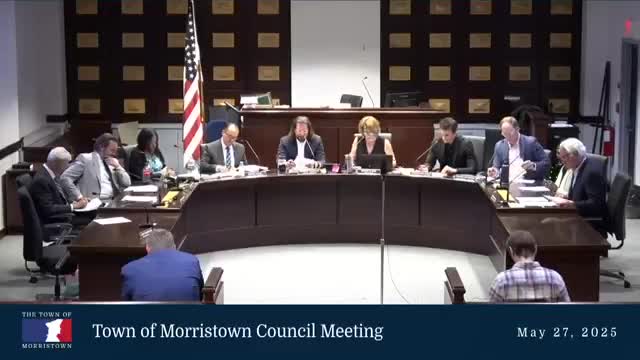
Summary
Morristown — The Morristown Town Council on May 27 adopted two ordinances authorizing long-term tax-exemption agreements with redevelopment entities and approved companion financial-contribution agreements that will route developer payments to the Morris Educational Foundation (MEF).
Morristown — The Morristown Town Council on May 27 adopted two ordinances authorizing long-term tax-exemption agreements with redevelopment entities and approved companion financial-contribution agreements that will route developer payments to the Morris Educational Foundation (MEF).
Council members approved ordinance O-20-2025, authorizing a tax-exemption and financial agreement with Lackawanna Place Morristown Urban Renewal LLC, and ordinance O-21-2025, authorizing a similar agreement with MLOP Spring Street Urban Renewal LLC. The council also adopted resolution R-74-2025 and R-75-2025 to execute the financial-contribution agreements that direct portions of the developers’ payments to the MEF.
Councilors said the agreements preserve certain public benefits while bringing new development and revenue into the town. Councilman Polipchuk told colleagues that one of the projects will generate about $6,500,000 for the town over 12 years and said the arrangements preserve public parking and keep the land taxable now, which he called an improvement over the status quo.
Supporters emphasized direct money to student-focused programs. Councilman Blomkamp and others described the payments to the MEF as a way to guarantee funds for school-related programs outside the annual town appropriations process; council members noted sums cited during discussion included roughly $1,500,000 and $1,800,000 committed to the MEF across the two agreements (figures given during the meeting by multiple council members).
Opponents and cautious voices raised two main concerns: that PILOT structures can shift costs between tax buckets (reducing the town portion while the school portion of property tax remains) and that routing public-value payments to a nonprofit establishes a precedent that requires careful vetting and oversight. One councilor said he would not vote in favor without more time to review, citing a prior local example in which public funds were moved into a nonpublic entity without adequate accountability.
Council members also discussed density, traffic and infrastructure impacts of future projects as the underlying redevelopment proposals move forward; several asked that such concerns be monitored earlier in the development review process rather than only when PILOT requests arrive late in approvals.
Formal actions - Ordinance O-20-2025 (Lackawanna Place long-term tax exemption): motion to adopt made and carried; roll-call votes recorded as yes by the council members present. (Transcript: motion introduced at 14:75–14:79; adoption called and carried, final roll call at 20:61–20:73.) - Ordinance O-21-2025 (MLOP Spring Street long-term tax exemption): motion to adopt made and carried; roll-call votes recorded as yes by the council members present. (Transcript: motion introduced at 20:87–20:91; adoption called and carried, final roll call at 22:57–22:61.) - Resolutions R-74-2025 and R-75-2025 (financial contribution agreements with the MEF): motions to adopt were called and carried; roll-call votes recorded as yes by council members present. (Transcript: resolutions discussed and voted at 23:55–28:25.)
Discussion vs. decision - Discussion: Councilors debated how PILOTs affect the overall tax bill (town vs. school share), the potential for increased density and infrastructure strain, and the propriety of channeling developer-funded public benefits through a nonprofit. - Decision: The council voted to adopt O-20-2025 and O-21-2025 and to approve R-74-2025 and R-75-2025, authorizing the town to enter the tax-exemption and financial-contribution agreements as described in the ordinances and resolutions.
What remains - Several council members asked for clearer vetting and accountability procedures for taxpayer-supported contributions to nonprofit organizations and suggested follow-up reporting by recipient organizations; the meeting record includes requests for additional oversight and for recipients to report on use of funds.
Why it matters The measures reconfigure how several redevelopment projects will be taxed and how a portion of the developers’ commitments will be delivered to a nonprofit focused on student programs. Councilors framed the votes as a way to secure public benefits and revenue to the town while noting that the total tax bill for property owners is not eliminated but rather allocated differently between municipal and school tax components.
Ending The ordinances and resolutions passed on May 27. Councilors asked administration and legal staff to ensure documentation and recipient reporting accompany the agreements going forward.