Get Full Government Meeting Transcripts, Videos, & Alerts Forever!
Get email alerts on the Sanctuary For Unborn topic
No spam. Unsubscribe anytime.
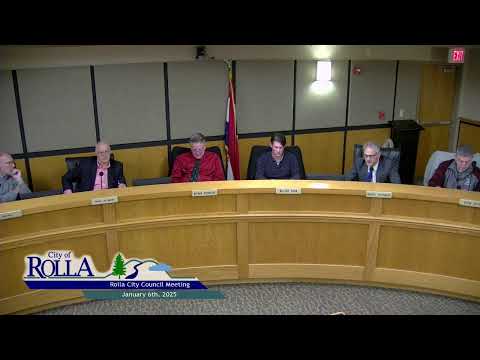
Rolla council opens heated debate on 'sanctuary for the unborn' ordinance; no measure adopted
Summary
Council members and about two dozen public speakers spent more than two hours debating a proposed local ordinance tied to federal law and Missouri’s Amendment 3; council did not adopt an ordinance and discussion was left open.
The Rolla City Council spent the longest item of its meeting on a proposed ordinance that would declare Rolla a “sanctuary city for the unborn” and create a local private right of action tied to federal statutes referenced as the Comstock Act.
The measure, introduced by Councilman Josh Roman, drew extended legal and policy discussion among council members, repeated requests for legal clarifications, and more than two dozen public comments both for and against the idea. No ordinance was adopted during the meeting; council voted to keep the topic in discussion and later to close further discussion for the moment.
Why it matters: Backers said the city ordinance would give residents a local enforcement mechanism to mirror federal prohibitions on mailing abortion-inducing drugs and related materials; opponents warned the local measure could prompt costly litigation, threaten access to miscarriage care and other medical treatments, and bring negative publicity and legal risk to Rolla.
Council discussion and legal questions Council members repeatedly asked what concrete outcomes the proposed local ordinance would achieve beyond existing federal and state law. Mayor Lou asked, “What is it that we’re trying to do specifically?” seeking a clear statement of purpose before moving into legal details.
Councilman Josh Roman framed the proposal as intended to ensure Amendment 3 — the recent Missouri ballot amendment about reproductive rights — “works within the confines of the federal statutes,” and to create a local private right of action so citizens could sue over violations tied to those federal provisions. Roman referred council members to a draft text in the packet and pointed specifically at a private-right-of-action section he said would set statutory damages and attorney-fee awards.
City staff and legal advisers cautioned the council about limits and risks. A staff speaker identified as Nathan (staff member) told the council the city could only pass ordinances that fit within state-authorized powers and cautioned that municipal courts are not equipped to adjudicate complex federal claims. Nathan also said some questions about whether a municipal ordinance could create a new cause of action remain legally unsettled and noted one Texas case (Lubbock) where a court said the city lacked authority to create a new private cause of action.
Public comment highlighted medical and practical concerns Residents gave extended public comment. Several citizens with medical backgrounds described clinical uses of the drugs named in the national debate (mifepristone and misoprostol) beyond elective abortion, and warned the draft local ordinance could impede miscarriage care or emergency obstetrical treatment.
Lindsay Bagnall, a Rolla resident, told the council she opposed a local ordinance and said it would “serve the purpose of the people who are coming to Rolla from Texas,” adding it would bring “negative publicity” to the city. Physician Jenny Cunningham described emergency clinical situations where the medications are used to treat miscarriage or postpartum hemorrhage and warned pharmacists and clinicians could be chilled from providing routine care if local rules were ambiguous. Another resident, Jenny (surname provided in the transcript), said: “Any attempt to legislate the medical care of Rolla’s women and girls offends me to the core,” and described near-fatal pregnancy complications she survived.
Advocates who supported a local ordinance argued the city should adopt a local enforcement mechanism mirroring federal prohibitions. Mark Lee Dixon and others, who traveled in to speak in favor, described on-line distribution of abortion drugs and urged the council to adopt measures they said would protect unborn children and to give citizens a private enforcement option.
Procedure and next steps Council members debated procedure repeatedly: whether to allow outside advocates to speak to council during the item, whether the city attorney should consult outside counsel, and whether to ask staff to draft a refined ordinance. An initial motion to call an outside speaker to the dais passed narrowly; a later motion to place a specific, revised ordinance on the agenda was withdrawn by its sponsor. Council ultimately voted to close the topic for the moment and signaled differing views among members about whether Rolla should pursue a local ordinance or leave the matter to the state and federal processes.
What the council did not do No ordinance was adopted. Council members made clear at several points that passage could lead to litigation; the American Civil Liberties Union had already sent notice letters to the city during the same period. Members who opposed moving forward cited the risk of expensive lawsuits and local disruption. Supporters said the draft had been revised to add clarifications and exemptions they argued would reduce unintended effects on medical care.
What to watch Council members said they will seek additional legal and policy information before any formal ordinance reading. Several council members and residents also asked that the city attorney follow up with outside counsel and with proponents and critics so the body understands legal risks and the ordinance’s practical effects before voting.