Get Full Government Meeting Transcripts, Videos, & Alerts Forever!
Get email alerts on the Signs topic
No spam. Unsubscribe anytime.
Rolla City Council rejects proposed changes to residential sign rules
Summary
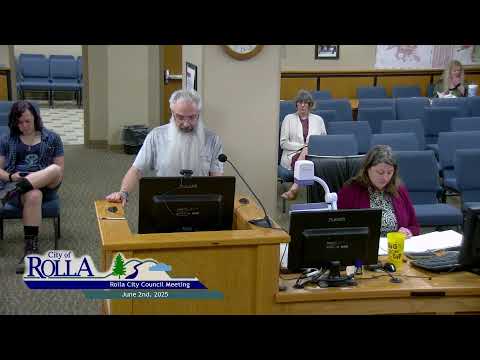
The Rolla City Council voted 5-6 against an amendment to Chapter 42 that would have changed how signage is measured for large residential lots, after several council members said the proposal handed greater expressive capacity to owners of larger parcels.
The Rolla City Council voted down an ordinance amendment to Chapter 42 that would have changed residential sign regulations, with the measure failing on a 5-6 roll call vote.
The amendment proposed clarifying how much signage is allowed on larger lots in residential (R1) districts by tying allowed sign area to linear frontage — roughly 32 square feet per frontage and an additional 32 square feet for each 80 feet of frontage thereafter. Planning staff told council the change was intended to resolve ambiguity about how many square feet of sign area a parcel could support.
Tom, a city planning staff member, summarized the proposal and the Planning and Zoning Commission's recommendation for approval. He said the changes were intended to clarify how the limit scales with frontage and to treat undeveloped parcels consistently in the code. "This clarifies, of all, you can have 32 square feet," Tom said while explaining the frontage math and how it applied to undeveloped lots.
Council debate centered on whether the ordinance would create unequal access to speech. One councilmember argued that basing allowed signage on lot size effectively gives owners of larger parcels a greater capacity to display messages. "If the government is establishing the rules for speech, it should be even," that councilmember said, explaining they would vote against the amendment for equity reasons. Other councilmembers defended the frontage-based formula as a tool to control visual clutter and safety concerns, saying larger lots can reasonably support more signage without the same nuisance effect as smaller, occupied lots.
After discussion the council took a roll call vote. Yes votes came from Councilmembers Craven, Jackson, Turban, Shelby and Welch; no votes came from Councilmembers McNabbin, Behrend, Hayes, Dickens, Rolos and Vaughn. With five in favor, the ordinance failed to pass.
The measure had surfaced after the council granted moratoriums on sign enforcement in prior Novembers for two years running; staff said the recurring moratoriums prompted a reconsideration of the rules. Planning staff and councilmembers discussed alternative approaches, including a single formula that would apply uniformly across all R1 parcels or leaving the existing 32-square-foot limit in place for all occupied R1 lots.
Council did not adopt an alternate text at the meeting; staff was asked to take feedback under advisement for possible redesign of the proposal.