
Council approves move of 911 dispatch system to Tyler-managed cloud for resiliency and security
Get AI-powered insights, summaries, and transcripts
Sign Up Free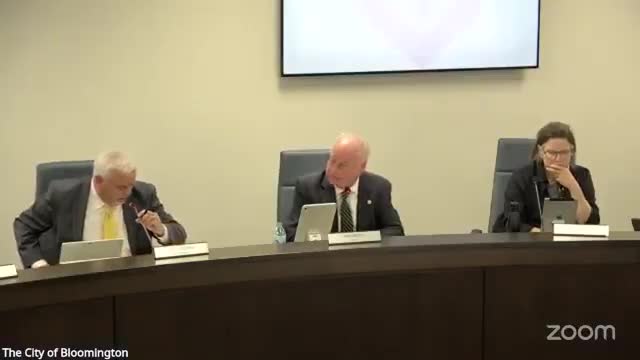
Summary
The Bloomington City Council approved a three‑year software-as-a-service agreement to move the city's computer‑aided dispatch (CAD) system to Tyler Technologies' GovCloud, citing improved disaster recovery, cybersecurity, and reduced local IT maintenance burden.
The Bloomington City Council approved a three‑year agreement on June 9 to migrate the city's computer‑aided dispatch (CAD) system to a Tyler Technologies cloud environment, a change city staff said will improve resiliency, cybersecurity and long‑term sustainability for 911 operations.
City Manager Jeff Jurgens introduced Darren Wolf, who leads the city's dispatch operations, and Darren explained the CAD system—purchased in 2005—supports all 911 and non‑emergency call processing, real‑time incident tracking for police, fire and EMS, and integrates with electronic citations, crash reporting and patient care reporting.
"Every 911 call received in our community... the system is used to process that call," Wolf said, describing the system's central role. He noted the system handled more than 85,000 calls last year and is deeply integrated with other public safety applications.
Information Technology Director Craig McBeth outlined cost considerations and staffing impacts. He said the city's current virtual environment runs about 18 virtual servers, and estimated an average cost of roughly $3,500 per VM per year; staff projected a roughly $63,000 offset in costs by moving to the cloud and said migration services are included in the proposal (McBeth cited an approximate $75,000 migration cost reflected in the vendor estimate). McBeth and Darren said Tyler's GovCloud (built on Amazon GovCloud) would assume infrastructure management, backups, updates, and security monitoring, while the city would retain ownership of its data.
Council Member Lee asked whether a formal cost‑benefit analysis had been completed; McBeth said direct cost savings are hard to pin down but identified the VM cost basis and the $63,000 offset. Member Mosley asked whether migration costs and decommissioning of on‑prem servers were included; staff said migration services were included but the minor costs to decommission local servers were not and are expected to be small. Staff said the contract includes a 24‑hour recovery point objective and recovery time objective requirement.
Council Member Montney moved to approve the agreement; the motion was seconded. Council voted electronically and staff announced there were "no nays to announce." The clerk recorded Council Member Montney voting yes remotely. The contract term is three years, after which the council will review renewal.
City staff described key project benefits as: improved resiliency (not being tied to a single building or power source), enhanced cybersecurity protections that are costly to replicate locally, reduced in‑house IT maintenance, and the ability to provide separate training and test environments that mirror the live CAD. Staff also noted the move aligns other city software (Munis ERP and ImageTrend) that have recently moved to cloud hosting.
The council did not adopt a new budget appropriation at the meeting; staff indicated ongoing operating costs would be part of normal budget planning and that vendor pricing covered hosting, managed services and migration.