Get Full Government Meeting Transcripts, Videos, & Alerts Forever!
Get email alerts on the Board Vacancy Selection topic
No spam. Unsubscribe anytime.
Board adopts cumulative voting process; public speakers urge appointment of Rick Crossan
Summary
The Green Bay Area Public School District board adopted a cumulative ("dot") voting process to narrow applicants for a board vacancy and will invite a small panel of candidates for interviews. During public forum, several speakers endorsed Rick Crossan for the open seat.
The Green Bay Area Public School District Board of Education on June 9 adopted a cumulative voting process to narrow a field of applicants for a board vacancy and to select candidates for interview.
Under the adopted process each board member received a block of votes they could allocate among applicants (dot voting); the board used multiple rounds of allocation and discussion to shrink the candidate pool and ultimately approved a slate of seven candidates to invite for interviews.
Members said the approach was meant to provide a transparent, public method for expressing board preferences without pre‑coordinated results. “The concept is to be able to identify present preference and how much preference they have in a particular candidate,” the board chair said when explaining the process.
Public comment before the work session included multiple speakers urging the board to appoint Rick Crossan to the open seat. Jason Wright, who identified himself as executive director of Brothers Helping Brothers and a 27‑year resident of Green Bay, described Crossan as “a pillar of that” community work and said Crossan had been “an inspiration” and a mentor. Nancy Welch, speaking as a former school board member, called for “a strong independent school board” and said Rick Crossan would be “experienced, knowledgeable, and most importantly, independent.” Melanie Matzka and Julie Ullman also spoke in support of Crossan’s appointment, citing his community engagement and connections to reading and literacy initiatives.
Board members described the adopted selection process as public and iterative: members first allocated votes among all applicants, then discussed top vote‑receivers and conducted subsequent rounds until the slate for interviews was finalized. The board voted to approve the interview slate during the special meeting that followed the work session.
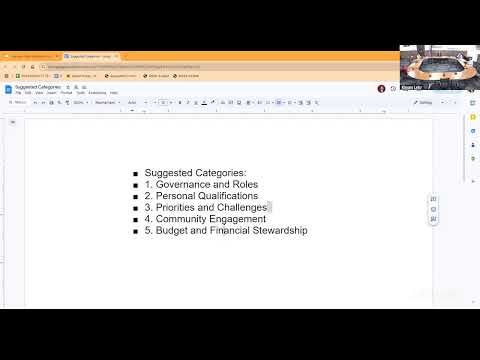
The district will send the interview categories to the invited candidates and arrange interviews; the board said interviews will cover governance and roles, personal qualifications, priorities and challenges, community engagement and budget/financial stewardship. Candidates were told the board will not share specific interview questions in advance, but will provide the topical categories so candidates can prepare.
The board did not make an appointment at the June 9 meeting; it will interview the invited candidates before selecting a replacement to serve through the next election cycle.