Get Full Government Meeting Transcripts, Videos, & Alerts Forever!
Get email alerts on the Property Tax Appraisal Budget topic
No spam. Unsubscribe anytime.
County appraisal chief warns understaffing, mapping gaps are costing Lampasas taxing units
Summary
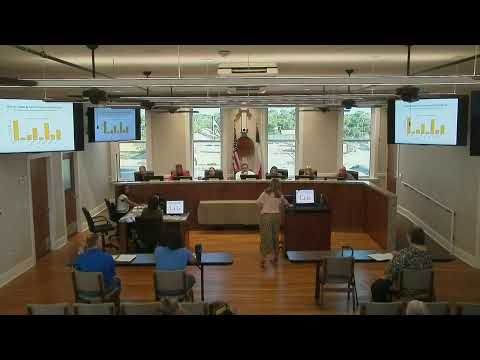
Lampasas County Chief Appraiser Juan Salcedo told the city council the Lampasas County Appraisal District (LCAD) is understaffed and behind on mapping and reappraisal work, projecting lost taxable value and seeking a higher FY25–26 budget and two additional appraisers.
Juan Salcedo, chief appraiser for the Lampasas County Appraisal District, told the Lampasas City Council on Monday that the appraisal district is behind on mapping and reappraisal work and is under-resourced for current construction and subdivision activity.
Salcedo said the district is operating “with 2 appraisers at this time” while handling roughly 2,000,532 parcels and contending with a surge in subdivisions and new homes. He told council members the district’s vendor has identified thousands of unmapped or unidentifiable parcels that have led to lost taxable value for local taxing units.
The appraisal chief said the district moved to new software in 2023 and has since found sharp increases in workload tied to data corrections and mapping. “We drew over 15,800 parcels in 1 year,” he said of the vendor’s mapping effort, and later noted the vendor had brought that total to 16,475 parcels. Salcedo said the vendor’s report shows about 3,557 parcels still cannot be identified by the district or its GIS vendor, and that 106 of those remain unresolved after recent work.
Why it matters: LCAD’s corrective work can add taxable value for the city and other taxing units; Salcedo framed the FY25–26 budget request as an investment that would recover lost revenue and keep the district compliant with state tiering and audit standards. He told council members the district had been budgeting as a smaller “tier 3” office even though a 2012 population shift moved Lampasas into the Comptroller’s “tier 2” classification, which carries higher operational expectations.
Most important facts: Salcedo presented a proposed FY25–26 budget of approximately $1.58 million (appraisal and collection combined) and said the appraisal-only portion (after an 80/20 split) would be in the neighborhood of $1.01 million. He said the district projects the city’s preliminary additional levy revenue (using last year’s tax rate for initial calculations) would be roughly $430,659 compared with last year, while the district’s requested local share of the new budget was about $47,290 for the city. He emphasized these are starting estimates based on last year’s tax rate and not an instruction to raise tax rates.
Staffing and operations: Salcedo recommended expanding the appraisal staff, saying the International Association of Assessing Officers staffing guidance implies the county needs roughly 10 appraisers to keep current on a county of Lampasas’s parcel count; the district currently budgets for far fewer. “You need 10 appraisers,” he said, adding the office currently has two certified appraisers working in the field and several staff in collections and mapping roles. Salcedo also told council that certified level-4 appraisers are difficult to recruit; his office is fast-tracking two level-3 appraisers toward level 4 by year-end.
Mapping, reappraisal and compliance: Salcedo said the district has not completed a multi-year reappraisal plan on schedule since 2020 and that the pace of new subdivisions and home construction—he cited roughly 300 homes identified this year in one new subdivision alone—has outstripped the district’s capacity. He said the district is moving toward more frequent aerial flights (biannual rather than the current three-year cycle) and additional mapping work to keep parcel data current.
Legal and audit context: Salcedo noted Lampasas’s Comptroller tier change in 2012 and said the district has been underbudgeting compared with tier-2 operational survey averages. He also said the district’s board of directors has approved the proposed budget and that the next steps are a public hearing and adoption of a final budget in July.
Remaining questions and next steps: Council members pressed for clarification about which taxing units will benefit and whether the increased workload is driven by countywide development outside the city limits. Salcedo said the growth is regional across the county and that the district will continue to work with cities and school districts to allocate improvements equitably. The appraisal district requested two additional appraisers, improved staff training and retention measures, digitization of historical records, biannual aerial flights, and cybersecurity and building repairs to protect servers. The council did not make an immediate vote on city funding during the presentation; Salcedo said the district’s board already approved the proposed budget and that it will move to a July public hearing and final adoption process.
Ending: Salcedo offered to provide the council with the underlying spreadsheets and preliminary levy calculations; he closed by urging the city to consider the requested allocations as an investment that would recover lost taxable value rather than an automatic tax increase.