Get Full Government Meeting Transcripts, Videos, & Alerts Forever!
Get email alerts on the Lcap Education Equity topic
No spam. Unsubscribe anytime.
District’s LCAP presentation highlights ELD focus, mental‑health supports and 'constructing meaning' instructional push
Summary
Superintendent Terry presented the district’s Local Control and Accountability Plan, stressing targeted actions for English learners and students with disabilities, expansion of mental‑health services, and piloting evidence‑based classroom routines.
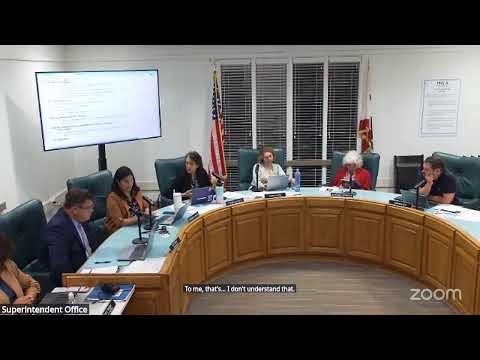
Superintendent Terry presented the Mountain View–Los Altos Local Control and Accountability Plan (LCAP) during the June 9 board meeting, outlining the district’s three‑year strategic priorities, targeted supports for unduplicated students and measurable actions to improve outcomes.
Why it matters: the LCAP governs how the district uses Local Control Funding Formula (LCFF) dollars tied to state priorities and requires measurable actions and expenditures for students who are low income, English learners and foster/homeless youth. Terry emphasized the district’s focus on English learners (ELs) and students with disabilities, groups that continue to lag on multiple indicators despite overall high district results.
Key goals and actions: the district framed two main goals: 1) sustain inclusive, culturally responsive classrooms that increase access and belonging, and 2) strengthen systems outside the classroom that support academic readiness and student wellness. To advance those goals the district described planned actions including expanded professional learning for tier‑1 instruction, stronger course‑team collaboration, co‑teaching, accelerated ELD programming and deeper counseling/college and career supports. The LCAP presentation noted a pilot to cohort EL students in grade‑level English and math to increase targeted support and belonging.
Evidence and outcomes cited: Terry reported green or blue status on 10 of 11 state dashboard priorities for the district overall but said disaggregated data show persistent gaps for ELs and foster youth. The district said reclassification rates for ELs doubled in the year covered and highlighted a 32% increase in CTE enrollment. Mental‑health programs and California Healthy Kids survey results were cited as improving school connectedness and adult support indicators.
Instructional initiative – 'Constructing Meaning': the presentation described an evidence‑based initiative to build consistent, high‑quality classroom routines (referred to as Constructing Meaning) intended to support discourse, scaffold access for ELs and boost deeper learning. Trustees asked for the research base, interim metrics and safeguards to ensure advanced classes (AP/honors) retain needed curricular breadth for exams.
Public input and next steps: the LCAP presentation was offered as a public hearing item; administration solicited public comment and invited trustees’ questions. Trustees requested more disaggregated dashboard data and clearer descriptions of measurable interim indicators (for example, how participating in Constructing Meaning will be tied to changes in D/F rates, a‑to‑g completion and state indicators). Terry said staff will bring a final LCAP to the board for approval at a future meeting and will share supporting research and metrics tied to the instructional and intervention strategies.
Attribution: Quotes and program descriptions in this article are drawn from Superintendent Terry and district staff (Elvis, the district’s business services lead) during the June 9 public hearing on the LCAP.