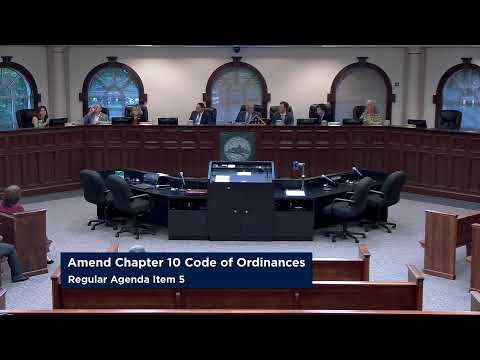
Roswell adopts short-term rental licensing and inspection ordinance with six-month ramp-up
Loading...
Summary
The City of Roswell on June 9 adopted an ordinance requiring short-term rental hosts to obtain licenses, submit to safety inspections, and provide 24/7 contact information; the ordinance includes a registration ramp-up and drew questions from residents about scope and enforcement.
The Roswell City Council on June 9 approved an ordinance amending Chapter 10 of the city Code of Ordinances to permit and regulate short-term rentals within the city.
Community Development Director Michelle Alexander told the council the ordinance requires hosts who rent properties through platforms such as Airbnb or VRBO to secure a license so properties can be inspected by the fire marshal for common safety hazards and so the city can maintain 24/7 contact information for operators. "It requires that they achieve, secure a license so that they can get their homes checked and inspected for occupational hazard and safety through the fire marshal," Alexander said.
Council member Sarah Beeson, who led the item in committee, said the change is designed to protect visiting guests, homeowners and neighbors by ensuring working smoke and carbon monoxide detectors, operable ingress and egress, and other basic safety features. "This is really to focus on the safety of people who are coming to visit us in Roswell," Beeson said. She emphasized the ordinance is not intended to eliminate short-term rentals and noted cities differ in approach; the council referenced Alpharetta's cap on short-term rentals and discussion of Athens' more rigorous rules.
Assistant City Attorney Joe Cusack and staff said there will be a registration ramp-up: owners will be required to register the following year with roughly a six-month on-ramp to allow the city to notify operators and implement the licensing process. Cusack described the period as a leeway for existing operators to register and be accounted for.
During public comment, a resident identified as Roman asked whether surrounding jurisdictions have comparable rules and whether the city had specific safety incidents that prompted the change. Staff and councilors responded that similar ordinances exist in nearby jurisdictions and that the ordinance was motivated by safety concerns documented in incidents elsewhere, including a cited out-of-state case involving carbon monoxide. Council member David Johnson noted other local jurisdictions, including Athens, have more stringent requirements such as owner presence and annual inspections.
Council member Beeson moved to approve the final reading of the ordinance; Council member David Johnson seconded. The motion passed unanimously, 5-0. The ordinance text, identified in the reading as Chapter 10, Article 18, will be incorporated by reference into the city code, and staff will begin the registration and enforcement process according to the ramp-up timeline described at the meeting.