Get Full Government Meeting Transcripts, Videos, & Alerts Forever!
Get email alerts on the Roads And Infrastructure topic
No spam. Unsubscribe anytime.
Larimer County commissioners dissolve decades-old General Improvement District after residents object
Summary
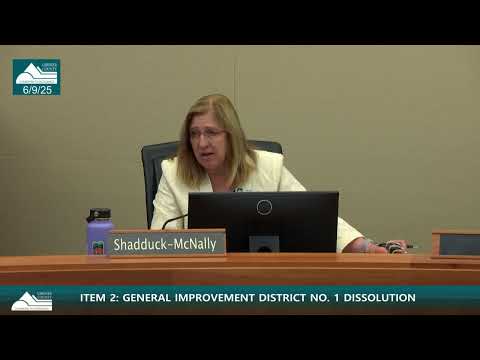
Larimer County commissioners voted 3-0 on June 9 to dissolve Larimer County General Improvement District Number 1, which covered Imperial Estates, Second Imperial Estates and the Westfield Subdivision, after residents asked for more time and clearer information about funding for major road repairs.
Larimer County commissioners voted 3-0 on June 9 to dissolve Larimer County General Improvement District (GID) Number 1, which covers Imperial Estates, Second Imperial Estates and the Westfield Subdivision. The vote came after residents urged the board to delay action and asked county staff for more time and clearer information about options for funding major road repairs.
The action removes a largely inactive GID created May 5, 1970, that has not collected a mill levy in decades. County attorneys and staff said the district cannot be used to restart property assessments without a new public vote under Colorado’s Taxpayer Bill of Rights (TABOR) and Colorado Revised Statutes 30-25-27.
Commissioners said the dissolution is primarily housekeeping: the old district no longer functions as intended, the account balance was spent down in February 2017, and the statutory framework for such districts has changed since the 1970s. County staff and several commissioners told residents the practical effect of dissolution will not change routine surface maintenance provided by Road and Bridge, but any major reconstruction would require formation of a new local improvement district (LID) or public improvement district (PID) and voter approval.
Chair Kristen Stevens opened the meeting and permitted public comment after staff pulled the GID item off the consent agenda. Planning Manager Jenny Axmaker and engineering staff introduced the issue and described the hearing process. County Attorney Frank Hauck summarized the legal constraints, telling residents, “this 1 can’t be used anymore to tax anybody. You’d have to go back to a vote, and you’d have to go back to a vote about what the money was going to be used for for a particular project.” Engineering staff member Katie Bilby said the district was created by petition and board action in 1970 and noted that “the current PID process is a lot more in-depth than in 1970.”
Residents from the affected neighborhoods stressed they had not had adequate time or information to consider alternatives. Jason Martin, identifying himself as a property owner in GID Number 1, said on behalf of more than 40 neighbors, “We object to the dissolution. We request that this item once again be pulled from [the] consent agenda,” and asked for “reasonable time and communication for our neighborhood to consider utilizing the GID.” Other residents asked specific questions about what counts as county maintenance and how assessments and ballots would work.
Staff answered procedural and technical questions in the hearing. Katie Bilby said routine surface work provided by Road and Bridge includes crack sealing and chip seal treatments and that chip seal has historically been applied every seven to nine years; she added Road and Bridge is pushing toward nine-year intervals based on material longevity. She described the PID/LID formation process: residents would select a small group to work with county staff, an inspector would document road conditions, the county would draft a maintenance plan and petition, and if petition thresholds are met the measure would go on the ballots only for residents within the proposed district. Bilby said, if residents begin the process now, “it actually would not go on the November ballot until 2026.”
Several commissioners thanked residents for attending and emphasized staff availability for follow-up. Commissioner Jody Shattuck McNally moved the dissolution, and the board approved the motion 3-0; Commissioners John Kefalas and Kristen Stevens voted aye alongside Shattuck McNally. The board and staff repeatedly invited residents to meet with county planning and engineering staff in evening or online sessions to review options and timelines.
County staff and the county attorney clarified limits and next steps: the 1970 GID cannot be reactivated to levy new taxes without a vote because TABOR requires voter approval for increased indebtedness or new property tax assessments; residents who want a dedicated funding mechanism must form a PID or LID and put that question to the affected voters. Staff said they have dissolved older GIDs and maintain roughly 60 PIDs in the county; Larimer County staff also reported the county maintains about 800 miles of unincorporated roads on approximately $7,000,000 in annual road-maintenance funding.
The board adjourned at 3:56 p.m. after the vote; staff committed to follow-up meetings with neighborhood representatives to explain the PID/LID application process, timeline and what counts as routine county maintenance versus projects that would require a special assessment and voter approval.