Get Full Government Meeting Transcripts, Videos, & Alerts Forever!
Get email alerts on the Water Access Wells topic
No spam. Unsubscribe anytime.
Planning commission approves code change allowing some large rural properties to drill wells during tap moratoriums
Summary
Larimer County Planning Commission recommended adoption of land use code amendments allowing properties larger than 35 acres to seek state well permits within certain water service areas (with provider consent) during local tap moratoriums, and set conditions requiring proof of water quantity and quality before building permits.
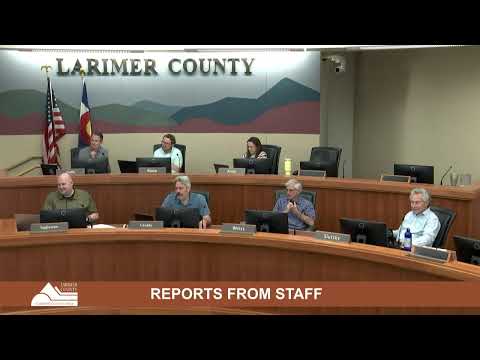
The Larimer County Planning Commission voted May 21 to recommend adoption of land‑use code amendments that allow certain large rural properties to pursue state well permits when local water providers have tap moratoriums, subject to conditions.
Staff said the amendment to Article 4 (section 4.3.0.7) narrows the county’s prior prohibition on wells inside water service areas and distinguishes between non‑taxing water service associations and special water districts. Under the approved language, properties larger than 35 acres within a water service area (but not a special district) may drill a well if the service area provides a consent letter; properties not in a water district or service area may also apply directly for a well permit under state rules.
Planning manager Jenny Axmaker explained that the change is intended as a limited fix for property owners who bought or hold parcels that lack access to taps because water providers have imposed moratoriums. “The goal in the proposed change to Article 4 is to find a reasonable partial solution to a problem that honestly the county did not create,” she said. Staff emphasized that state well permits remain the primary regulator of groundwater appropriation and that the county will require demonstration of adequate quantity and quality (for example, a test well or proof) before issuing building permits.
The code amendment also clarifies that cisterns cannot serve as the primary water source for a dwelling; they may be used only as supplemental storage. County engineering staff said the county’s rural area road standards and other technical requirements will still apply when access or safety issues arise.
Commissioners debated the measure. Commissioner John Weiss voted against the Article 4 amendment, saying he preferred a county groundwater study before loosening local land‑use limitations: “I would much rather see the county spend time and effort… to study our waters,” he said, citing uncertainty about aquifer capacity and potential impacts to existing wells. Other commissioners said the change offers a targeted, low‑cost remedy for a small number of large parcels while broader groundwater study work is pursued. Commissioner Eggleston noted the local scale of likely demand and said a modest number of wells on large parcels would not meaningfully affect the larger basin.
The commission approved the Article 4 amendment by roll call (7–1) and included an effective date of June 23, 2025. Staff told commissioners a county groundwater study is a planned implementation item (staff expects to pursue grants and begin a study in late 2025/early 2026) and that a broader water‑adequacy code update is scheduled later in 2025 to address long‑term policy changes.
The Planning Commission’s recommendation will go to the Board of County Commissioners for final action.