Get Full Government Meeting Transcripts, Videos, & Alerts Forever!
Get email alerts on the Behavioral Health topic
No spam. Unsubscribe anytime.
Larimer County outlines behavioral health strategy; Longview to open adolescent acute-care unit this summer
Summary
Amy Martonis, director of Behavioral Health Services for Larimer County, told commissioners May 19 that the department has refined strategic priorities tied to the 2018 local behavioral health sales tax and that the county has invested roughly $128 million since 2019 in behavioral health, including a $43 million Longview campus.
Amy Martonis, director of Behavioral Health Services for Larimer County, told the Board of County Commissioners on May 19 that the department has refined its purpose, values and six strategic priority areas in a planning process tied to the local 2018 sales tax measure that funds behavioral health work. "The purpose of our department is that we exist because our community values behavioral health," Martonis said.
Martonis said the community has generated about $128,000,000 in dedicated funding for behavioral health since 2019 and that three primary ongoing uses of those tax revenues are Longview’s construction and operations ($43,000,000 investment to build and open the campus), the Impact Fund grant program and co-response investments that pair clinicians with law enforcement. She told commissioners the Impact Fund has awarded 228 grants totaling $14,700,000 to 72 organizations and that the department invests approximately $500,000 annually in co-response.
Dr. Leslie Brooks, executive director at SummitStone’s Longview campus and SummitStone’s chief medical officer, provided operations data for the facility from its opening on Dec. 2, 2023, through March 30, 2025. She said Longview served 4,678 unique clients through its 24/7 urgent care and recorded about 6,000 total urgent-care visits. "We are reaching folks in some of our smallest areas of the county who are using our facility and our services," Brooks said, noting that 79% of unique urgent-care clients were Larimer County residents and that a small share (about 2.4%) listed out-of-state addresses for varied reasons, including travel or homelessness.
Brooks described ongoing quality-outcomes work — measuring severity at intake, interventions and recovery — and said Longview is collecting client feedback and other outcome measures. Commissioners asked about data sharing and cross-system metrics. Martonis and Brooks described an effort called the LINK project and said the department has funded an impact-fund grant to support exploratory work and is learning from other communities about phased, privacy-conscious approaches to data sharing. Martonis said this is "going slow to go fast" and emphasized the need for appropriate releases and permissions.
On adolescent services, Brooks said the county approved a proposal in December to implement an adolescent unit for ages 12–17. The unit has eight licensed beds (two single-occupancy rooms and three double-occupancy rooms) but will open with five single-occupancy rooms initially, serving up to five youths referred first through the county Department of Human Services. Brooks said the unit will provide short-term acute care — "This is short term acute care for 5 to 7 days" — not long-term qualified residential treatment facilities (QRTPs). Licensing steps are underway: an adolescent endorsement from the Behavioral Health Administration has been granted and the Colorado Department of Human Services has issued a provisional residential childcare facility license; full licensing requires enhanced staff background checks and completed hires. Brooks said about 15–20 FTE positions remain open for the unit and targeted late-summer opening. The county scheduled a work session on July 7 for additional details.
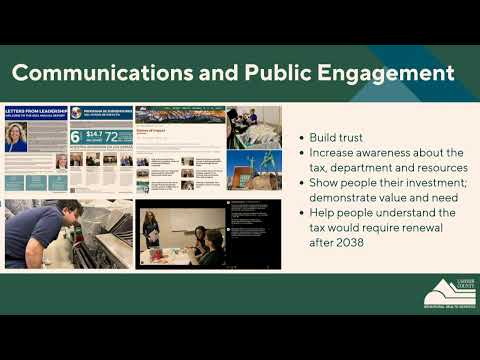
Martinis described a request for proposals the department issued to design a multiyear funding initiative; the county contracted with Corona Insights to lead stakeholder engagement, framework development and recommendations, with stakeholder meetings planned through the fall and a December briefing to the board. Madeline Novy, the department’s communications specialist, said the communications plan will combine personal stories and return-on-investment data to build public understanding and trust about the local tax-funded behavioral health system.
No formal board votes were taken during the briefing. Commissioners asked multiple operational and policy questions — including how local workforce efforts align with statewide initiatives and how Longview’s adolescent unit will connect to home-based services and discharge planning — and staff committed to return in July with more detailed plans.