Get Full Government Meeting Transcripts, Videos, & Alerts Forever!
Get email alerts on the Wildfire Mitigation topic
No spam. Unsubscribe anytime.
Larimer County announces $100,000 in community wildfire mitigation grants; Fireshed adds $65,000
Summary
Larimer County officials on Tuesday announced $100,000 in community mitigation grants for 2025, awarding funds to 19 neighborhoods and homeowner associations to support local wildfire risk reduction and resilience projects.
Larimer County officials on Tuesday announced $100,000 in community mitigation grants for 2025, awarding funds to 19 neighborhoods and homeowner associations to support local wildfire risk reduction and resilience projects. The county’s Office of Emergency Management also said the Northern Colorado Fireshed Collaborative is providing an additional $65,000 to expand the program.
The awards, presented by Josh Roberts, mitigation coordinator for Larimer County’s Office of Emergency Management, fund projects written and managed by the communities themselves. Roberts said grant-funded activities include hazardous fuels mitigation, community chipping and slash-removal programs, purchase of tool-and-equipment libraries (for example saws and dump trailers) and other neighborhood-scale mitigation work.
The grants matter because they support actions that reduce wildfire risk at the household and neighborhood level and encourage neighbors to coordinate mitigation work. “These projects not only do they help reduce the risk, but they really help improve resilience,” Roberts said during the meeting, noting the program’s emphasis on community-led efforts and neighbor engagement.
Community leaders who received awards described how small grants were stretched into larger mitigation efforts. Dave Herter of the Cherokee Meadows Road Association, who also represents Livermore Fire Protection District, said his award funded training on surviving wind-driven wildfires and home ignition zone assessments, a program run with Wildfire Partner Ambassadors. “We really appreciate these grants,” Herter said, adding that properly prepared homes free up fire department resources to focus on other structures.
Several mountain and foothill communities described similar uses of funds. Rachel Ondy of Crystal Lakes Road and Recreation Association said Crystal Lakes has been a two-time recipient, using roughly $10,000 in earlier awards for a pullout for a fire truck and for roadside mitigation. Wayne Brautigam, chairman of the Crystal Mountain Road Association, described grants that helped remove burned structures and fund timber removal after the Cameron Peak Fire; he thanked county staff and a Forest Service grant partner.
Other recipients reported grants in the $5,000–$10,000 range. Tom Hossfeld, president of the Red Feather Highlands Maintenance Association and coordinator for a Community Wildfire Protection Plan (CWPP) implementation team, said his organization used grants to buy chainsaws, pole saws and a dump trailer and to organize slash-hauling and burning operations. Jen Nimlow of the Jack Pine Road Association said a $5,000 chipping-and-slash grant supported community mitigation days and enabled safer egress by clearing ten feet on each side of critical roads.
Roberts outlined trends in program demand: the grant pool began in 2022 at $50,000 with 14 proposals; last year a $100,000 pool drew 21 proposals requesting about $160,000; this year 34 proposals requested just over $300,000. Commissioner Jody Shattuck McNally emphasized the program’s return on investment, saying research indicates “every dollar that we invest…is worth $13 in savings for suppression and recovery,” and that the county’s $100,000 therefore produces an outsized benefit for the community.
Roberts said the application process is an online application opened annually, with review according to published criteria, independent evaluations and partner input; the county provides an application workshop to help groups unfamiliar with grant applications.
The Northern Colorado Fireshed Collaborative’s Karina Marshall told the room the collaborative provided $65,000 in additional funding through its third-round fireshed fund to help expand awards this year. “This is a really cool innovative program that is so grassroots and developing community resiliency,” Marshall said.
County Manager Lorinda Volker and other commissioners praised the Office of Emergency Management staff for program management, vetting applicants and holding workshops to make funds accessible. Commissioners and staff repeatedly framed the program as an example of county reinvestment in neighborhoods and public-private partnership, and they encouraged continued community participation and interagency coordination.
For many recipients, the grants complemented other funding sources such as Forest Service grants, DFPC (Division of Fire Prevention and Control) assistance, FEMA funding and local fundraising. Several speakers described multi-year work that combines federal grants, county awards and volunteer labor to clear slash, haul material, operate chipping programs and train local wildfire ambassadors.
Looking ahead, Roberts and commissioners said demand exceeds available county funds; the additional $65,000 from the Fireshed Collaborative expanded the county’s capacity but did not cover all requested projects. Roberts noted the program has grown each year in applications and requested funding, reflecting both increasing local engagement and continuing wildfire risk.
The county recognized all award recipients at the meeting and took a group photo with participants. Officials urged residents and voluntary organizations to apply in future cycles and to attend county workshops explaining the application and evaluation process.
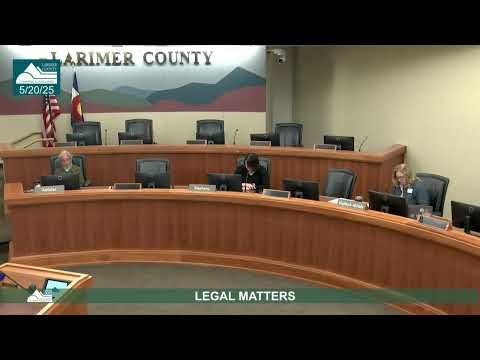
Speakers quoted in this article spoke at the Larimer County Board of County Commissioners administrative matters meeting on May 20, 2025. The Office of Emergency Management announced the awards; the county described the additional Fireshed funding as a partner contribution. Specific grant amounts for individual recipients were reported by those speakers when they described their projects and past awards (examples: $5,000 and $10,000 awards, and one recipient’s statement of a $555,000 grant for hazardous-tree removal).