Get Full Government Meeting Transcripts, Videos, & Alerts Forever!
Get email alerts on the Water Supply Planning topic
No spam. Unsubscribe anytime.
Jefferson County begins water‑supply planning under new state housing and land‑use laws; staff to coordinate with 50+ local water providers
Summary
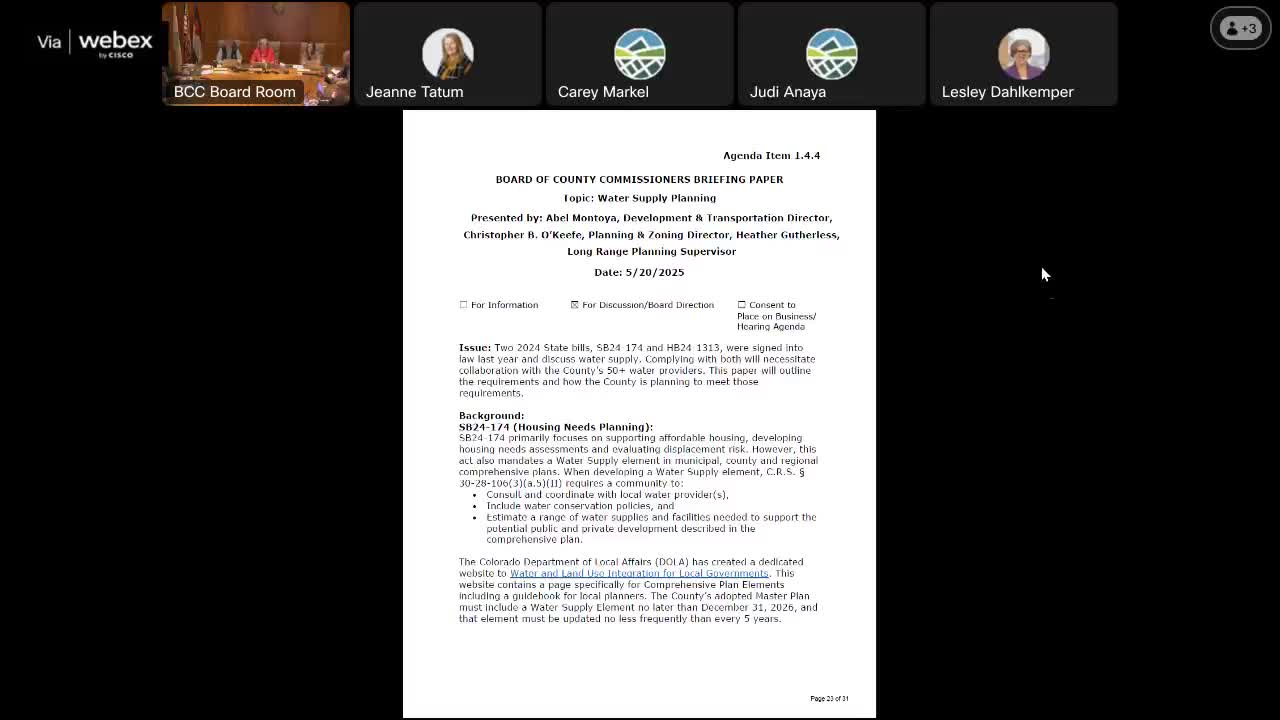
County planners told the Board of County Commissioners on May 20 that new state requirements tied to recent housing and land‑use bills require Jefferson County to add a water‑supply element to its comprehensive plan and to coordinate with more than 50 local water providers to estimate supplies, conservation policies and facilities needed for anticipated development.
County planning staff told the Board of County Commissioners on May 20 that new state legislation and related guidance require Jefferson County to add a water supply element to its comprehensive plan and to work with local water providers to estimate supplies, facilities and conservation policies needed to support potential development.
Staff identified two legislative sources discussed in the briefing: a Senate bill introduced as “Senate Bill 24 1 74” (described in the briefing as a housing needs planning bill that added water‑supply elements to comprehensive plans) and House Bill 1313, described as state land‑use criteria that affects transit‑oriented growth and density requirements. Staff said the county must coordinate with local water providers, add water conservation policies and estimate a range of water supplies and facilities to support the development shown in the plan.
“Many of these requirements for water are not required to be completed for at least 18 months, but some have incremental components that we have to submit to the state, beginning as early as June 30,” planning staff said. Staff described a staged approach: incorporate skeletal water‑supply elements now within the Together GEFCO comprehensive plan update and fill in details through 2026, coordinating closely with more than 50 water providers that serve areas across the county.
Staff said the county already has a set of water conservation policies adopted in 2020 that satisfy some immediate requirements and that a dedicated state website and guidance are being developed by the Department of Local Affairs. The briefing noted key deadlines: a preliminary housing opportunity goal report is due to the state on June 30; a full water‑supply element and related materials must be in the county’s comprehensive plan by Dec. 31, 2026; and zoning or overlays for identified transit centers must be in place by Dec. 31, 2027 to meet density targets if no exemption is granted.
Commissioner Zenzinger voiced concern about scale and timing and cited a preliminary county analysis: “preliminary analysis indicates that approximately 1,500 acres of land in GEFCO would be required to have a minimum of 15 units per acre with an average of 40 units per acre in unincorporated GEFCO. And that could mean 60,000 more residential units and a population increase of a 150,000 people,” she said, attributing the figures to the county’s early modeling. She and other commissioners emphasized the county does not control water providers’ operations and that developers and utilities must demonstrate water availability under standard development review.
Staff also discussed the Lookout Mountain Water District, which has infrastructure and aging‑system concerns and has engaged the county to explore coordination; staff said districts are generally willing to cooperate on future planning even as they guard their water rights. Commissioners and staff noted a separate legal challenge filed by some home‑rule municipalities over House Bill 1313; the county attorney said the filed lawsuit, as currently framed, would not directly delay the county’s planning obligations.
Staff asked the board whether it wanted more detailed briefings and said it would reach out to providers with the draft land‑use recommendations to begin the required coordination. No formal county action was taken at the briefing; staff will continue to refine the water‑supply element and return with analysis and proposed items for compliance with state deadlines.