Get Full Government Meeting Transcripts, Videos, & Alerts Forever!
Get email alerts on the Parks Pros Plan topic
No spam. Unsubscribe anytime.
Public raises conservation, stewardship and staffing concerns at Kitsap County PROS plan hearing; county extends comment period
Summary
Kitsap County parks staff presented the draft 2025 Parks, Recreation and Open Space (PROS) Plan and responded to public concerns about Port Gamble Forest Heritage Park, stewardship groups, volunteer roles, and staffing. The Planning Commission unanimously extended the written public comment period to May 27 at 5 p.m.
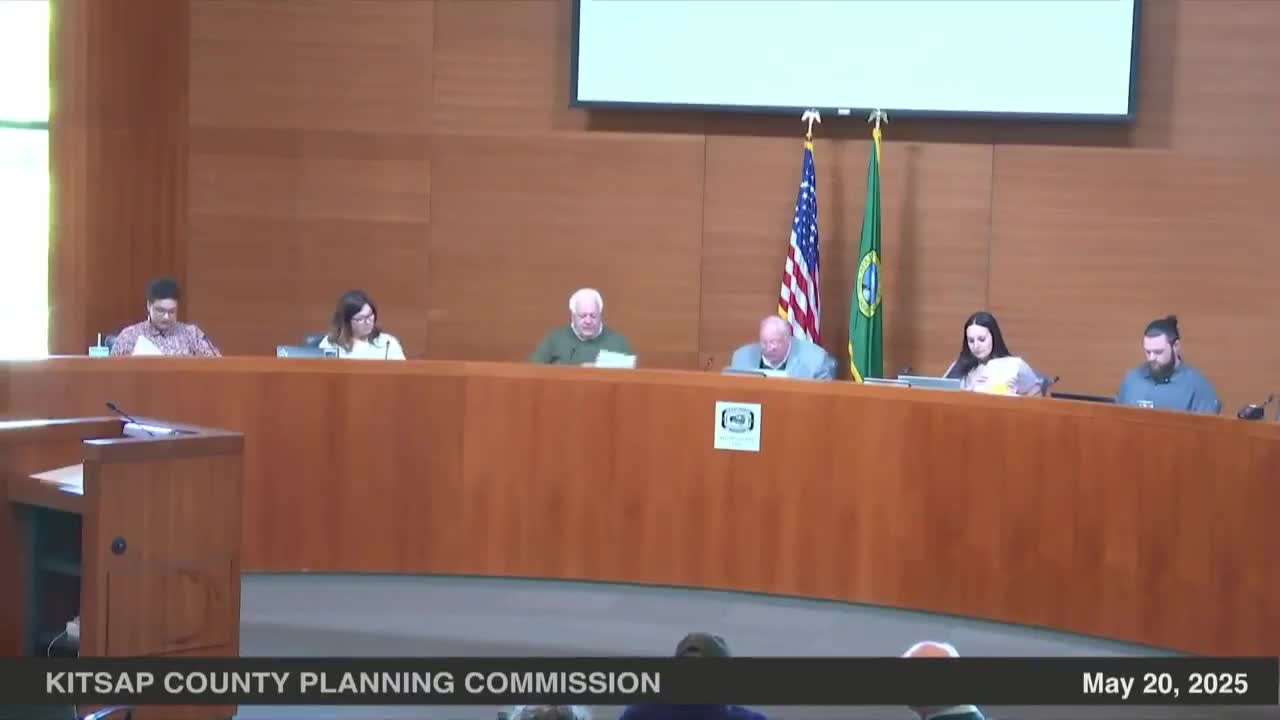
Kitsap County parks staff opened a public hearing May 20 on the draft 2025 Parks, Recreation and Open Space (PROS) Plan and told the Planning Commission the document is a six‑year strategic plan that guides goals, objectives and the capital improvement program.
Alex Wisniewski, Kitsap County parks director, said the PROS plan meets Growth Management Act requirements for parks and open space and is the planning document the county uses to remain eligible for Recreation and Conservation Office (RCO) grants. Carmen Smith, parks planner, said the draft was released Feb. 10 for a five‑week public comment period; staff received 447 comments during that period and had opened an additional two‑week hearing comment window prior to the meeting.
Most public commenters urged stronger conservation protections for the county’s large heritage parks, especially Port Gamble Forest Heritage Park. Patricia Wiegand urged classifying a large portion of Port Gamble as a nature preserve to maximize carbon storage. Robin Salthouse asked the commission to “insist the PROS plan maintain Port Gamble Forest Heritage Park as a heritage park,” and several speakers said the draft appears to prioritize active recreation (for example, mountain biking) over passive, habitat‑focused uses.
Parks staff responded that the PROS plan is a high‑level policy document and “does not propose management changes for heritage parks, and it does not propose any athletic facilities, sports fields, or development within the county’s heritage parks,” as Carmen Smith told the commission. Smith also noted that the privately proposed North Kitsap United project adjacent to Port Gamble is on private property and is not a parks department project. She added that park‑specific planning (including management plans) will address details such as trail user designations and specific proposed facilities.
Speakers also raised concerns about stewardship and volunteer programs. Alex Wisniewski and Carmen Smith told the commission the department values volunteers and stewardship groups and that stewardship activities — from manual trail work to participation on park management steering committees — will continue. Wisniewski said the department manages about 11,400 acres and 74 parks, employs roughly 41 staff and is “about 50% of what the department should be in terms of full time staff members based on current levels of park development.” Staff said volunteers provide roughly 45,000 hours of service annually and that those hours are a significant component of maintenance and trail work.
Members of the public criticized the draft plan’s readability, said survey findings had not been fully reflected in capital priorities, and asked for clearer priority‑setting, better ongoing engagement and greater protection for rare species and habitats reported inside Port Gamble. Several commenters asked that trails in heritage parks be designated pedestrian only; staff said those decisions would be addressed in park‑level planning.
After public testimony the commission considered a motion to extend the written public comment period. A motion to extend the comment deadline to Tuesday, May 27 at 5 p.m. was moved, seconded and approved by the Planning Commission. Staff told the commission the extension would not affect the planned schedule for deliberations (June 3) and findings of fact (June 17) and that the county will later follow the Planning Commission process with the Board of County Commissioners and with RCO for plan approval.
No formal management changes or capital projects were adopted at the hearing; staff repeatedly described the PROS plan as “high‑level” and said site‑specific or programmatic changes (for example, stewardship program operations, pedestrian‑only trails, or reclassification management) will be addressed in subsequent park management planning and capital project processes.