
Planning commission finds urban service-area expansion and land-use change for 470.9-acre Baumwaimea Road site consistent, 6-3
Get AI-powered insights, summaries, and transcripts
Subscribe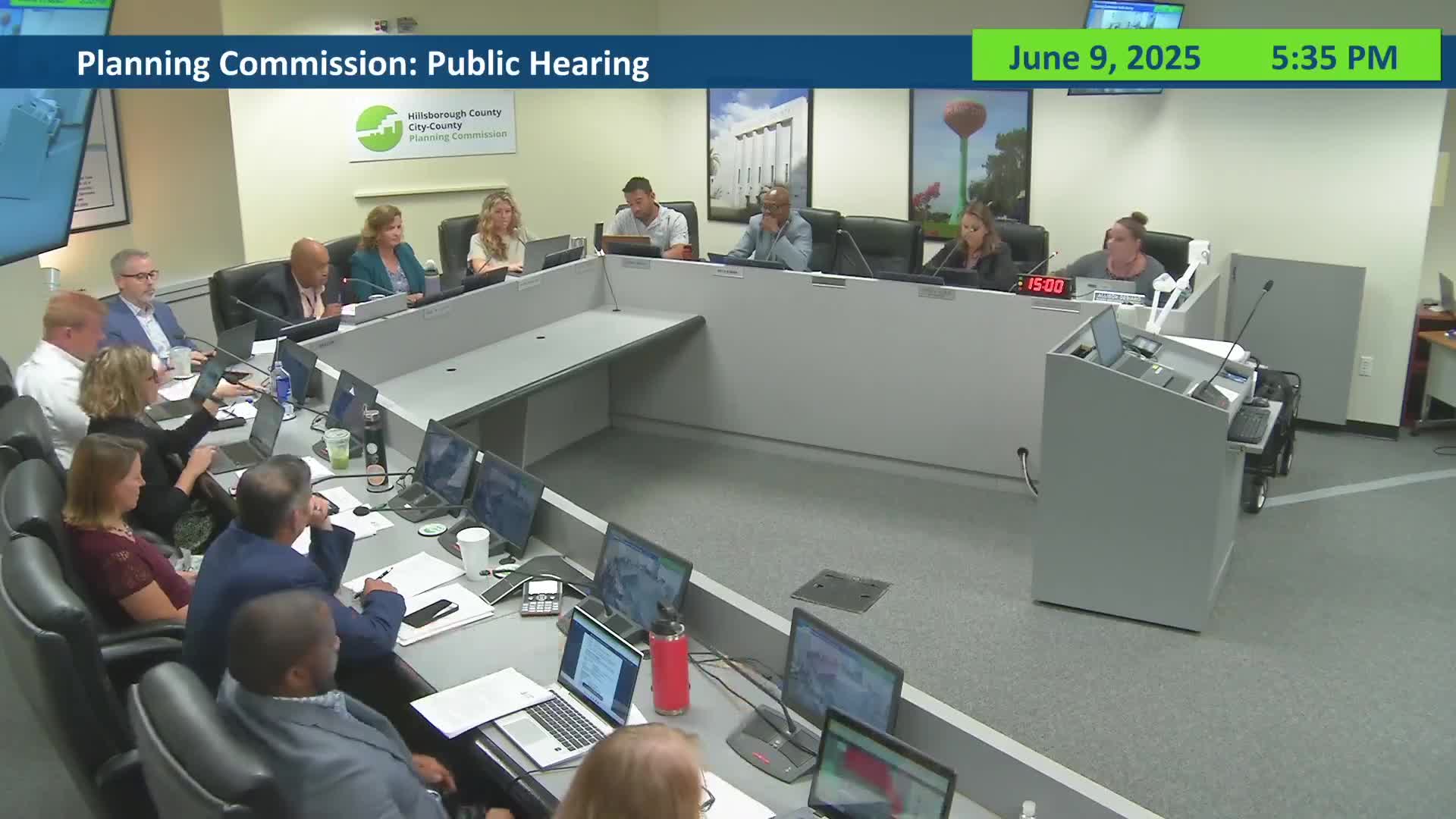
Summary
The Hillsborough County Planning Commission voted 6–3 on June 9, 2025, to find HCCPA 25‑08 (an urban service area expansion) and HCCPA 25‑07 (a future land‑use change) consistent with the county comprehensive plan for a 470.9‑acre property at 16410 Baumwaimea Road.
The Hillsborough County Planning Commission voted 6–3 on June 9, 2025, to find HCCPA 25‑08 (an urban service area expansion) and HCCPA 25‑07 (a future land‑use change from Agricultural Rural 1 to 5 to Residential 4) consistent with the comprehensive plan for a 470.9‑acre property at 16410 Baumwaimea Road, sending the applications on in the plan‑amendment process.
Planning commission staff analyst Alexis Myers presented the two privately initiated applications and recommended the commission find them inconsistent with multiple goals, objectives and policies of the county comprehensive plan. Myers told commissioners the proposal would bring 470.9 acres into the urban service area and, at a minimum, would require connection to public water and sewer. Staff also flagged inconsistency with Future Land Use Objective 4.4 and Policy 4.4.0.1 and cited concerns about compatibility with surrounding agricultural and mining designations and the South Shore area‑wide systems community plan.
The applicant team, represented by attorney Jake Kramer of Stearns Weaver Miller and land planner David Smith, argued the site functions as a transition between industrial and conservation lands. Kramer said the property sits adjacent to lands covered by the Waimama Village overlay that allow industrial and employment uses and that the applicant has preserved mitigation‑bank conservation lands to the east. The project team said roughly 60 percent of the total site would remain as lakes and conserved lands; they estimated about 200 acres of upland developable area and suggested a realistic built yield “in the range of about 600 to 700 units,” rather than the maximum theoretical total shown in staff materials.
Todd Randolph, speaking for the Sierra Club Tampa Bay group during public comment, urged commissioners to deny both amendments. Randolph cited a letter from the Hillsborough County Environmental Protection Commission noting extensive wetlands on the property and warning that development “may present considerable permitting challenges.” He also noted parts of the site are in FEMA Flood Zone AE.
Commissioner Kona moved to find HCCPA 25‑08 consistent (citing FLU Policy 2.3.0.9 and Objective 4.4); Commissioner Seaman seconded. After roll call the motion carried 6–3. Roll call recorded votes as follows: Bowden — No; Buzza — Yes; Cardenas — Yes; Kona — Yes; Kress — No; Lauck — Yes; Lankos — No; Steven — Yes; Joseph — Yes. Later the commission considered HCCPA 25‑07 (the companion future‑land‑use amendment) and took a separate consistency finding motion, moved by Commissioner Kona and seconded by Commissioner Buzza. That motion also passed 6–3 (recorded as Bowden, Kress and Lankos voting no). The commission’s actions were findings of consistency for the planning‑process record; they did not themselves adopt zoning or development orders.
Key technical and policy details discussed at the hearing: - Acreage: 470.9 acres were petitioned for inclusion in the urban service area (HCCPA 25‑08). The companion land‑use amendment (HCCPA 25‑07) would change the site from Agricultural Rural 1 to 5 (AR‑1/5) to Residential‑4 (Res‑4). - Development potential: Staff’s materials noted under AR‑1/5 the site could be considered for roughly 94 dwelling units; under Res‑4 the theoretical maximum rose to 1,883 dwelling units (applicants said those theoretical totals overstate likely yield). The applicant estimated about 3.5 units per developable acre and a practical buildout of several hundred units. - Environmental and permitting concerns: The Environmental Protection Commission flagged wetlands on site and warned of permitting challenges. The applicant said mitigation‑bank and conservation easement lands are already preserved to the east and would remain in perpetuity; applicant materials indicated a significant portion of the property is proposed as lakes and preserved conservation. - Utilities and service: Expanding the urban service area would obligate connection to public water and sewer if development occurs.
Discussion vs. decision: Commissioners’ votes were limited to a “consistency” finding with the comprehensive plan, not final approvals of rezoning or site development. Staff repeatedly described the applications as inconsistent with several comprehensive‑plan policies; the commission majority disagreed and found the applications consistent for purposes of forwarding the amendments through the statutory review process. Commissioners who opposed the consistency findings cited policy and compatibility concerns in their remarks.
Next steps: The planning commission’s consistency findings advance the applications in the county’s plan‑amendment process; any future rezoning or site‑specific permitting will be evaluated separately and will be subject to environmental permitting, utility availability and other regulatory reviews.