Get Full Government Meeting Transcripts, Videos, & Alerts Forever!
Get email alerts on the Substance Use Prevention topic
No spam. Unsubscribe anytime.
Kitsap Public Health outlines substance use prevention and response work, highlights naloxone training and partnership network
Summary
District staff described a two-year buildup of substance-use prevention and response activities: convening a 45+-organization network, provider outreach, community naloxone trainings, a GIS map of services, and trend monitoring including buprenorphine prescribing and overdose data.
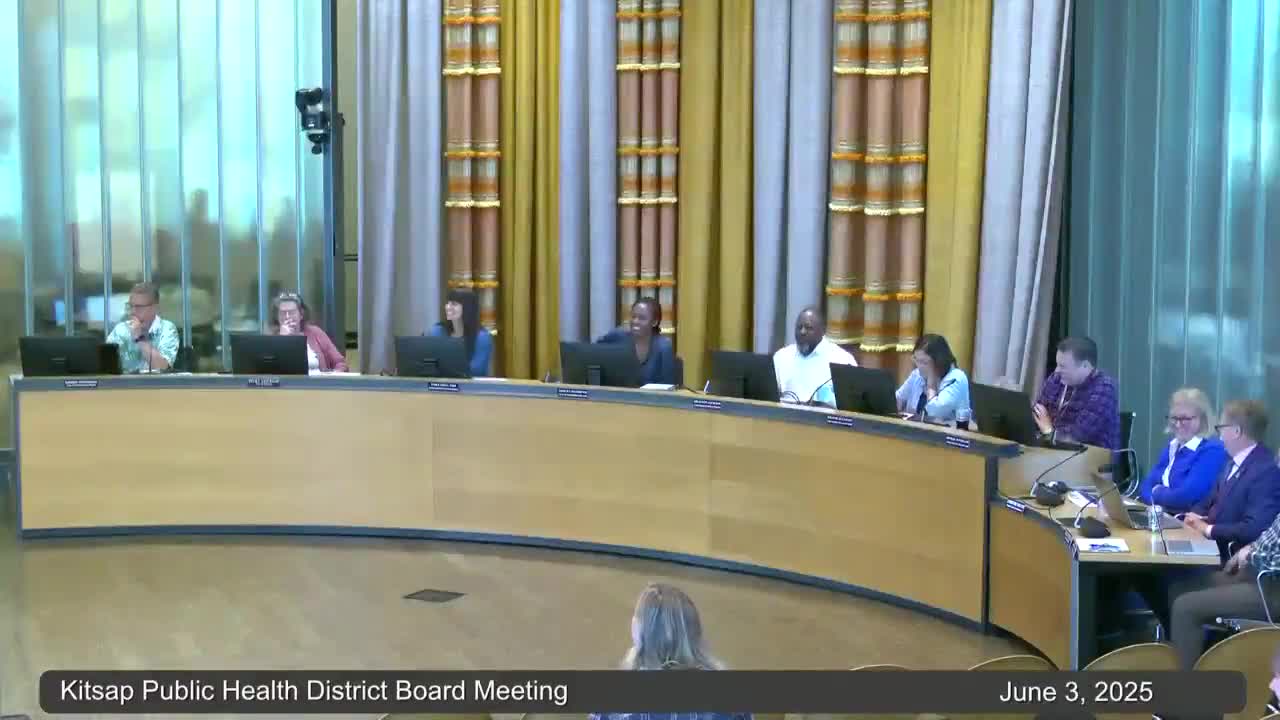
Kitsap Public Health District staff presented an overview May 20 of the district’s substance use prevention and response work, describing network building, public education, naloxone distribution and data monitoring as core activities.
Program manager Dana Bierman told the board the Substance Use Prevention and Response work moved into the Chronic Disease and Injury Prevention program in 2023 and that staff used national mentorship and community interviews to organize four focus areas: partner broadly; education and resources; overdose response supports; and monitor and analyze trends. “Substance use prevention is a complex health condition,” Bierman said.
Since 2023, staff have convened quarterly network meetings — four in 2024–25 — that included more than 45 organizations across prevention, harm reduction, treatment and recovery. The district created a GIS network map to show service connections and gaps, maintains a partner list of roughly 150 people for outreach, and started an advisory council with Olympic College in 2025 to include people with lived experience.
Bierman summarized outreach and education: provider briefings in coordination with the health officer, presentations to community groups and nursing programs, stigma‑informed overdose education and naloxone training. The district reported training about 490 individuals and distributing roughly 847 naloxone kits in 2024 (Kitsap Public Health District distribution only), and staff noted additional naloxone distribution from community partners and public cabinets administered by regional entities.
On treatment and clinical measures, staff highlighted an increase in buprenorphine prescribing and linked that partly to the earlier elimination of the X-waiver requirement, which previously required special certification for prescribers. Health officer Gibb Morrow said expanding initiation of buprenorphine in emergency medical services and emergency departments — and rapid linkage to ongoing treatment, including telehealth — is an important emerging standard of care.
Bierman noted epidemiology work on overdose dashboards: fatal overdoses per 100,000 rose from 2016 to 2023 and preliminary 2024 numbers suggested a decline, a trend Morrow described as “encouraging, yet might be too soon to tell.” The presentation advised continued emphasis on collaboration across law enforcement, health care, fire/EMS, and community-based organizations; Bierman said several law‑enforcement agencies and prosecutorial partners have participated in the district’s network meetings.
Board members asked about law-enforcement prosecution of suppliers, geographic shifts in unhoused populations and outreach targets for naloxone education. Bierman said trainings and outreach have been offered widely — to small nonprofits, rotary groups, colleges, community events and recovery organizations — and encouraged jurisdictions to contact the district for presentations.
The presentation did not propose a board action; members thanked staff and discussed follow-up briefings on buprenorphine initiation in the field later in the year.