Get Full Government Meeting Transcripts, Videos, & Alerts Forever!
Get email alerts on the Public Health Governance topic
No spam. Unsubscribe anytime.
Kitsap board approves interlocal agreement to formalize deputy health officer coverage with Clallam and Jefferson
Summary
The Kitsap Public Health District board approved an interlocal agreement formalizing mutual deputy health officer appointments with Clallam and Jefferson counties to ensure coverage when local officers are unavailable; the vote was by voice with one member recorded as opposed.
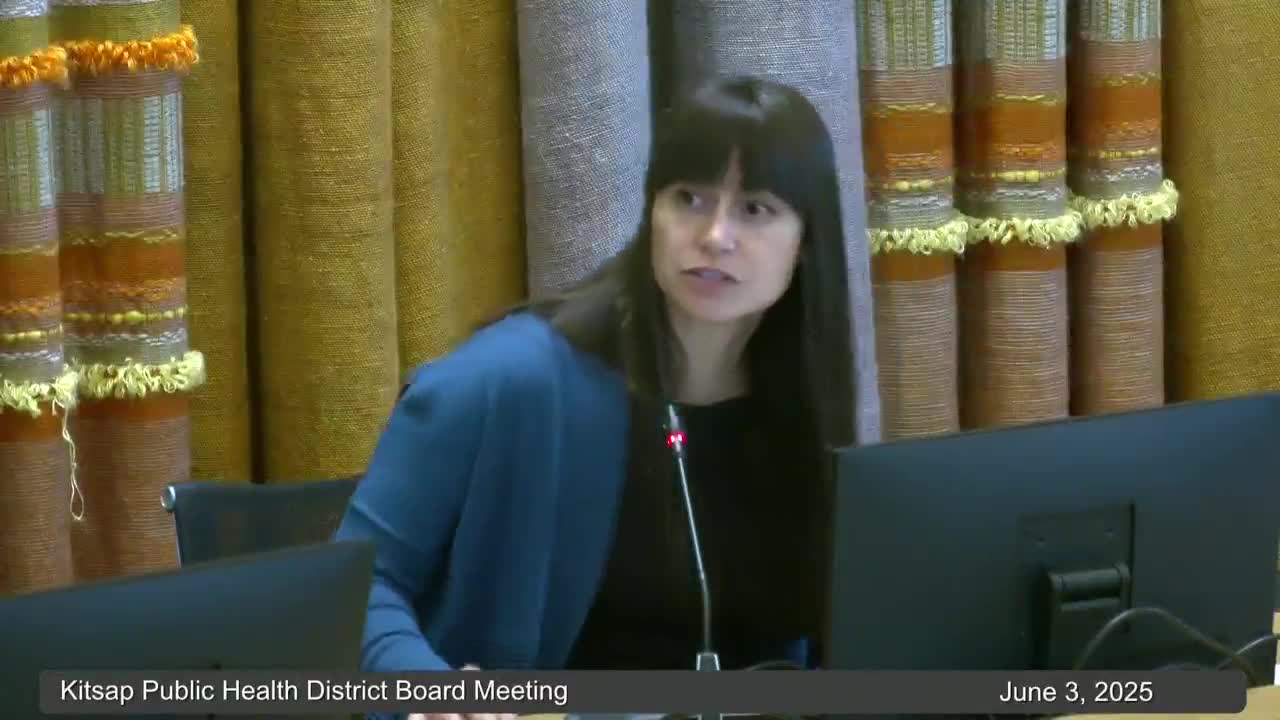
Kitsap Public Health District board members on May 20 approved an interlocal agreement that formalizes deputy health officer appointments between Kitsap, Clallam and Jefferson counties to ensure statutory coverage when a local health officer is unavailable.
The agreement codifies an existing practice under which Kitsap’s health officer may serve as deputy health officer for Clallam and Jefferson, and vice versa, and clarifies roles, responsibilities and liability coverage if a covering officer must make legally significant public-health decisions.
Health officer Gibb Morrow told the board the district has relied on regional arrangements for coverage and that the recent loss of state-funded regional health officer positions made formal agreements more important. “The ask, I think, at this point is that you approve that contract,” Morrow said, describing the document as a way to “clarify what the roles and responsibilities and expectations are” and to ensure liability protection if a decision leads to litigation.
Board administrator Yolanda Fong summarized logistics: the agreement follows a memorandum in the meeting packet and would not change routine expectations for mutual coverage. Morrow said the arrangement is not intended as a revenue-generating contract; if extraordinary mutual response requires more than roughly 10 hours of his weekly time, he would consult the health-board chair.
Commissioner Christine Rolfes moved to approve the agreement; the motion was seconded and carried by voice vote. The board chair called for those in favor to say “aye.” After the vote the chair noted one member recorded opposition; no roll-call tally with names was provided in the meeting record.
The board’s action authorizes staff to finalize the interlocal agreement that had already been signed by the Clallam and Jefferson health boards and directs the health officer and administrator to execute the version approved by the board.
The board then proceeded to presentations on chronic disease, substance-use prevention and hepatitis C program work.