Get Full Government Meeting Transcripts, Videos, & Alerts Forever!
Get email alerts on the Employee Benefits topic
No spam. Unsubscribe anytime.
McAllen ISD projects health fund shortfall; staff propose contribution increase, plan design changes and pharmacy RFP review
Summary
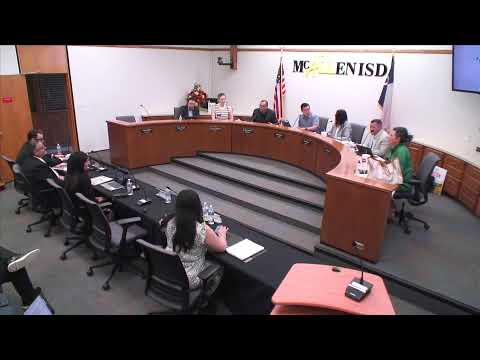
McAllen Independent School District benefits staff presented a health plan update Monday that projected the health insurance fund would finish the current year in the red and could show a larger deficit next year without design changes or additional contributions.
McAllen Independent School District benefits staff presented a health plan update Monday that projected the health insurance fund would finish the current year in the red and could show a larger deficit next year without design changes or additional contributions.
Andy Silva, speaking for benefits and insurance, told trustees the health fund ended the prior fiscal year with a marginal positive balance but is projected to finish 2024–25 about $1.4 million in the red. Without changes to employer contribution or plan design, Silva said the projection for 2025–26 is roughly a $4.8 million deficit. "At the end of last fiscal year, barely did that break even point," Silva said of the fund balance; he later summarized the projection as "about $1,400,000" in the red for the current year.
Why it matters: A sustained deficit in a self-funded plan may require increased employer contributions, increased employee premiums, or plan design changes; all three carry financial and personnel implications for employees and the district.
Staff-proposed and modeled options described in the presentation: - Employer contribution increase: The district currently budgets $466.50 per employee per month into the self-funded health plan. The presentation included a planned $55-per-employee-per-month increase (to $521.50) that would add roughly $2,000,000 to the fund balance. - Plan consolidation / single-plan scenario: Staff modeled a single, modified basic plan (one-plan offering) as a potential cost-containment option. Modeling showed that consolidating to a single-plan structure could materially reduce fund pressure but would require roughly 542 members to migrate from richer plans to the base-level design. - Specialty drug tier for GLP‑1 medications: Staff identified GLP‑1 drugs (Manjaro, Ozempic and similar) as a major pharmacy cost driver. Proposals include adding a specialty tier with coinsurance (20–30%) for targeted drugs; modeling showed potential pharmacy-side savings in the low hundreds of thousands per year (example: roughly $278,000 for a 30% coinsurance on targeted specialty drugs). - 340B / hospital-pharmacy sourcing pilot (ZorroRx example): Staff cited a vendor arrangement that would route a limited set of medications through a hospital pharmacy under federal 340B purchasing to capture discounts; current modeling identified about 115 members and potential annual savings of about $137,000 for the eligible drug set.
Enrollment and utilization notes: Presentation data showed 3,046 employees enrolled in district plans: majority (2,200+) on the basic plan; 503 in the high plan; 39 in the state plan; and roughly 284 who waive coverage. Silva said the pharmacy specialty-driver analysis identified about 112 members on Manjaro at the time of modeling.
RFP process and vendor responses: The district is in an RFP year for both medical administration and pharmacy benefits. Silva said the medical RFP received four responses: two third-party administrators (Blue Cross Blue Shield, the incumbent, and UnitedHealthcare) and two proposals described as direct-care models that do not function as full claims administrators. The pharmacy RFP received five responses, including the incumbent RayaRx and proposals from Blue Cross, ProactRx, ServRx and UnitedHealthcare. Staff said selection interviews and recommendation work will take place over July–August, with a target to present an award for board consideration in September so new arrangements can be in place ahead of annual enrollment.
Trustee discussion and context: Trustees asked whether specialty drugs or unpredictable high-cost medical claims are the principal drivers of the deficit; Silva said unpredictable high-cost medical claims (catastrophic events) can spike year-to-year but that the pharmacy specialty drugs have been a consistent cost driver over recent years. Board members also discussed non-financial plan features, employee education on existing wellness and nutrition benefits, and the trade-offs of maintaining multiple plan options versus a single-plan design.
Ending: Staff will complete RFP evaluations and modeling, return with recommendations and present vendor finalists and scoring for board consideration later this summer. The board suggested interviews with finalists and expects an award recommendation before or during the September timeframe, ahead of annual enrollment.