Get Full Government Meeting Transcripts, Videos, & Alerts Forever!
Get email alerts on the Property Tax topic
No spam. Unsubscribe anytime.
Stonecrest holds public hearing on proposed 2025 millage rate; city proposes 1.257 mills
Summary
At a June 9 special-called meeting, Stonecrest officials presented a proposal to keep the city millage at 1.257 mills for 2025, held a public hearing and recorded motions to open and close the hearing. Presenters said any tax increases would stem from county property reassessments, not a city rate increase.
The Stonecrest City Council on June 9 held a special-called public hearing on a proposed 2025 millage rate the city says would remain at 1.257 mills, the same rate adopted for the past four years.
The presentation and hearing mattered because, while the city is proposing no change to its millage rate, DeKalb County reassessments can raise individual property tax bills; city staff said the proposed 1.257 mills would generate roughly $2.8 million and represent about 17% of the city’s operations and maintenance budget.
Eric Harkin, revenue manager in the city finance department, presented the proposed millage and the required public-notice calculations. Harkin said the city is proposing to keep the 2025 millage rate the same as 2024 at 1.257 mills and explained the rollback-rate concept required by state law: "A rollback rate represents the millage rate that would produce the same total revenue on the current year's digest that last year's millage rate would have produced had no reassessments occurred." He noted the state-required PT-32.1 form was used to calculate the percentage tax increase shown in the notice.
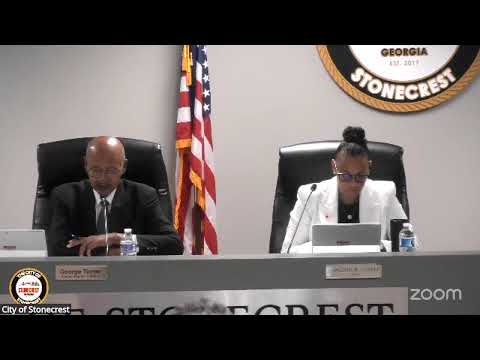
Mayor Pro Tem George Turner placed the figures in lay terms for residents, saying the city’s millage is a small portion of most tax bills. "For the last 4 years, we've levied the same millage rate ... 1.257 mil," Turner said. He gave the presentation’s examples: a homesteaded home with a fair market value of $300,000 would see about a $2.37 city tax charge under the 1.257 rate, and a non‑homestead property with a $500,000 value would see about a $3.33 city charge. Turner emphasized that county and school levies make up the bulk of most taxpayers’ bills.
Harkin and staff told the council that because some property values increased in the county’s reassessment, the city’s tentative calculations show a 1.53% overall tax increase on the digest; staff said that increase stems from reassessments, not a change in the City of Stonecrest’s millage rate. The presentation listed 11,165 homestead properties (average fair market value $300,000) and 9,177 non‑homestead properties (average fair market value $500,000). The 2025 digest reflects an estimated revenue increase of $69,043 (about 2.46% compared with 2024) due to reassessments, according to the slides.
The council opened the public hearing after a motion; the motion to open the hearing passed 3–0 (Districts 1, 2 and 4 voting in favor; Districts 3 and 5 absent). Public commenters asked clarifying questions about assessment sources and impacts. Dennis Meeks of Meadow Vista Drive asked whether assessments come from the city or DeKalb County; Harkin and staff responded that DeKalb County performs property assessments and that taxpayers may appeal assessments through the DeKalb County tax commissioner's website. Wanda Collier asked, "How will this tax increase benefit the community, and why is this tax increase necessary?" Nita Aaron said she appreciated the explanation and said she was in favor.
After public comment the council moved to close the hearing; the motion to close passed 3–0 (Districts 1, 2 and 4 aye; Districts 3 and 5 absent). No final adoption of a millage ordinance or vote to set the tax rate occurred during the special-called meeting. City staff said decisions on allocation of any increased revenue would be made during the 2026 budget development process. Staff also noted the state requires the specific notice language used in the advertisement and that a second public hearing was scheduled later the same day at 6 p.m.
The meeting concluded with a motion to adjourn, which the council approved 3–0.