Get Full Government Meeting Transcripts, Videos, & Alerts Forever!
Get email alerts on the Master Plan topic
No spam. Unsubscribe anytime.
Staff briefs planning board on council edits to Baltimore County Master Plan 2030
Summary
Department of Planning staff on June 5 reviewed County Council amendments to Baltimore County Master Plan 2030 with the Planning Board, highlighting additions, removals and reordering of goals and place types.
Department of Planning staff on June 5 walked the Baltimore County Planning Board through numerous amendments the County Council made to the Baltimore County Master Plan 2030 after the board's adoption and the council's subsequent action.
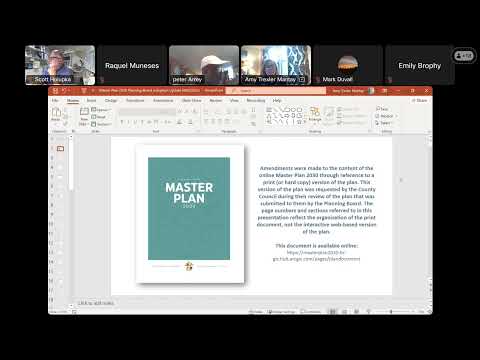
"The Baltimore County Master Plan 2030 was adopted by council, on 01/16/2024," Amy Mantay, deputy director of the Department of Planning, told the board. Mantay said the council requested a printed PDF-format official plan in addition to the online content, and that staff consolidated hub content into a hard-copy PDF used for the adopted document. "They did not feel that the online version was substantial enough for them to be able to adopt and make amendments to, so we had to create an after the fact…we had to kind of take all that content and and put it into a PDF," Mantay said.
Mantay outlined a long list of edits by council members. Key changes included reordering strategic priorities (Councilman Patoka moved "vibrant communities" ahead of "equity" and "sustainability"); clarifying that changes to the plan must be made legislatively by County Council; and inserting language that land-use decisions about individual parcels are to be evaluated case by case and are not required to conform to the high-level vision framework (Councilman Jones). Councilman Young added a new "institutional node" place type to accommodate redevelopment opportunities around the University of Maryland, Baltimore County (UMBC). Councilman Marks removed several descriptive passages and altered node boundaries in parts of his district; Councilman Crandall removed nodes within the Seventh District. Other edits ranged from adding actions to amend the automotive services overlay district for electric vehicles (Patoka) to council-specific road and sewer project priorities (Marks) and creation of a mobility node (Ketch).
Mantay and board members noted some edits removed references to recognized features; for example, passages referencing Lafarge Quarry were struck in whole. When a board member asked, "What was the fiscal analysis that he's referring to?" Mantay replied, "I do not know," and noted that Planning staff had not been provided the council's reasoning for many amendments. A board member said staff would try to explain impacts when possible but that the rationale for some council changes was not shared.
Why it matters: the council's post-adoption edits change wording, place-type maps and action priorities in the county's guiding plan. Those edits can influence how staff and decision-makers interpret the plan's aspirations and near-term priorities, even though the plan's vision framework is described as aspirational rather than mandatory for parcel-level land-use decisions.
Mantay said staff will provide the presentation and the adopted PDF to board members for review; the County Council's resolutions and amendments (including Resolution 8-25 and Resolution 19-25) were among the documents cited by staff as the source of changes.
Ending note: Planning staff emphasized they can explain implementation impacts of specific edits when asked, but in many cases the council did not provide the underlying rationale for its changes, which limits staff's ability to fully explain why particular edits were adopted.