Get Full Government Meeting Transcripts, Videos, & Alerts Forever!
Get email alerts on the Household Hazardous Waste topic
No spam. Unsubscribe anytime.
Home Resource, Missoula Public Health outline year‑round household hazardous waste drop‑off and alternatives
Summary
Home Resource and Missoula Public Health described how their appointment‑based Household Chemical Disposal facility accepts residential hazardous materials year‑round, what items are accepted or excluded, how the program is funded, and alternatives residents can use to reduce hazardous waste.
Home Resource and Missoula Public Health told a packed Lunch & Learn that Missoula now has a year‑round, appointment‑based Household Chemical Disposal facility for residential hazardous materials and urged residents to reduce and reuse hazardous products when possible.
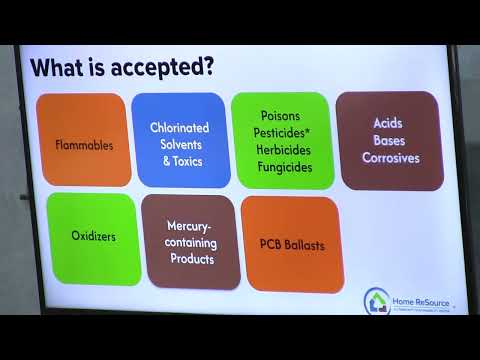
"We opened this year‑round facility last July," said Mike Lessard, program director at Home Resource, describing a change from the single annual drop‑off events that previously served the community. The facility accepts flammables, chlorinated solvents, toxics, pesticides, acids and bases, oxidizers, mercury‑containing items and PCB ballasts, among other household hazardous wastes.
The program was created as a partnership between Home Resource and Missoula Public Health to replace the former one‑weekend collection model, which speakers said encouraged long‑term storage of hazardous materials and contributed to illegal dumping and water contamination risks. "Having just this one time event meant that people were collecting things much longer than they should," Lessard said.
Kelsey Alling, who works in Missoula Public Health’s water quality department and helps run the Household Chemical Disposal facility, explained the material categories and constraints. She said the facility will accept intact, nonleaking mercury thermostats and thermometers but will not accept asbestos. Compact fluorescent lamps and fluorescent tubes (CFLs) are accepted at Home Resource for a small fee to cover shipping and processing.
Several disposal limits and operational details were given: aerosol spray paint is limited to five cans per appointment because cans fill storage space quickly and are expensive to dispose of; PCB ballasts are accepted at one per appointment due to high disposal costs (Alling said about $7 per pound); and the facility currently operates by appointment Tuesdays 9 a.m.–12:30 p.m., Fridays 12:30–4 p.m., and one Saturday each month. Appointments cost $20 to help offset disposal expenses.
Speakers described the disposal supply chain: collected materials are consolidated and shipped to high‑temperature incinerators (Alling said the closest is in Salt Lake City) and Home Resource contracts with ACT Enviro for pickup and shipment. Alling estimated that a single outbound hazardous‑waste shipment can cost in the tens of thousands of dollars and said the program is subsidized through Missoula’s water‑treatment fee; the appointment fee supplements that funding.
The presenters stressed the service is for residential waste only; businesses and schools require different, DOT‑regulated shipping and handling and cannot drop materials at the facility. They also said the program primarily serves Missoula County residents but has occasionally accepted materials from outside the county on a case‑by‑case basis.
Beyond disposal logistics, speakers offered practical alternatives to reduce hazardous waste: use vinegar‑and‑water for glass cleaner; dry and reuse or donate usable oil‑based paint (Home Resource accepts oil‑based paints that have never frozen, are more than half full and less than five years old for resale); dry latex paint for curbside pickup (commercial haulers ask that latex paint be dry enough to avoid spills); and try soapy water for many houseplant insect problems. They noted reused or donated materials may be repurposed by other community programs or the city water treatment plant where appropriate.
The presentation closed with a brief description of on‑site drop‑off logistics: residents can stay in their cars, staff will inspect and move items, and appointment slots are spaced to keep drop‑offs quick and safe. Lessard and Alling invited attendees to tour the facility bays after the presentation.
No formal policy votes or regulatory actions were taken during the session; the event was an informational public outreach presentation.