
Geneva council debates 2026 budget targets, signals possible tax-levy increase
Get AI-powered insights, summaries, and transcripts
Subscribe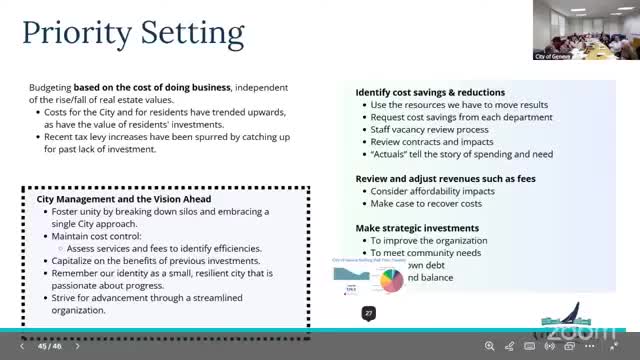
Summary
City officials and councilors spent the meeting laying out 2026 budget assumptions — including rising health and labor costs, debt service and a requested 5% cut in non‑staff spending — and debated whether to raise the tax levy to shore up services and pay down debt.
City Manager and Comptroller-led staff briefed the Geneva City Council on assumptions and priorities for the 2026 budget on a presentation that framed the budget as the city’s “blueprint” for services and maintenance.
The City Manager summarized the central tension: rising personnel and fringe costs, persistent debt payments and limited state and federal revenue growth. The presentation noted an estimated 12–15% increase in salaries and fringe benefits under current contract projections and an estimated city share of employee health‑insurance costs increasing about 15% next year. Staff said the general‑fund budget for 2025 was $20,898,780 and that current debt service funded from the general fund was about $2.1 million in 2025 and is projected at roughly $2.0 million for 2026.
The discussion focused on a “maintenance of effort” approach staff used to open department budget work: maintain 2025 staffing and service levels, assume state aid remains flat, project sales‑tax receipts as flat and ask departments to plan a 5% reduction in non‑staffing expenditures. Departments were also asked to prepare scenarios showing above‑maintenance requests separately.
Why it matters: councilors said the choices will determine whether the city can maintain public safety, infrastructure and services for seniors, renters and other residents without worsening long‑term debt or deferring maintenance.
Councilors’ priorities were shaped by a councilwide survey: seven of nine councilors responded. Public safety and public works ranked highest overall; parks and recreation, housing/planning/economic development and administrative services followed. The City Manager said staff will use the priorities to narrow department budget requests as they meet with department heads over the summer.
Debate and direction
Mayor Valente said he would support a budget that keeps the city “moving forward” and that he expects both a tax‑levy and a tax‑rate increase if the council wants to avoid deferring maintenance and allow for capital replacements. “You have my full support to come forward with a budget... I do expect a tax levy increase, and I do expect a tax rate increase,” the mayor said.
Councilor Peeler urged restraint and proposed holding the levy to about a 5% increase for the city’s portion. Councilor Gillette and others suggested outsourcing two functions instead of adding permanent staff: contracting an economic‑development firm and contracting grant‑writing services to bring expertise without adding full‑time personnel and benefits costs. Several councilors proposed a formal multiyear plan to reduce indebtedness and asked staff to identify techniques to pay down debt (for example, targeted use of fund balance, a discipline to limit new bonding and continuing the city’s equipment amortization practice).
Staff assumptions and next steps
Staff told the council they are assuming: state aid (including one‑year AIM increases) will remain flat into 2026; federal grant availability is uncertain; sales tax will be modeled as flat but scenarios will include declines; and interest earnings could show slight growth. Departments are to prepare budgets that show current staffing levels, the requested 5% non‑personnel reductions and any above‑maintenance requests clearly separated.
The City Manager and Comptroller asked the council to confirm priorities so that staff can finalize the budget calendar. Staff plans an August budget preparation update and will present the city manager’s proposed budget on Sept. 9.
No formal budget adoption was taken at the meeting. Council direction to staff was to proceed with the maintenance‑of‑effort baseline, include the assumed increases in labor and fringe, present scenarios that reflect the council’s expressed priorities (public safety, public works, debt reduction and strategic economic development) and provide options showing the levy impact of different sets of choices.
Ending
Staff will return to council with a manager’s budget presentation in September and an August update in advance. Councilors asked for detailed debt history, water/sewer fund images and several revenue and expense scenarios to inform a final vote later in the fall.