Get Full Government Meeting Transcripts, Videos, & Alerts Forever!
Get email alerts on the Urban Growth Boundary topic
No spam. Unsubscribe anytime.
Senate approves Monmouth urban growth boundary amendment bill amid housing‑supply debate
Summary
The Oregon Senate passed House Bill 26 47 A, allowing the city of Monmouth to amend its urban growth boundary to add up to 75 net residential acres and remove up to 90 acres under specified conditions.
The Oregon Senate on Wednesday passed House Bill 26 47 A, a measure that establishes a process by which the city of Monmouth may amend its urban growth boundary (UGB) to add up to 75 net residential acres and remove up to 90 acres under specific conditions.
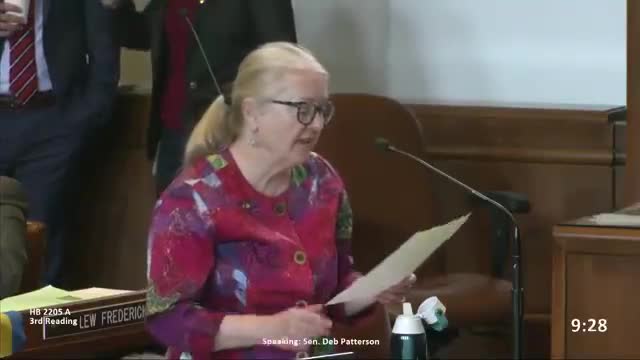
Sponsor Senator Patterson said the bill allows the city to add contiguous land that “must be able to connect to nearby water and sewer services” and requires the city to adopt comprehensive plan amendments to permit residential development at a minimum density of seven units per acre upon annexation.
Nut graf: Supporters described the measure as a narrowly tailored tool to enable housing development where existing UGB land is unbuildable because of wetlands, floodplain or other constraints. Opponents and some supporters said the Legislature should avoid ad‑hoc land‑use bills and pursue broader reforms to provide consistent, equitable tools statewide.
Floor debate focused on the housing shortage and the land‑use system’s constraints. Senator Golden said he would vote yes to “honor the folks who do the work at that airport” in a different resolution, but on this bill he emphasized discomfort with one‑off legislative decisions on county‑level land use and noted existing Department of Land Conservation and Development (DLCD) processes for UGB changes.
Senator Meek supported the bill as a tool to make previously included UGB land productive: “A lot of the land that's in…urban growth boundaries are could be wetlands, could be on steep slopes, and could be really, structurally unbuildable. But yet it's included as part of our urban growth boundary.”
Sponsor Senator Patterson noted protections for farmland and wetlands and said the process preserves family farms while allowing needed housing capacity. The measure includes conditions for removed and added parcels, owner consent for added sites, and a minimum density requirement for development.
The bill passed third reading and was declared passed; the floor record shows 27 ayes and the roll call annotations indicated excused and nay votes as recorded in the journal.
Ending: Senators on both sides said the housing crisis requires flexibility, but several urged the Legislature to craft broader, consistent changes rather than repeated city‑specific bills.