Get Full Government Meeting Transcripts, Videos, & Alerts Forever!
Get email alerts on the Rural Housing Workforce Barriers topic
No spam. Unsubscribe anytime.
Central and Southern Oregon witnesses cite infrastructure and CTE funding gaps as barriers to building homes
Summary
Speakers from Central and Southern Oregon told the Senate Housing and Development Committee that water and sewer constraints, inconsistent CTE funding, and immigration-related labor fear worsen the construction workforce shortage in rural and frontier counties.
Stakeholders representing Central and Southern Oregon told the Senate Housing and Development Committee June 4 that workforce shortages intersect with infrastructure constraints and uneven education funding, which together impede housing development outside the Portland region.
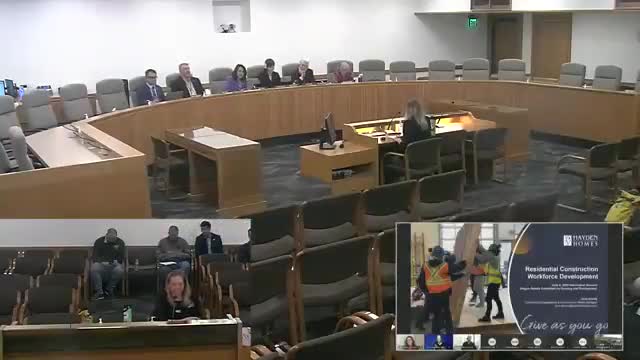
"In order for Oregon to successfully build 36,000 new homes every year for 10 years, we need sustained statewide investments in and legislative solutions for our residential construction workforce," said Jen Kovitz, community engagement and government affairs manager for Hayden Homes and a member of the housing production workforce steering committee. Kovitz told the committee that construction shortages include framers, code professionals, electricians, plumbers, HVAC technicians and energy-efficiency trades; she said immigrants make up about 14% of Oregon’s construction workforce and that 7% of the industry are undocumented, adding that fear of enforcement is removing workers from the labor pool.
Mark Griffith, director of apprenticeships at Klamath Community College, described local barriers including dry wells, lack of sewer and public water, and land-use constraints that block development in rural and fringe areas. "Homes with failed or unreliable wells are nearly impossible to resell," Griffith said, adding that high infrastructure costs make affordable housing projects particularly difficult.
Both witnesses urged expanded, sustained funding for construction CTE and pre-apprenticeship programs in high schools and community colleges, stronger dual‑credit pathways that give students a year of credit toward apprenticeships, and employer incentives to take on apprentices. Proposed policy changes included allowing 16‑year‑olds with BOLI‑approved safety certifications to work on active residential job sites, a 2:1 apprentice-to-journeyperson ratio in rural and frontier counties, lowering the apprenticeship entry age to 16, and leveraging local workforce boards to deliver regional training.
Kovitz and Griffith also criticized parts of the Echo Northwest study’s outreach: they said the study relied on long written surveys and hour-long Zoom calls that were difficult for tradespeople on site, and they recommended multilingual outreach, on-site visits and participant stipends for future research to better reach small and non‑English speaking contractors.
Ending: Both Central and Southern Oregon witnesses urged legislative and funding action rather than more study, arguing that regional pilots, sustained CTE funding and infrastructure investment are needed to unlock buildable land and expand the apprenticeship pipeline.