Get Full Government Meeting Transcripts, Videos, & Alerts Forever!
Get email alerts on the Veterans Retirement Tax Subtraction topic
No spam. Unsubscribe anytime.
Committee hears testimony on bill to exempt 100% disabled veterans' military retirement pay from state income tax
Summary
House Bill 2050A would create a state personal income tax subtraction for federal retirement pay received by certain veterans and enlisted retired guard/reservists. The House Revenue Committee held a public hearing on June 5, heard proponents and opponents, and closed the hearing without a committee vote.
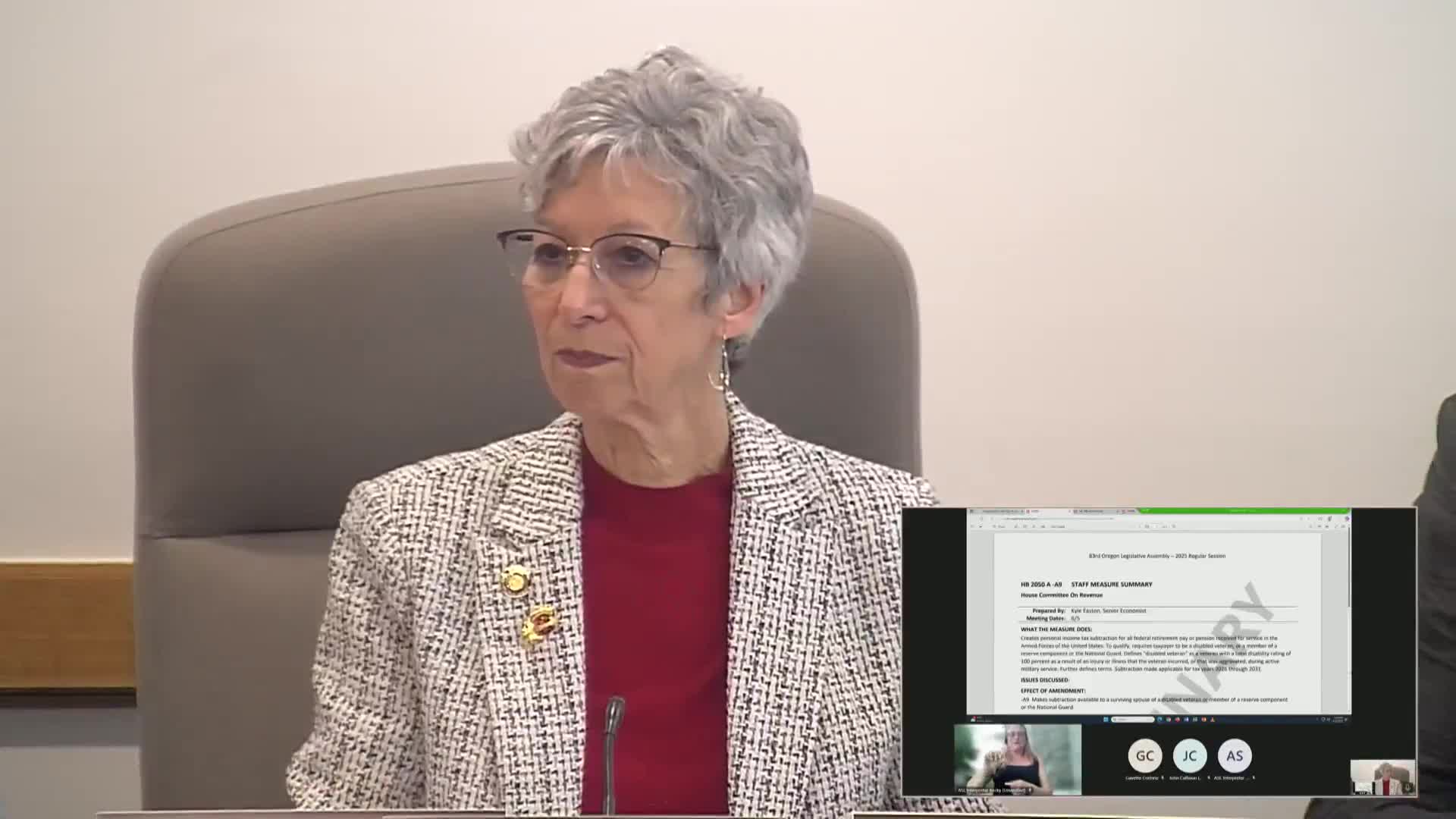
The Oregon House Committee on Revenue held a public hearing on Thursday, June 5, on House Bill 2050A, which would create a personal income tax subtraction for federal retirement pay or pension received by certain veterans and retired members of the reserve components. The committee received testimony and closed the hearing; no vote was taken.
Representative Emily McIntyre (state representative, House District 56) described the bill as a narrowed effort to retain veterans who might otherwise move to states without income tax on military retirement. McIntyre said the measure began broader but was pared down to limit cost. "I am in Klamath County ... they brought up several people that were retiring and moving out of state to another state that didn't have income tax on their retirement," she said, urging members to consider the bill's potential benefits to veterans.
Representative Thuy Tran (state representative, House District 45 and Air National Guard member) explained a committee amendment that substantially narrows eligibility. Tran said the amendment limits the subtraction to "100% disabled veterans" and to enlisted retired guardsmen and reservists, a group she described as having smaller retirement benefits and for whom the exemption would be a recruitment and retention tool.
Timothy S. Cowan, chair of the legislative commission for the American Legion Department of Oregon, testified in support of the bill. Cowan said the American Legion supports the legislation and praised the legislature's recent actions on veterans' issues.
John Calhoun, representing Tax Fairness Oregon, testified in opposition. He said the measure treats one kind of income differently from others and raises equity and fiscal concerns. Calhoun argued the bill could prompt broader demands for pension exemptions and divert state funds from priorities such as schools and homelessness programs.
Committee members asked for definitions and limits. The committee staff read into the record the statute cited by the bill for the definition of "veteran" (ORS 408.225). Representative Tran clarified that the bill as amended focuses on veterans with a 100% disability rating as determined by the U.S. Department of Veterans Affairs. Committee members also noted an amendment (dash a9) that would allow a surviving spouse receiving the pension income to qualify under the measure.
Witnesses and members referenced the fiscal trade-offs. Representative McIntyre said the bill is intended as a modest step and emphasized local impact in parts of her district where veterans make up a larger share of the population. John Calhoun of Tax Fairness Oregon urged caution, saying exemptions of this kind could reduce available funding for other state priorities.
The committee chair closed the public hearing and noted several other veterans-related bills pending in the session, including House Bill 3287, House Bill 3306 and Senate Bill 225A. The committee did not vote on House Bill 2050A during the hearing.