Get Full Government Meeting Transcripts, Videos, & Alerts Forever!
Get email alerts on the Transient Lodging Tax topic
No spam. Unsubscribe anytime.
Revenue committee reviews three amendments to transient lodging tax bill, no votes taken
Summary
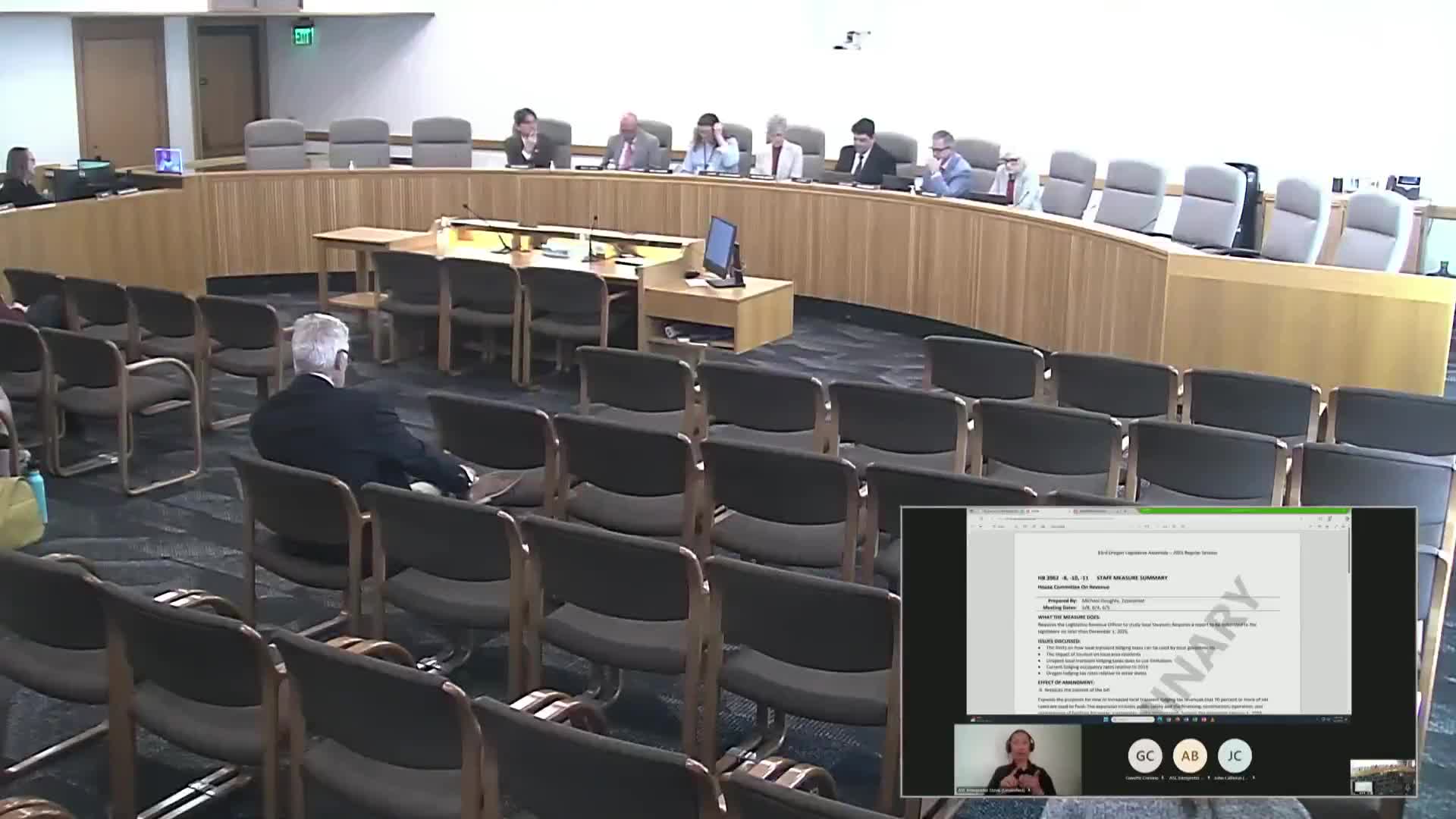
The Oregon House Committee on Revenue on Thursday, June 5, opened a work session on House Bill 3962 to review three amendments that would change how local transient lodging tax (TLT) revenues can be used. The committee did not take any motions or votes; the meeting was informational.
The Oregon House Committee on Revenue on Thursday, June 5, opened a work session on House Bill 3962 to review three amendments that would change how local transient lodging tax (TLT) revenues can be used. The committee did not take any motions or votes; the meeting was informational.
The bill originally required that at least 70% of local TLT net revenues be used for tourism promotion or tourism-related facilities. Representative Walters described the dash 8 amendment as expanding eligible uses to include certain public safety and ‘‘critical infrastructure’’ needs such as water, wastewater and transportation. Walters said the amendment also adds reporting requirements to the Department of Revenue and includes a sunset for the expansion.
Representative Cyrus Javedi, state representative for House District 32, explained the dash 10 amendment as similar to dash 8 but broader. ‘‘Community infrastructure means facilities for water, wastewater, transportation, recreation, including but not limited to parks, trails, and tourism access points, and public amenities, including but not limited to public parking and public restrooms,’’ Javedi said. He said dash 10 would give cities and counties additional options for projects such as trail access points and public restrooms and would include a 10‑year sunset and reporting to allow future review.
Representative Marsh presented a different approach in the dash 11 amendment. Marsh said the amendment ‘‘flips the buckets’’ so that a larger share would remain under local control and a smaller share would be reserved for destination marketing. Marsh described the proposal as changing the allocation to a 70/30 split with the larger share available to cities and counties and 30% directed toward destination marketing organizations or tourism promotion.
Committee members pressed for guardrails and accountability. Representative Smith asked, ‘‘How do you make sure that this doesn't turn into a money grab for the cities? How do you make sure it still has a tourism focus?’’ Representative Walters acknowledged that the amendments create discretion for local governments and said the intent is to provide flexibility to maintain services that support tourism, saying local transparency and voters’ accountability would be important. Javedi emphasized the reporting requirements in the amendments that would require local governments to report tax revenues and uses to the Department of Revenue.
Members also discussed the treatment of public safety and special districts. Javedi clarified that public safety in the drafts includes services provided by police, sheriff, district attorney, fire, search and rescue and emergency medical services, and that special districts (for example, a separate fire or EMS district) could be included in eligible uses. Committee members asked whether the changes would give cities ‘‘more flexibility’’; reading of the amendment language by committee staff indicated that the local portion could be spent on the listed city or county services.
Representatives raised concerns about certainty for destination marketing organizations and trade groups. One member suggested local governments and industry groups such as the League of Cities and the Oregon Restaurant & Lodging Association should try to reach a negotiated understanding so DMOs would have stability if allocations change.
The committee chair closed the work session without votes and said members will continue discussion at a future meeting. No formal actions, motions or votes were taken on House Bill 3962 during this session.