Get Full Government Meeting Transcripts, Videos, & Alerts Forever!
Get email alerts on the Produce Safety Cleaning Sanitizing topic
No spam. Unsubscribe anytime.
Maine agriculture officials outline farm food‑safety steps for cleaning, sanitizing and water treatment
Summary
Maine Department of Agriculture presenters urged growers to assess hazards, train workers, keep a sanitation schedule and follow pesticide labels when treating wash water, emphasizing that cleaning must precede sanitizing and that worker illness and water quality are primary risks.
Lindsay Warner, produce farm inspection program manager for the Maine Department of Agriculture, led a recorded workshop on on‑farm food safety that focused on hazard identification, cleaning and sanitizing of food contact surfaces, and options for treating post‑harvest water.
Warner said the state inspects produce farms under a cooperative agreement with the U.S. Food and Drug Administration and that her presentation aimed to help growers "think like an inspector," identify biological hazards and manage the conditions that amplify risk.
Warner told attendees that efforts should center on preventing pathogenic microorganisms — bacteria, viruses and parasites — from contaminating produce. "The goal is to minimize the risk, not eliminate it," she said, and added that the only guaranteed way to remove pathogens is to apply a validated kill step before consumption and avoid recontamination.
Why this matters: Foodborne illness disproportionately harms children, elderly people and people with underlying health conditions; small farms that sell directly to consumers can face legal exposure if they distribute adulterated food and may need to follow the federal Produce Safety Rule and related retail food codes, Warner said.
Key inspection‑focused guidance
- Hazard identification: Warner advised growers to map produce flow and traffic patterns on the farm and to look for likely points of contact — water, soil amendments, harvest containers, equipment, doors, and areas where condensation or leaks can drip onto produce. Sources of human pathogens commonly include other people and animals, she said.
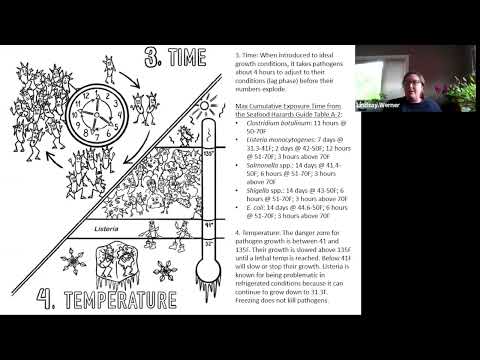
- Conditions that amplify risk: Warner highlighted untrained or sick workers, poor facility hygiene, pests, plumbing or backflow issues, equipment that is difficult to clean, and wet, cool environments where Listeria can persist. She cautioned that unassessed equipment changes can create new cleaning challenges.
- Worker policies and training: A speaker identified as a food safety specialist urged farms to assign a responsible person for food safety who wants the role; Warner and the specialist both stressed training and clear sick‑leave or exclusion policies so ill workers do not handle food or food contact surfaces.
Cleaning, sanitizing and sanitation planning
Warner said cleaning and sanitizing are distinct steps: surfaces must be visibly clean before sanitizers are applied because organic matter binds sanitizer and reduces effectiveness. She told growers how to build a master sanitation schedule and pair it with standard operating procedures and inspections.
Practical points included: - Wet cleaning steps: preclean to remove gross debris, rinse, apply detergent and scrub, rinse, inspect and then sanitize if required, allowing surfaces to dry before use. - Dry cleaning options: for situations where adding water would raise risk, options include alcohol‑based products that dry quickly, dry heat, UV or compressed‑air tools; these options are generally more costly. - Frequency: cleaning frequency should match soil load, temperature, crop type and equipment design. Warner noted sensors used by large processors (indicator organisms) are expensive and not required for farms, so growers must make reasoned decisions based on risk factors.
Warner gave numerical context used by inspectors: produce pH and temperature influence microbial growth (berries often have pH ~3–4.5; many vegetables and melons ~5–7); and sanitizing targets a 5‑log reduction (about 99.999% reduction) on a clean hard surface. She warned that if initial contamination is very high a sanitizer may not reduce risk sufficiently.
Water, backflow and post‑harvest treatment
Warner recommended assessing water quality and backflow prevention devices to avoid contaminating supply wells or irrigation systems. She described two backflow protection categories — backpressure and back‑siphonage devices — and said common garden‑hose attachments may not protect against both failure modes.
On wash water treatment, Warner said single‑pass wash lines should still be treated to prevent transfer from one piece of produce to many; for recirculated systems, the industry is shifting away from bleach toward peroxyacetic acid (PAA) because PAA is easier to manage and more environmentally friendly. She cautioned growers to follow the pesticide label: "The label is the law," and incorrect application or concentrations can render food adulterated under federal law.
Pesticide registration and applicator licensing
Warner summarized regulatory points: antimicrobial pesticides have different label uses (direct food, indirect food, nonfood), and the Environmental Protection Agency (EPA) registration and the container label determine permitted uses and concentrations. She said the Maine Board of Pesticides Control separately registers pesticides for use in Maine and noted that growers who apply pesticides and sell more than $1,000 of produce annually generally must hold an applicator license, with a narrow exception for sanitizing food contact surfaces.
Tools, suppliers and resources
Warner listed practical tools and suppliers — test strips and titration kits to confirm sanitizer concentration, industrial‑grade spray bottles and foamers, brushes and pumps, and distributors such as Nelson‑Jameson — and urged growers to choose equipment that resists chemical degradation. She also pointed to resources: Produce Safety Alliance tools, University of Vermont hygienic design guidance and recorded webinar materials that would be shared with attendees.
No formal actions recorded
The session recorded recommendations and resources but contained no formal motions, votes or regulatory directives from the Maine Department of Agriculture. Warner and a department colleague offered to share slides and resource links; Warner said Anna would email the presentation and resources to attendees.
Ending
Warner and the department urged growers to prioritize worker training, assign a responsible food‑safety lead, maintain a sanitation schedule adapted to crop and equipment risk, ensure proper backflow protection and follow pesticide labels when treating water. The department also offers training and staff can be contacted for guidance and upcoming sanitation trainings.