Get Full Government Meeting Transcripts, Videos, & Alerts Forever!
Get email alerts on the Community Immunity Act topic
No spam. Unsubscribe anytime.
Centralized 'Community Immunity' plan draws legal, parental concerns at Massachusetts hearing
Summary
Sen. Rausch's Community Immunity Act (S1618) drew support for standardizing exemption reporting and outreach but also sharp criticism over a provision that would let minors consent to preventive care; witnesses and committee members flagged constitutional and implementation concerns.
The Joint Committee on Public Health took testimony on S1618, the Community Immunity Act, which proposes centralized exemption management, improved school reporting and additional public-health measures. Sen. Julian Rausch and other backers framed the bill as building state vaccine infrastructure to close reporting gaps and protect vulnerable residents.
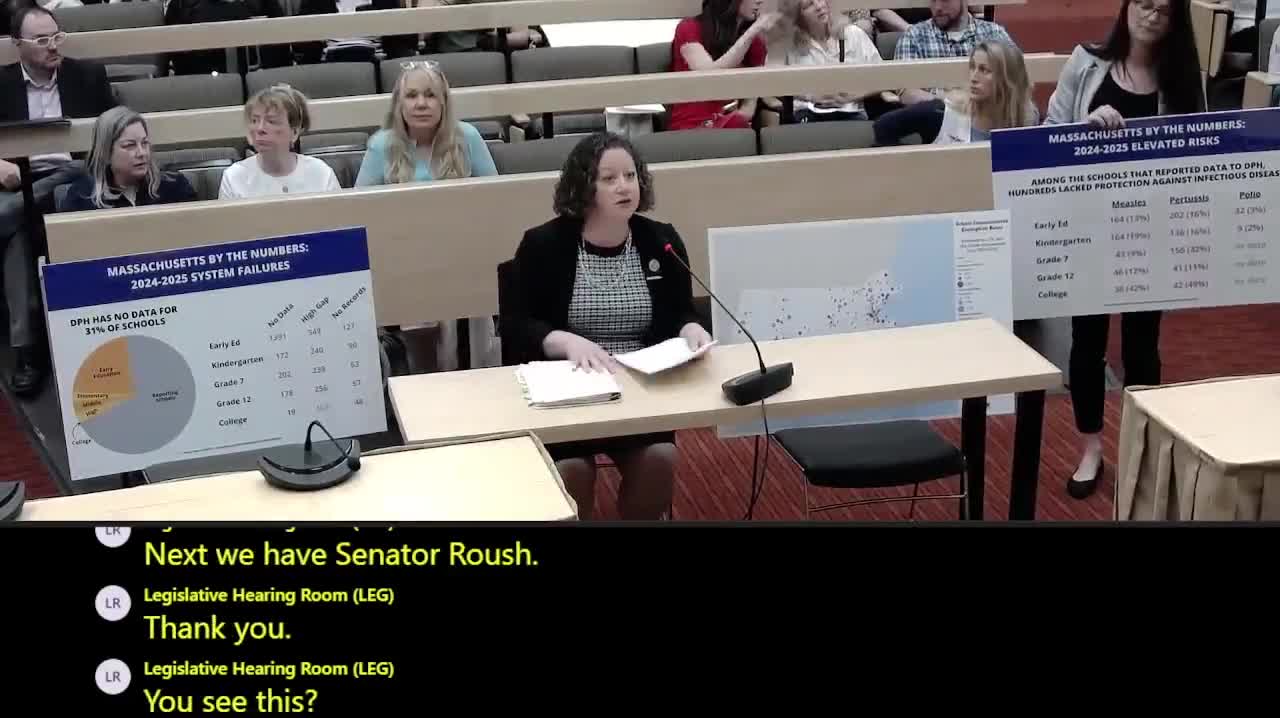
Sen. Rausch presented DPH-supplied maps showing hundreds of K–12 schools with missing or incomplete immunization data and argued for centralized management: "The responsibility for vaccine exemption management is falling on our already overburdened school teachers and child-care providers," she said, urging standardized, public-health-led oversight. She emphasized that the bill is intended to plug holes in datasets and to provide consistent implementation across communities.
Supporters said the bill would professionalize exemption handling and reduce outbreaks by improving data, outreach and education. They noted that neighboring states that changed law and reporting have improved vaccination rates.
Critics sharply focused on language in S1618 that would allow minors to consent to preventive care in some settings and on provisions that could require standardized state forms for exemptions. Public testimony warned that the minor-consent language — with no explicit age threshold or cognitive-capacity criteria — risked overriding parental authority and raised constitutional concerns. Pediatric and legal witnesses stressed the long-standing principle that parents make health decisions for non-emancipated minors except in narrow, established cases in statute or case law.
Attorney Vanessa Pompey Britt and other legal observers warned committee members that the bill could prompt litigation over parental rights and free-exercise protections; some speakers cited recent Massachusetts Supreme Judicial Court precedent that has protected parental and religious objections in narrow situations.
Sen. Rausch said the bill does not alter existing insurance coverage frameworks and that its goal is to centralize reporting and clarify exemption protocols rather than abruptly eliminate rights. She acknowledged constitutional questions and said the bill authors had tried to avoid provisions that might be vulnerable to challenge.
Lawmakers and witnesses requested clearer definitions for any minor-consent authority, explicit age or capacity criteria, and more detail on reporting workflows, privacy protections and insurance/financial responsibility in the event of adverse events. No vote was taken at the hearing.