Get Full Government Meeting Transcripts, Videos, & Alerts Forever!
Get email alerts on the Blight And Demolition topic
No spam. Unsubscribe anytime.
Committee advances bill to speed demolition of dilapidated buildings in Baton Rouge
Summary
A state Senate bill to streamline condemnation and demolition of blighted structures in East Baton Rouge Parish was amended and advanced after testimony from city officials, economic development leaders and department staff about backlogs, notice procedures and coordination with local code and title-clearance efforts.
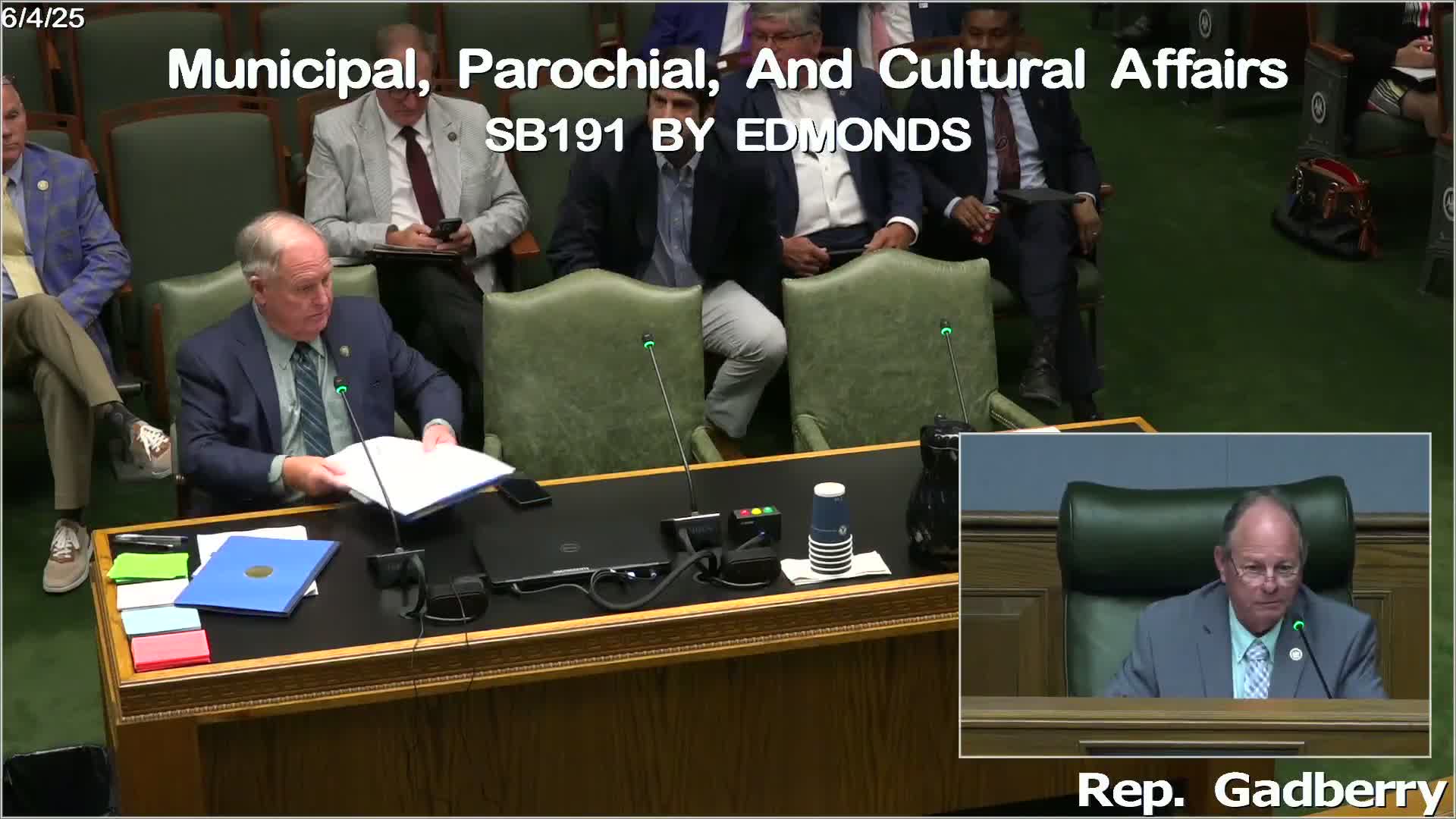
Senate Bill 236, which would give East Baton Rouge Parish and its municipalities a streamlined process to condemn and demolish dilapidated or dangerous structures, was amended and advanced by the Municipal, Parochial and Cultural Tourism Committee on June 4.
The committee moved the bill favorably as amended after testimony from city-parish officials and business groups who said faster demolition is a needed tool to reduce crime and encourage redevelopment.
Senator Edmonds, the bill—s sponsor, told the committee the proposal provides authority "for the demolition or removal of dilapidated and dangerous buildings or structures at the governing authority of a parish or municipality." He framed the measure as a response to citizen complaints and a mayoral priority to improve safety and economic development.
Charlie Davis, chief administrative officer for the City-Parish of Baton Rouge, said crime and blight are closely related and called removal tools "a tool we need in our toolbox" to make neighborhoods safer. Dario Scalco, director of public policy at the Baton Rouge Area Chamber, told the committee BRAC "supports this bill by Senator Edmonds because it addresses blight in East Baton Rouge Parish and streamlines the processes to address public safety and neighborhood investment."
Rachel Lambert, director of the Department of Development for the City of Baton Rouge, described how the amendment changes the hearing body. "So the only thing that's going to change ... is that instead of having the council as being the hearing body ... the administrative hearing officer, AKA Blightcourt, as you may know it, Representative Marcel, will be the hearing officer," she said, adding that the amendment does not remove due process.
Committee members pressed Lambert and city staff on implementation details: how properties are identified, how multiple heirs are noticed, whether the process clears title, and whether the blight court has bandwidth to handle more cases. Lambert said the department uses title experts and the parish attorney—s office to research heirs, that notices are reissued when required, and that the city currently staffs roughly 30—35 people in development and runs a "blight court" every two weeks with a docket of roughly 60 properties.
Members also raised concerns about local control and coordination with the Metro Council and other local entities. Senator Edmonds said he would consult the metro council if the bill advances further; several legislators asked the sponsor to preserve local ordinance changes and to coordinate with efforts to clear title through a separate RDA-related measure.
The committee adopted technical and substantive amendments to clarify statutory citations (including language referencing RS 13:2575 and related provisions), to vest condemnation hearings with an administrative hearing officer rather than the full governing authority, and to add procedural language about how emergency or large-volume dockets are handled.
Representative Lyons made the motion to move the bill "favorably as amended"; there were no objections and the measure will proceed as amended.
Less-critical discussion in the hearing returned repeatedly to the backlog of complaints (the committee was shown a document noting more than 64,000 blight-related service calls since 2016 and an average of about 19 such calls per day), the difficulty of clearing succession/title issues when properties have multiple heirs, and the policy goal of returning parcels to productive use rather than simply acquiring them.
The committee record shows support from the mayor—s office, the Baton Rouge Area Chamber, and other local stakeholders; a small number of cards registered opposition. The bill now advances out of committee with the sponsor and city staff pledged to continue local coordination.
Ending note: the bill as amended leaves notice and hearing protections in place and shifts condemnation hearing authority from the full governing authority to an administrative hearing officer ("blight court") while requiring local legislative steps to change municipal codes where needed.