Get Full Government Meeting Transcripts, Videos, & Alerts Forever!
Get email alerts on the Human Services Reorg topic
No spam. Unsubscribe anytime.
Senate committee advances 'one-door' plan to consolidate workforce, SNAP and disability services
Summary
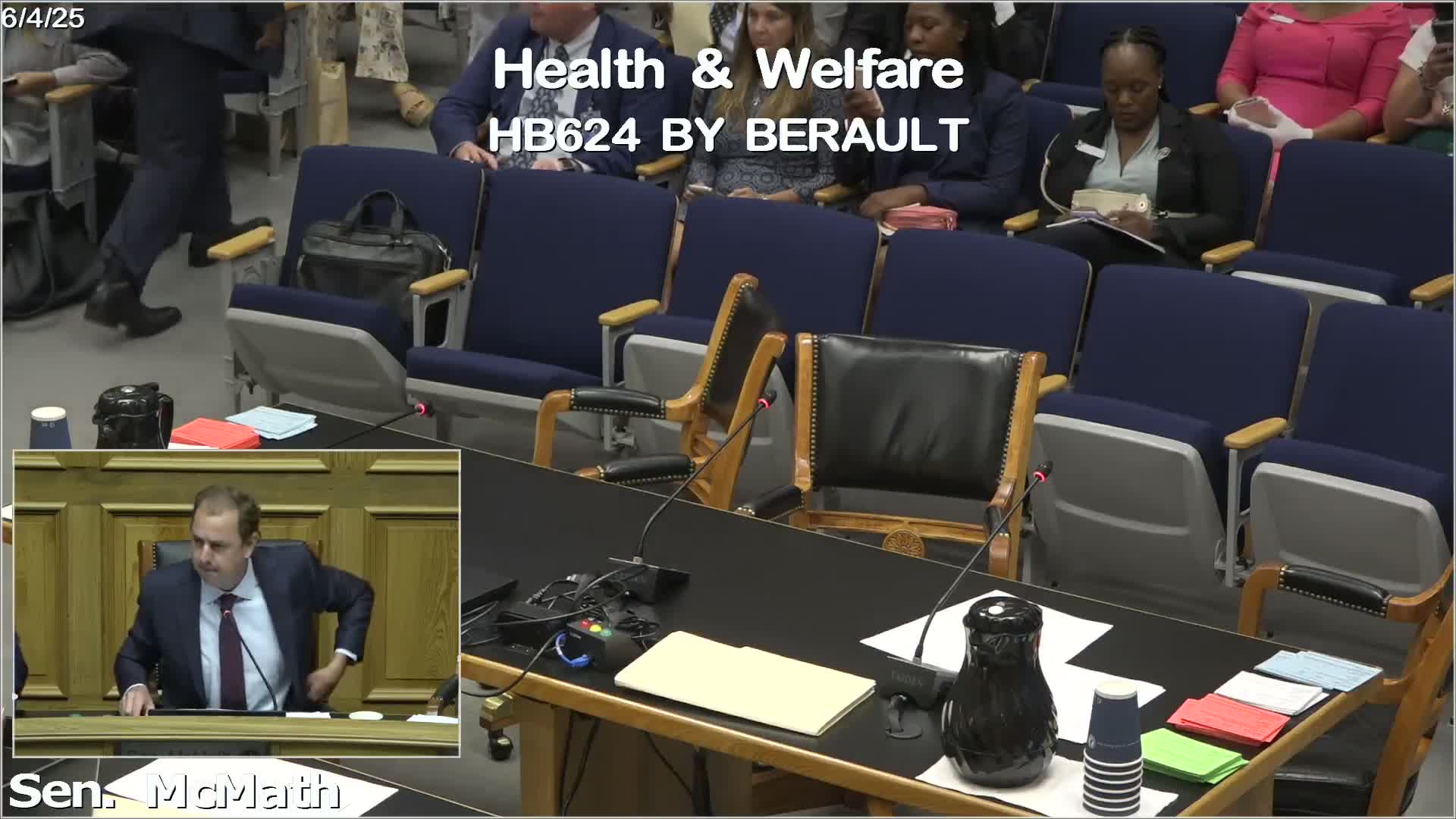
The Senate Health and Welfare Committee on Wednesday voted to report House Bill 6 24 as amended, a sweeping reorganization that would create a new agency, Louisiana Works, to consolidate workforce and TANF functions while shifting SNAP and disability services to the Louisiana Department of Health.
The Senate Health and Welfare Committee on Wednesday voted to report House Bill 6 24 as amended, a sweeping reorganization that would create a new agency, Louisiana Works, to consolidate workforce and Temporary Assistance for Needy Families (TANF) functions while shifting Supplemental Nutrition Assistance Program (SNAP) and certain disability services to the Louisiana Department of Health.
Supporters said the proposal is intended to simplify access to public benefits and help move recipients into employment. Representative Brett Berrault, the bill sponsor, told the committee the plan creates “one door, one stop shop” so citizens meet a single cross‑trained case manager rather than separate program specialists.
The bill’s proponents described multiple objectives: reduce duplicated eligibility work across agencies, improve workforce pipelines for growing employers and let the Department of Children and Family Services (DCFS) focus solely on child welfare and protective services. Representative Berrault said a task force created after the 2023 audit produced the structure now before the committee.
Agency leaders told senators the reorganization will require substantial operational planning. Susie Shown, the current secretary overseeing workforce programs, said the model will rely on cross‑training field staff and that the agency intends to start cross‑training immediately. David Matlock, DCFS secretary, said the change would allow DCFS to “focus on the job we’re supposed to do” and that he needs frontline child‑welfare hires regardless of the reorg.
Lawmakers pressed officials about costs and transitions. The committee’s fiscal summary cited a Legislature Fiscal Office (LFO) estimate that DCFS would need roughly $12.2 million in state general funds beginning in FY 2026 to offset federal funding changes tied to moving programs. Secretary Matlock said some of those funds could come from savings when duplicate eligibility positions become unnecessary and from vacant SNAP positions that can be reallocated to frontline child‑welfare work; he told senators he expected to ask for about 125 additional child‑welfare workers to meet caseload needs.
Several senators urged safeguards before major changes occur. Senator Luno and others asked for statutory guardrails so agency rulemaking and program transfers do not produce unintended legal or operational consequences. Committee counsel said many interagency transfers will be performed through implementing language and technical amendment sets; staff presented and the committee adopted a long set of technical amendments moving program language and job titles between departments.
Supporters argued the plan could reduce benefits cliffs and improve coordination for clients who need multiple services, while skeptics cautioned about implementation risk in rural areas and urged performance measures. Secretary Shown suggested workforce participation rate changes could be a primary metric, telling senators that a modest rise of a few percentage points in employment would indicate progress.
After extended questioning and adoption of multiple technical amendment sets, the committee voted to report House Bill 6 24 as amended. Senator Hensgens moved the final report; there were no objections recorded in committee. The bill will move to subsequent floor consideration where lawmakers plan additional work to refine funding, oversight and implementation timelines.