Get Full Government Meeting Transcripts, Videos, & Alerts Forever!
Get email alerts on the Broadband Deployment topic
No spam. Unsubscribe anytime.
Senate committee hears House Bill 689 to tighten state broadband enforcement and change procurement rules
Summary
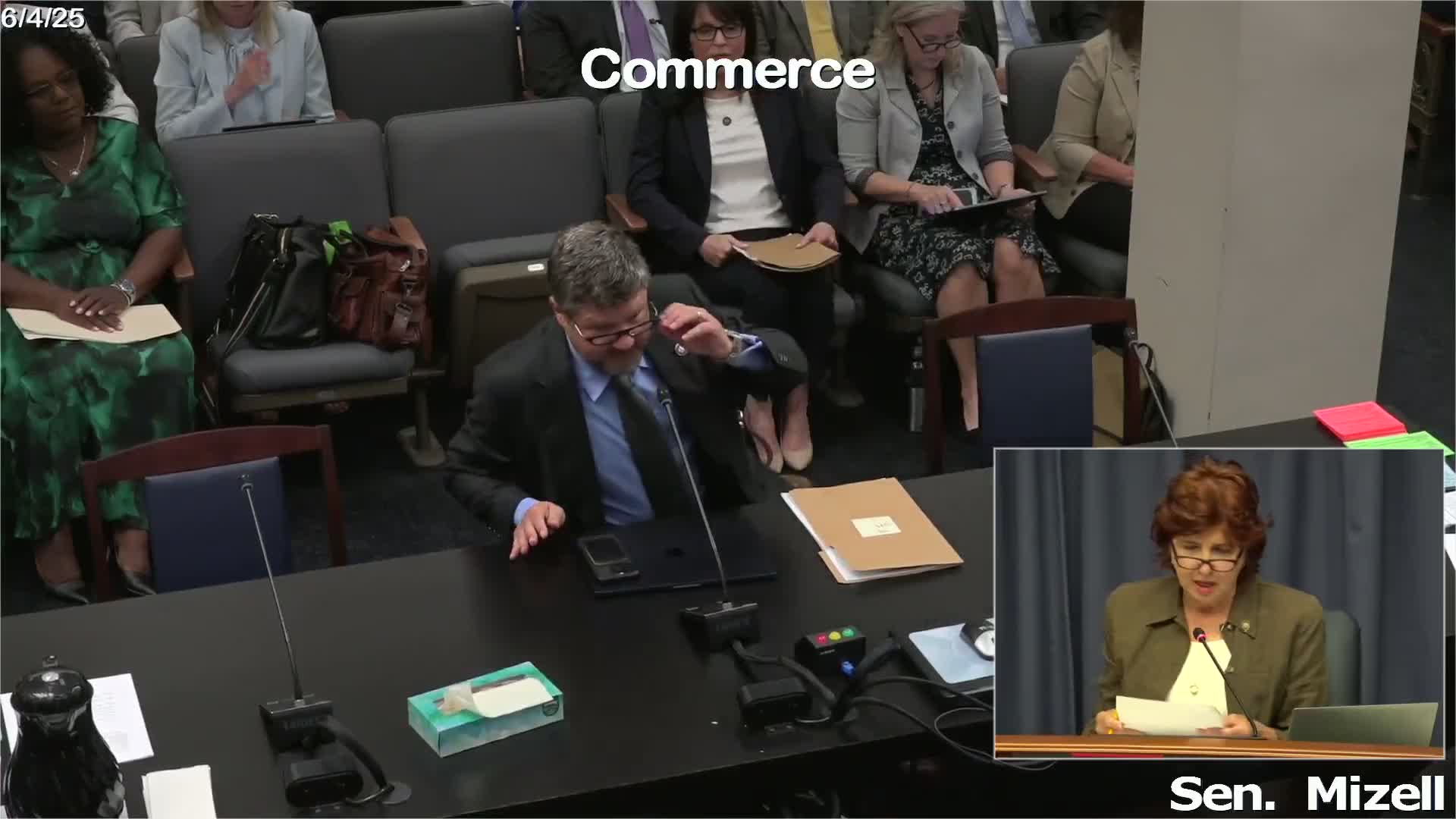
Representative Desotel told the Senate Commerce Committee House Bill 689 is a narrow fix to improve enforcement and flexibility for state-funded broadband projects, including higher administrative fees and the ability to use third-party contractors.
Representative Desotel, presenting House Bill 689 to the Senate Commerce Committee, told members the measure is a narrowly focused rewrite of an earlier proposal and was developed with industry input. "This is gonna be a really fast bill, because it's a really, really simple bill," she said, summarizing the intent to strengthen the Louisiana State Office of Broadband Development and Connectivity’s ability to oversee federally funded broadband projects.
The bill would let the state office set customized milestone thresholds for disbursements, raise an administrative fee (the proposal discussed would permit the office to collect up to 2.5 percent), and authorize an additional 2.5 percent to hire third-party contractors for technical and auditing work rather than expanding staff payroll. Desotel said the changes are intended to ensure the state-funded broadband network is "deployed effectively, efficiently and equitably" and to provide tools to address inadequate speeds, pricing violations and construction-related damages.
Vineth Iyengar, executive director of the Louisiana State Office of Broadband Development and Connectivity, told the committee the office needs flexibility to implement federal program rules and to speed reimbursement to contractors. "Everything that we do has to be approved by the federal government," Iyengar said, adding that the office currently fields complex technical audits with a staff of four and that third-party contractors are used for field audits and compliance work.
Senators pressed for specifics. Senator Abraham asked how the state currently enforces provider obligations, noting constituents' complaints about service and pricing. Desotel and Iyengar said enforcement options under prior agreements were limited after payments were made and that the bill would expand recourse, including penalties, fund-suspension, recovery and program exclusion. Desotel cited instances in which construction damaged water systems and said the bill clarifies that providers must repair damage the state paid to construct.
Committee members also focused on procurement language in the bill that would allow the office to use "alternative procurement methods consistent with requirements defined" by federal officials. Iyengar said the language is intended to align state law with federal guidance used in prior Gumbo rounds, which required federal approval of program rules and competitive scoring processes. Some senators called the procurement clause vague; Iyengar and other broadband staff said matching the federal process enabled the state to run competitive award processes approved by the National Telecommunications and Information Administration (NTIA).
Public testimony included Tom Giovannetti, president of the Institute for Policy Innovation, who urged caution about giving the state office regulatory authority. "The federal program requires the states to set up broadband offices for the purposes of mapping and distributing grants. It's a grant distribution agency, it's not a regulatory agency," he said, opposing any move that could allow price regulation or broad enforcement powers.
Other written and oral comments the committee received included opposition letters and cards from CTIA, US Telecom and regional chambers of commerce; several business and provider representatives attended but did not all speak. Committee members noted the bill had been amended in the House with industry participation and that additional clarifying amendments could still be offered.
No formal vote on the bill occurred in the Senate committee during the hearing. Speakers and committee members emphasized the bill's dependency on federal approvals and federal program funds: Iyengar said the office must spend the available $176 million within the federal timeframe and that cash-flow delays for small providers can constrain deployment. Supporters said the change would speed payments and give the office investigative and compliance authority; opponents warned of creating a state regulatory role for a program that is federally driven.