Get Full Government Meeting Transcripts, Videos, & Alerts Forever!
Get email alerts on the Public Safety topic
No spam. Unsubscribe anytime.
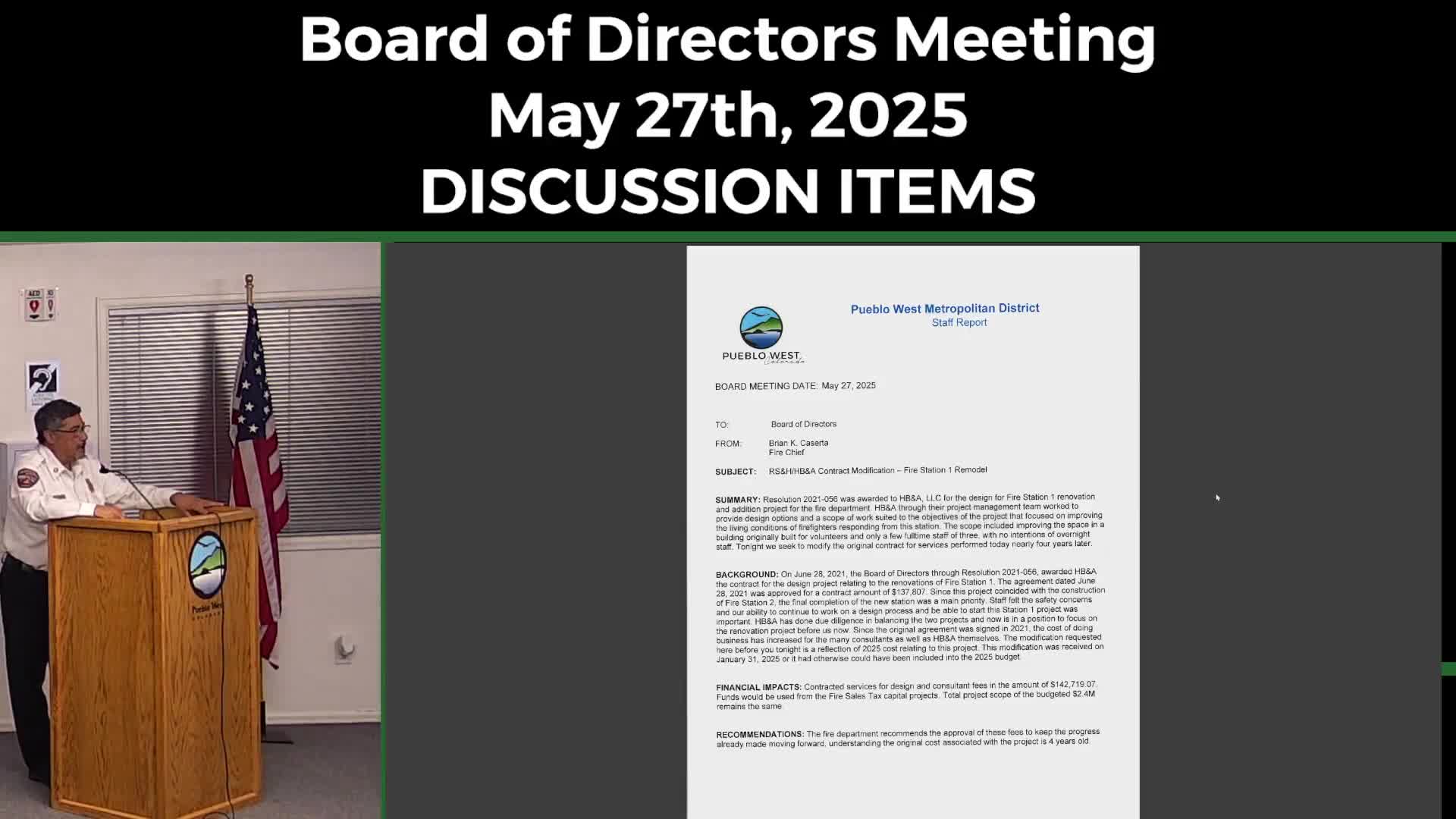
Pueblo West fire chief outlines phased remodel of Station 1; HBNA requests $142,719 contract modification
Summary
Fire Chief Brian Caserta described a phased plan to bring Station 1 into code compliance and modernize living and support spaces. Design is near complete; HBNA has requested a $142,719 modification to its 2021 contract. The board discussed costs, funding from the 6A fire sales tax, and longer-term options including a new station.
Pueblo West’s fire chief on May 20 urged the board to approve a contract modification so the district can finish final design and put Station 1 remodeling out to bid, while leaders said they will continue to weigh whether to renovate or build a new facility in coming years.
Brian Caserta, fire chief, said the original HBNA (listed in the record as HBNA Architects) contract adopted in 2021 covered a full remodel of Station 1. After updated cost estimates the department and leadership decided to phase the work to address immediate safety and habitability issues first. Caserta said the firm has requested a modification to its original contract of $142,719 to complete detailed plans that will allow the project to be solicited for construction bids.
Why it matters: Station 1 was built as a volunteer station in 1997 and lacks modern sleeping quarters, secondary means of egress, and bathrooms compliant with current American Disabilities Act standards. The district budget currently contains $2.4 million for Station 1 work; staff said design is nearly complete and they plan to advertise for construction bids and aim to begin work in the fall.
Caserta told the board the remodel emphasizes safety “particularly for our new board members” and that key immediate needs include creating secondary egress from sleeping areas, upgrading bathrooms to ADA standards, separating contaminated gear from living spaces with negative-pressure systems and dedicated areas for turnout gear, and shifting some office and fitness spaces to meet operational needs. "We found out the scope of what today's prices look like ... HBNA has requested a modification to their original contract that was in 2021," Caserta said.
The board discussed costs and alternatives. Directors and staff outlined the fire sales tax (approved as ballot measure 6A in 2020) that funds equipment, staffing and capital projects; staff said the fund is projected to support planned projects but that the 6A revenue is not yet permanently guaranteed and runs for 10 years. Directors asked for a clearer multi‑year capital plan and said they wanted oversight on procurement and cost estimates. Christian J. Hein, district manager, and Katrina Peter, chief administrative officer, said staff will provide a multi‑year capital plan for the fire-sales-tax revenue, and Caserta said he will provide a three-year capital plan and a prioritized equipment and facility needs list.
No formal vote on the HBNA modification occurred at the meeting; the item was discussed and staff were asked to return with detailed plans, cost breakdowns and timeline for board consideration.