
Senate panel presses author to narrow parental-consent bill after hours of questions
Get AI-powered insights, summaries, and transcripts
Subscribe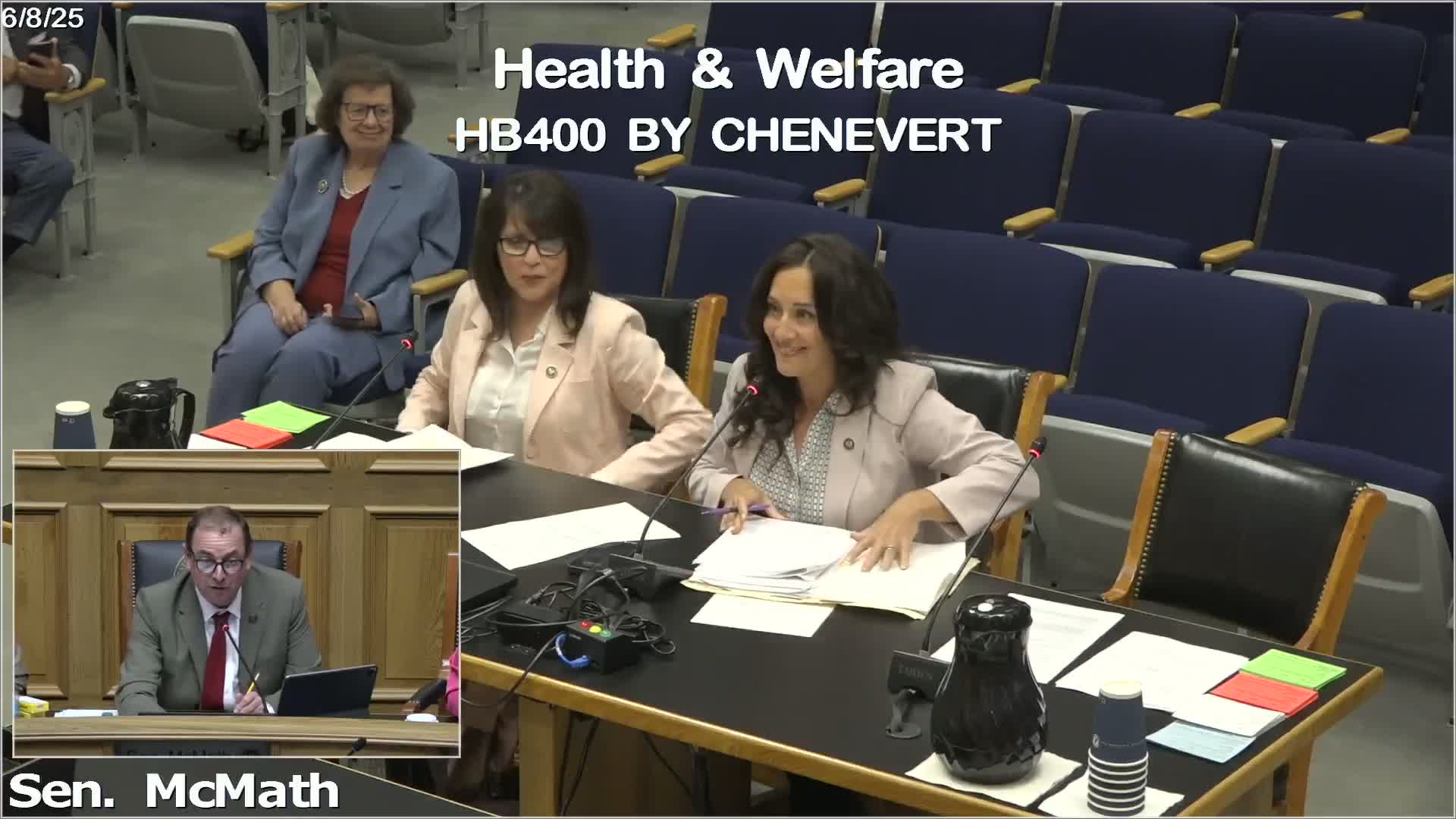
Summary
Senate Health and Welfare members raised legal and practical concerns about House Bill 400, which would change minor consent rules for medical and mental health care; the bill’s author agreed to pull the measure for rework and to seek Law Institute review.
Senate Health and Welfare members on June 8 questioned and then asked the author of House Bill 400 to withdraw the measure temporarily after extensive debate about whether it would change who may consent to medical or mental-health care for minors.
The bill’s author, Representative Shannon Barrett, told the committee the measure would “put parents or guardians on the forefront of medical decisions for their children” by defining who may consent and by creating a statutory definition of en loco parentis for the bill’s subsection. She said the measure would not change emergency-care exceptions.
Members and witnesses pressed several issues that lawmakers said were not fully considered in the version before the committee. Kim Humboldt, general counsel for the Louisiana Department of Health, and multiple senators said the bill’s language as drafted risked expanding an existing pregnancy-related exception and could unintentionally alter the long-standing legal meaning of “en loco parentis,” a term used across Louisiana law and juvenile cases.
Senator Jackson Andrews and others pointed to existing statutory provisions—cited in committee discussion as R.S. 40:1079.1, R.S. 40:1079.2 and R.S. 40:1121.8 and to R.S. 40:1159.4—that currently allow a minor certain narrow consents (for example, in labor and some communicable-disease treatment contexts). Senator Andrews said the proposed amendments would “expand the exemption” beyond current law, especially by broadening care related to pregnancy beyond childbirth settings.
Representatives of advocacy groups and providers gave differing views. Morgan Lamondre of STAR told the committee that minors can lose parental-record access under some electronic systems at age 13 and warned that limiting minors’ access to care could harm children who are being abused or trafficked. Jill Hines of Health Freedom Louisiana said she generally supported the legislation’s intent but raised concerns about civil- and criminal-liability shields and asked for clearer hierarchy language for who may consent.
After the discussion, the bill’s author agreed to withdraw the measure from further action in this committee so it could be revised. Chair McMath said the committee would request a Law Institute review to resolve statutory-definition and cross‑reference issues before reintroduction. No formal committee vote on the bill’s passage was taken.
The decision leaves open the bill’s next steps; the committee signaled an intent to keep working with the Department of Health and stakeholders on narrowed language, including returning the pregnancy exception to align with existing R.S. 40:1079.1 limitations tied to labor and childbirth.
Representative Barrett said she would prepare amendments and work with staff and LDH before the bill returns to the Senate floor.