
Grand Junction council directs staff to pursue two-lane configuration downtown, splits approach at Grand Avenue
Get AI-powered insights, summaries, and transcripts
Subscribe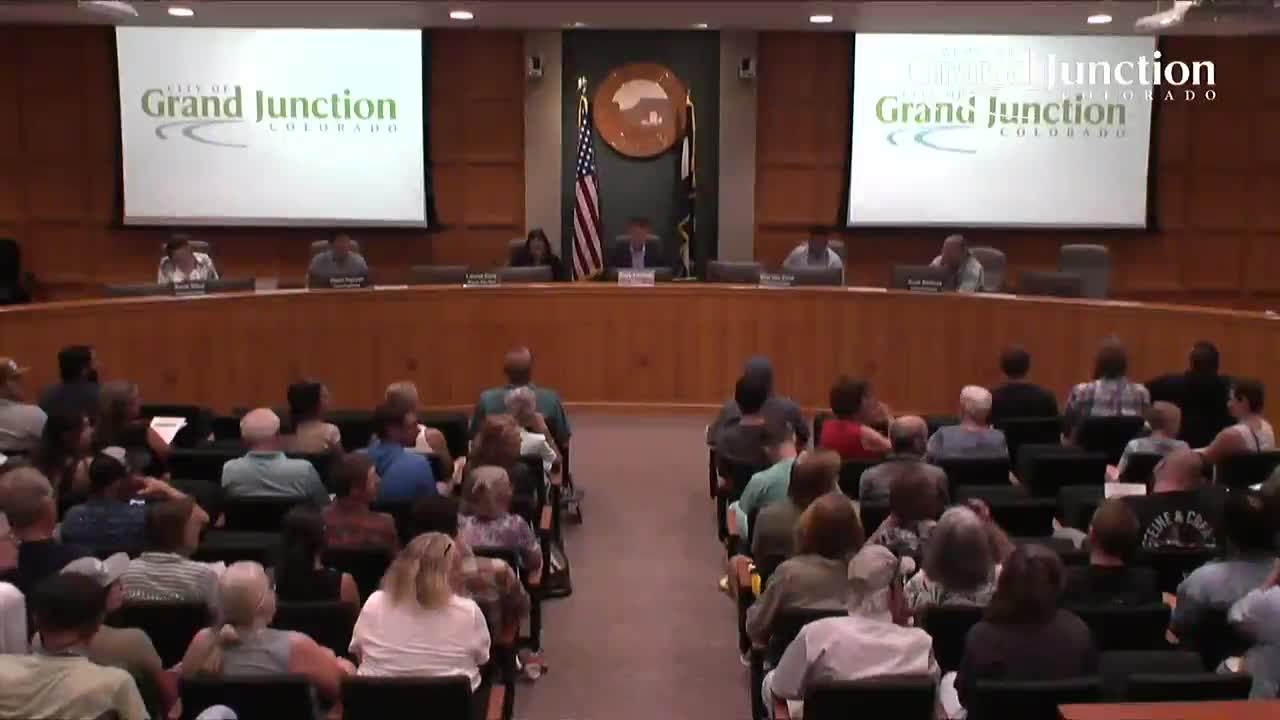
Summary
The Grand Junction City Council voted 7-0 to direct staff to move forward with a two-lane-with-bike-lanes configuration for Fourth and Fifth streets south of Grand Avenue and to advance work on the corridor north of Grand.
The Grand Junction City Council voted 7-0 to direct staff to move forward with a two-lane-with-bike-lanes configuration for Fourth and Fifth streets south of Grand Avenue and to advance work on the corridor north of Grand with its separate configuration.
Mayor Cody Kennedy framed the meeting as a chance to narrow next steps after a pilot project and extensive public comment. “I thought this was a pretty important time to receive some additional public comment,” he said as the council opened the special session.
The vote followed a staff presentation from City Engineer and Transportation Director Trent Prawal and hours of public comment from residents, downtown business owners and emergency responders. Prawal described two principal alternatives: a single-lane “pilot phase 2” layout that keeps a single travel lane with a buffered bike lane, and a two-lane option that restores two vehicle lanes while providing a bike lane adjacent to the travel lane with a buffer and altered parking geometry.
Prawal told the council Fourth carries about 3,000 vehicles a day and Fifth about 5,000, and that the two-lane option would require some parking changes and limited concrete work at key intersections. He also said the two-lane plan would remove most of the temporary delineator bollards used during the pilot and rely more on striping and, where appropriate, low-profile speed treatments.
Councilmember Robert Ballard moved the motion to direct staff to advance the two-lane-plus-bike-lane concept south of Grand and to proceed with the separate approach north of Grand; Councilmember Scott Winn seconded. The roll call was unanimous: Ballard, Jason Balfas, Cole, Wynne, Wilma Stout, Ben Van Dyke and Mayor Kennedy voted yes.
Public commenters were split but many urged caution and compromise. Dr. Adam Pindell, a physician assistant at Saint Mary’s, said the pilot had lowered speeds and reduced crashes and warned that reversing course could raise speeds again. “It costs more money to go backwards, increasing speeds, increasing accidents, and increasing street noise,” he said. Former Mayor Abraham Herman and multiple neighborhood residents praised the proposal to treat the area north of Grand separately to protect residential safety around parks and playgrounds.
Others urged the council to keep changes that had improved pedestrian safety and downtown activity. “Since the pilot program started, we've seen crashes decrease,” said Tara Flaherty, a downtown employee and parent. Several business owners described lost customers and asked the council to restore angled parking in front of the U.S. Postal Service or to open nearby lots as temporary parking while designs are finalized.
Council discussion emphasized compromise and direction to staff rather than immediate permanent construction. Several council members asked staff to monitor speeds and crash data, refine sight-line and intersection work at Colorado Avenue and other high-risk corners, and explore parking mitigations such as use of nearby lots behind the Rock Slide and Avalon properties. Staff noted CDOT contributed funding for earlier work on the corridor and that future capital reconstruction would be needed to add full streetscape features such as concrete bulb-outs.
The motion directs staff to develop drawings and implementation steps for the two-lane-plus-bike configuration south of Grand and to continue work on the north-of-Grand configuration, return with details and data, and track speed and crash measures as the council evaluates performance. The council did not adopt a timetable in the motion but asked staff to bring follow-up information and recommended metrics to aid future decisions.
With the motion approved, Mayor Kennedy closed the special meeting and thanked participants for the turnout and input.