
Fort Collins pauses Remington Oak purchase-and-sale after parking concerns; staff to lean on parking study
Get AI-powered insights, summaries, and transcripts
Subscribe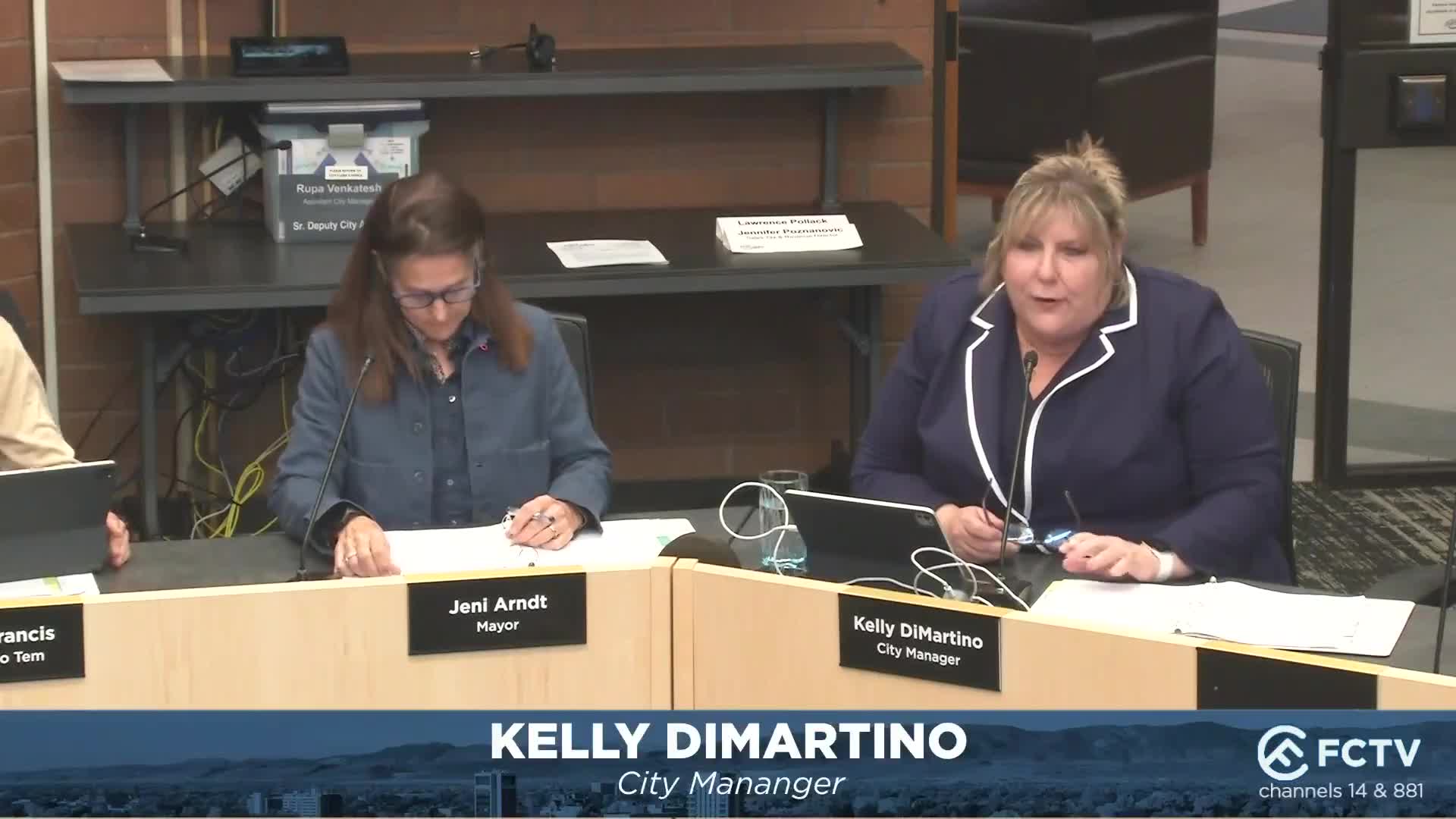
Summary
City staff said they will not present a purchase-and-sale agreement for the Remington Oak parking lot, citing new information about parking use, rising land valuation and funding uncertainty. Housing Catalyst said the pause leaves its project at a halt and requested clarity to proceed toward tax-credit applications.
Fort Collins city staff told the City Council at a special work session that they will not bring forward a purchase-and-sale agreement with nonprofit developer Housing Catalyst for the Remington Oak surface parking lot, citing new parking data, an updated appraisal and shifts in funding options.
City Deputy Director for Sustainability Services Josh Birx summarized the site's history, saying the city acquired the parcel with GID bond proceeds in 1977 and that the bonds matured in 1996. "Back in February of 2022 and then later in April of 2022, an MOU was approved by council ... that created a partnership between Housing Catalyst and the city of Fort Collins for the entire property," Birx said, adding the MOU required "a 1 for 1 preservation or replacement of the existing parking spaces." He said the MOU allowed termination under a number of circumstances and left each party responsible for its own costs if it ended.
Deputy City Manager Tyler Marr told council the decision not to present a purchase-and-sale agreement followed new information gained while moving from an MOU to drafting an agreement. Marr said an updated appraisal showed the site's value was substantially higher than previously expected and that the city learned the lot's utilization patterns extend into evenings and later hours, complicating earlier assumptions about daytime-only use. "We chose not to bring forward that purchase and sale agreement," Marr said, and recommended pausing to let a concurrent parking optimization study finish and to increase engagement with downtown stakeholders.
Housing Catalyst representatives told council the site is highly valuable to them for funding reasons: Kristen Fritz, Housing Catalyst vice president, said the parcel lies in a qualified census tract and in a transit-oriented area, which in turn makes low-income housing tax credit (LIHTC) applications more competitive. "The value of that equity boost is usually somewhere around $75,000 per unit," Fritz said, adding that the organization had modeled a roughly 75-unit project on the site.
Housing Catalyst CEO Julie Bruin said the organization has spent money and staff time on the project and that without a purchase-and-sale agreement it is at a "full stop." Bruin and Fritz said that while other sites could be pursued, moving a project to another parcel would require repeating substantial due diligence and could delay applications; they asked the city to clarify the path forward so Housing Catalyst can determine whether to continue investing in site work.
Parking services senior manager Eric Kussberg told council the lot's operation is more complex than earlier summaries indicated. Staff reported varying counts during the discussion: Birx referenced approximately 52 spaces retained by prior agreements; parking staff said the lot has 63 spaces and that permit holders (26 identified permit accounts) currently use many daytime spaces but that many permit restrictions lift at 6 p.m., making the lot open to all users in the evening. Kussberg also said the city's ongoing optimization study — led by Walker Consultants — has been made aware of the Remington conversation and that consultants will incorporate scenarios accounting for a possible loss of spaces.
Councilmembers stressed competing priorities. Several members asked that staff retain the current memorandum of understanding while pursuing a fuller process. Some councilmembers urged preserving housing as a priority; others cautioned that downtown businesses, people with limited mobility and special events rely on convenient surface parking.
Staff outlined next steps: finalize and discuss the parking optimization study in a council dialogue scheduled for Sept. 23, then allow time to consider implementation actions. Marr and Birx said the MOU remains in effect and could either be amended or terminated by council; they noted Housing Catalyst has asked the city for a no-interest loan to cover development costs incurred to date totaling "over $700,000." City staff proposed additional outreach with downtown stakeholders, reviewing the optimization study's recommendations and then returning to council with options. Housing Catalyst said it could consider alternate approaches, including development on half the parcel or pursuing another site, but said both the tax-credit timeline and site-specific financing mean uncertainty raises the cost and risk of delay.
The work session produced no formal council vote. Staff recommended a careful pause to complete the parking study, broaden engagement and clarify whether the MOU should be revised or terminated before restarting a transaction process. Housing Catalyst said it needs a clear path to be able to commit to further expense and to meet upcoming tax-credit application windows.
Council members asked staff for a public-facing map and clear counts of public versus private parking downtown and asked that staff factor downtown businesses, older residents and people with mobility limitations into any mitigation plans. Staff agreed to return with updated materials, to keep the MOU in place unless council directs otherwise, and to bring potential revised MOU or purchase-and-sale options back to council after the parking study and outreach.