Get Full Government Meeting Transcripts, Videos, & Alerts Forever!
Get email alerts on the Corporate Liability topic
No spam. Unsubscribe anytime.
Senate Judiciary Committee adopts substitute to clarify when corporate veil can be pierced
Summary
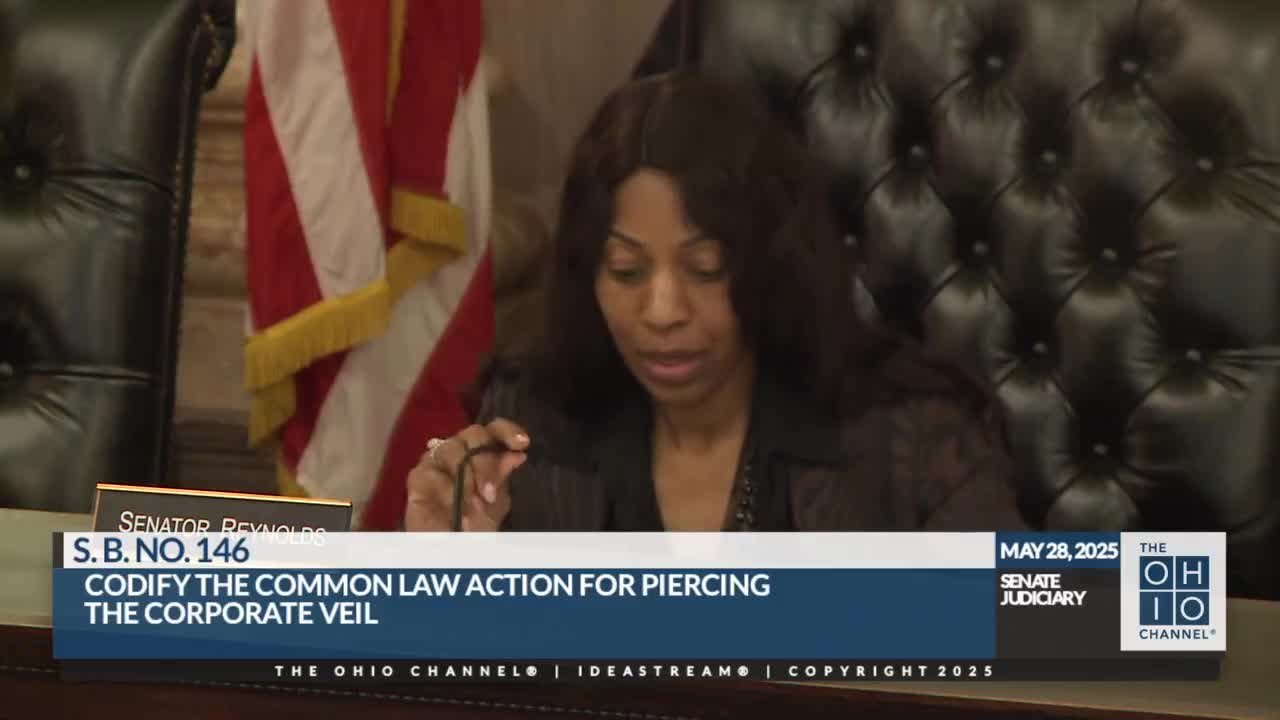
The Ohio Senate Judiciary Committee adopted a substitute to Senate Bill 146 that, supporters say, would codify Ohio common-law standards for piercing the corporate veil and limit regulatory efforts to impose personal liability on business owners and officers.
The Ohio Senate Judiciary Committee adopted a substitute to Senate Bill 146 that supporters say would codify the state's common-law standards for piercing the corporate veil and narrow circumstances under which individuals can be held personally liable for acts of a business.
The substitute was offered and moved for adoption by Vice Chair Reynolds and, after no objections were raised during committee discussion, "the substitute bill is adopted," the chair announced. The committee then heard proponent testimony from business and industry representatives before recording the item as the bill's second hearing.
Supporters said the change is meant to preserve the traditional balance between corporate separateness and holding bad actors accountable. "The process can be the punishment," testified Greg Russell, partner at Vorys, Sater, Seymour and Pease and general counsel for the Ohio Oil and Gas Association, describing cases in which the state has sought to impose personal liability on owners or officers in enforcement actions. Russell cited pending litigation involving Blaze Oil, where the state is seeking liability for an owner after a corporation failed to plug three wells, and a state action against Northwood Oil and Gas, where the president was alleged to have failed to require corporate compliance.
Anne Marie Spera, partner at Bricker & Eckler, representing the Ohio Alliance for Civil Justice, told the committee the protection of corporate separateness is long-standing in Ohio law and noted the principle appears in the Ohio Constitution, Article 13, Section 3. "Piercing the corporate veil remains a rare exception that should only be applied in the case of fraud or other exceptional circumstances," Spera said, and she described the substitute as setting the standard that must be met to hold individuals liable while specifying facts that are insufficient for veil piercing.
Kevin Shemp, an associate attorney at Dickinson Wright testifying for the Ohio Chamber of Commerce, said codifying the factors courts use to permit veil piercing would increase predictability for businesses and investors. "Senate Bill 146 will improve the business and legal climates in the Buckeye state by reinforcing the long standing principle that business entities provide broad liability protections for their owners," Shemp said. He and other witnesses noted the bill does not eliminate liability for criminal conduct or for harms where the entity itself remains liable.
Committee members were shown written proponent testimony filed by the Ohio Business Roundtable, the Ohio Council of Retail Merchants, the National Federation of Independent Business (NFIB), and the Ohio Manufacturers Association.
The committee adopted the substitute and took proponent testimony; no roll-call vote on the substitute was recorded in the transcript. The item was recorded as Senate Bill 146's second hearing before the committee.