Get Full Government Meeting Transcripts, Videos, & Alerts Forever!
Get email alerts on the Senate Bill 153 topic
No spam. Unsubscribe anytime.
Election‑law overhaul draws broad opposition at committee hearing; critics say SB 153 would disenfranchise voters and burden election officials
Summary
Advocates for voter access, county election officials and civil‑liberty groups testified against Senate Bill 153, warning that documentary proof‑of‑citizenship requirements, curtailed drop‑boxes and signature rules for ballot initiatives would increase provisional rejections, create legal risk and impose heavy administrative costs
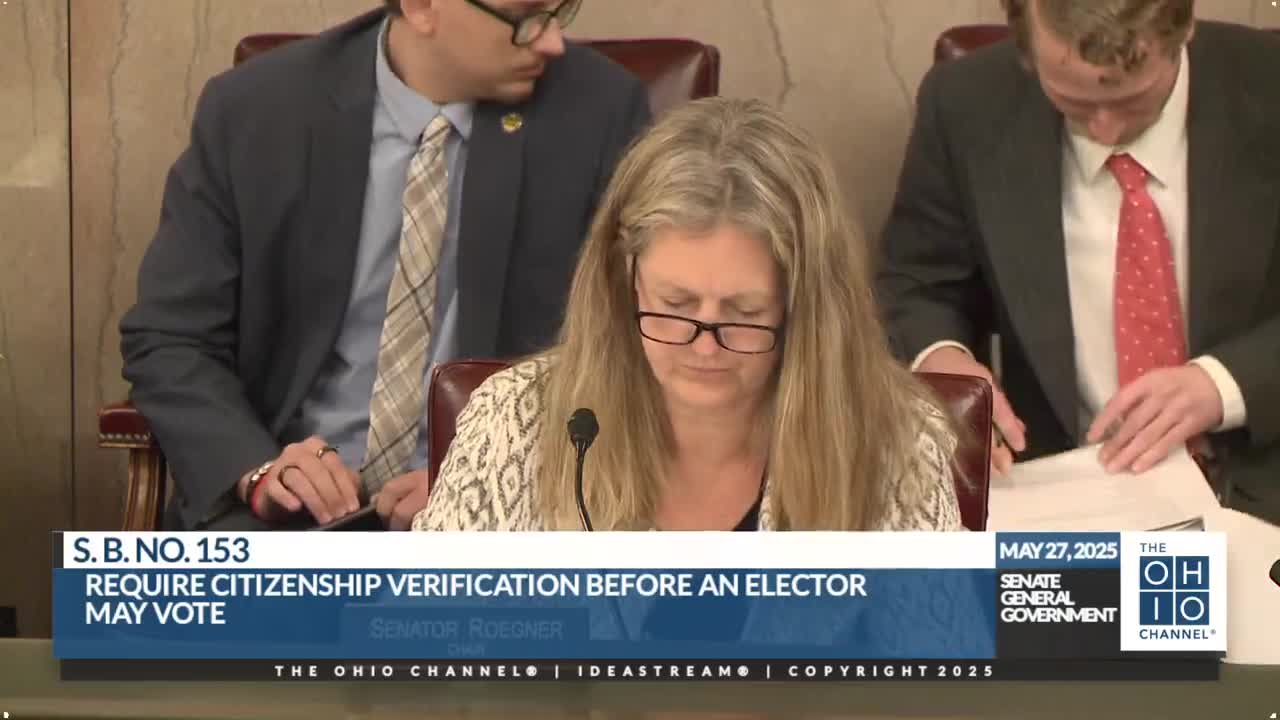
Public‑interest groups, election advocates, poll workers and civil‑liberty lawyers told the Ohio Senate General Government Committee the state should reject Senate Bill 153 because, they said, it would make it harder for eligible Ohioans to register and vote and would hamper citizen ballot initiatives.
Witnesses said SB 153 imposes documentary proof‑of‑citizenship (DPOC) requirements for registrants and would increase provisional ballots and cancellations when clerical errors, data mismatches or postal delays occur. They warned that the bill’s signature, timing and ‘‘compensated circulator’’ rules would intimidate volunteers and sharply raise the cost and complexity of placing measures on the ballot.
Kelly Dufour of Common Cause Ohio and Greer Ashbury of All Voting Is Local Action called for more study and greater input from county boards of elections, which witnesses said are already implementing recent changes to registration and data transfer systems. The Ohio county boards were not widely present to testify, advocates said, because verification and certification work for the May primary was underway at the time of the hearing.
Advocates cited multiple areas of concern:
- Documentary proof of citizenship: Witnesses said requiring documentary proof at registration or when updating an address or name would create new barriers for high‑school and college registration drives, libraries, community groups and voters who lack immediate access to birth certificates, passports or other documents. They said the requirement would disproportionally affect elderly, low‑income and rural voters. Several lawyers warned the DPOC rule would return the state to a set of practices previously struck down by federal courts and likely produce litigation under the National Voter Registration Act and the Constitution.
- Provisional ballots and voter cancellations: Testimony described how mismatches between BMV (drivers‑license) records and voter rolls, postal delays and simple data entry errors already generate provisional ballots. SB 153’s new rules would cause provisional rejections to trigger cancellation of registrations, witnesses said, risking repeated disenfranchisement for voters who try to cure problems after an election.
- Drop boxes and vote‑by‑mail logistics: Witnesses urged maintaining accessible drop‑box options and adjusting deadlines rather than eliminating options relied upon by voters and carers. Several witnesses provided county‑level data showing thousands of voters use drop boxes, and said mail delays can cause legally posted ballots to arrive outside arbitrary deadlines.
- Ballot‑initiative and petition rules: Organizations that run signature drives said new disclosure requirements and penalties for petition circulators would deter volunteers and raise costs for citizen petitions that qualify statewide or locally.
Legal and civil‑liberty groups warned of fast litigation if any part of SB 153 becomes law. Richard Topper, an attorney who has worked as a poll observer and trainer, and Eric Zagranz, a constitutional law professor and practitioner, urged the committee to consider federal preemption (NVRA, HAVA) and recent case law that struck down similar measures in other jurisdictions.
County poll workers, veterans of precinct operations and poll‑location managers described practical problems at check‑in and said trained election office staff—not volunteer poll workers with hours of training—should handle any documentary verification. Several witnesses recommended alternative reforms: improve back‑end database validation, fund county boards for additional staffing and equipment, expand early voting and same‑day registration options, and give boards time to implement system changes before imposing more statutory changes.
Ending: Committee members heard a long list of written comments and multiple in‑person objections. No final action on SB 153 was recorded at the hearing; witnesses urged the committee to slow down, consult county election officials, and allow audits and administrative changes to proceed before considering major statutory revisions.