Get Full Government Meeting Transcripts, Videos, & Alerts Forever!
Get email alerts on the Earned Wage Access topic
No spam. Unsubscribe anytime.
Senate committee hears competing views on earned‑wage access; advocates press for fee caps, tip limits and real‑time tracking to prevent advance stacking
Summary
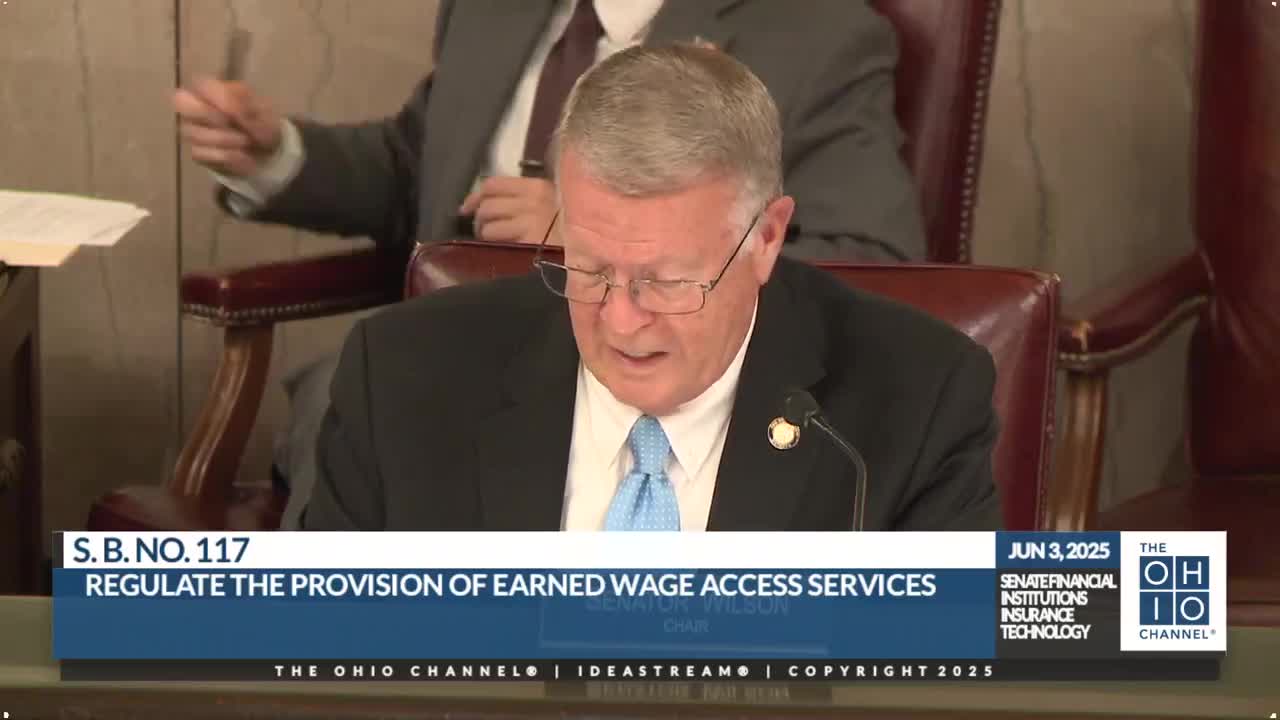
Opponents and interested parties urged stronger consumer protections for earned‑wage access (EWA) services during testimony on Senate Bill 117, recommending fee caps, default gratuity set to zero, classification of EWA as credit in some cases, and a centralized tracking system to prevent consumers from taking multiple advances across providers.
Witnesses testifying in opposition and as interested parties told the Senate Financial Institutions, Insurance and Technology Committee that Senate Bill 117 needs stronger guardrails for earned‑wage access (EWA) products, particularly for direct‑to‑consumer services that are not employer‑integrated.
“Almost half of the consumers in that dataset were stacking these loan product or stacking these advances,” Monica Burks, policy counsel for the Center for Responsible Lending, told the committee, citing the group’s analysis of about 214,000 EWA transactions. Burks said her organization found that a minority of frequent users generate the majority of advances and that transaction fees and tips can trap low‑income workers in repeat usage.
Burks and other witnesses described three industry models before the committee: employer‑integrated programs that route repayment through payroll; employer‑sponsored or employer‑paid programs that may charge no fee; and direct‑to‑consumer apps that access bank accounts or checking‑account data and withdraw repayment. Witnesses and committee members repeatedly distinguished employer‑integrated services, where the employer can verify pay and deduct paycheck repayments via payroll, from direct‑to‑consumer products that have no employer tie.
Recommendations from witnesses included: a statutory or regulatory cap on per‑transaction fees; setting the default gratuity or tip to $0 and making any tip clearly voluntary and easy to change; monthly caps on total fees paid by a consumer; classifying certain EWA transactions as loans under state or federal lending statutes when the product functions like credit; and implementing a real‑time, centralized tracking system to block “advance‑stacking” across multiple providers.
Tori Hollingsworth, executive director of the Ohio Community Development Corporation Association, urged the committee to delete language that would exclude EWA services from being treated as credit and to adopt states’ best practices such as fee caps used in Georgia and Kentucky. Danielle Delio Spires of the Ohio Poverty Law Center cited a Consumer Financial Protection Bureau interpretive rule and urged the committee to adopt protections that would bring TILA‑style transparency to the product. John Barnes of Catalyst Regulatory and Compliance recommended a centralized transaction tracking system used in some states to prevent consumers from exceeding statutory limits or becoming overextended.
Committee members asked about real‑world urgency for consumers and alternatives for workers who need small emergency cash. Senator Lang and others expressed concern that some consumers rely on EWA to meet basic needs in the short term; witnesses said that is precisely why protections are needed so charges do not compound and push consumers into repeat use.
No committee vote or legislative decision on SB 117 was recorded at the hearing; the committee concluded the third hearing after receiving written submissions from industry organizations.
Why it matters: Witnesses said EWA products are increasingly used by low‑ and moderate‑income workers for routine expenses and that stacking advances across multiple apps can materially reduce take‑home pay. The committee heard specific policy options — fee caps, tip reforms, transparency and centralized tracking — that could be adopted to limit consumer harm while preserving access.