Get Full Government Meeting Transcripts, Videos, & Alerts Forever!
Get email alerts on the Opioid Overdose Response topic
No spam. Unsubscribe anytime.
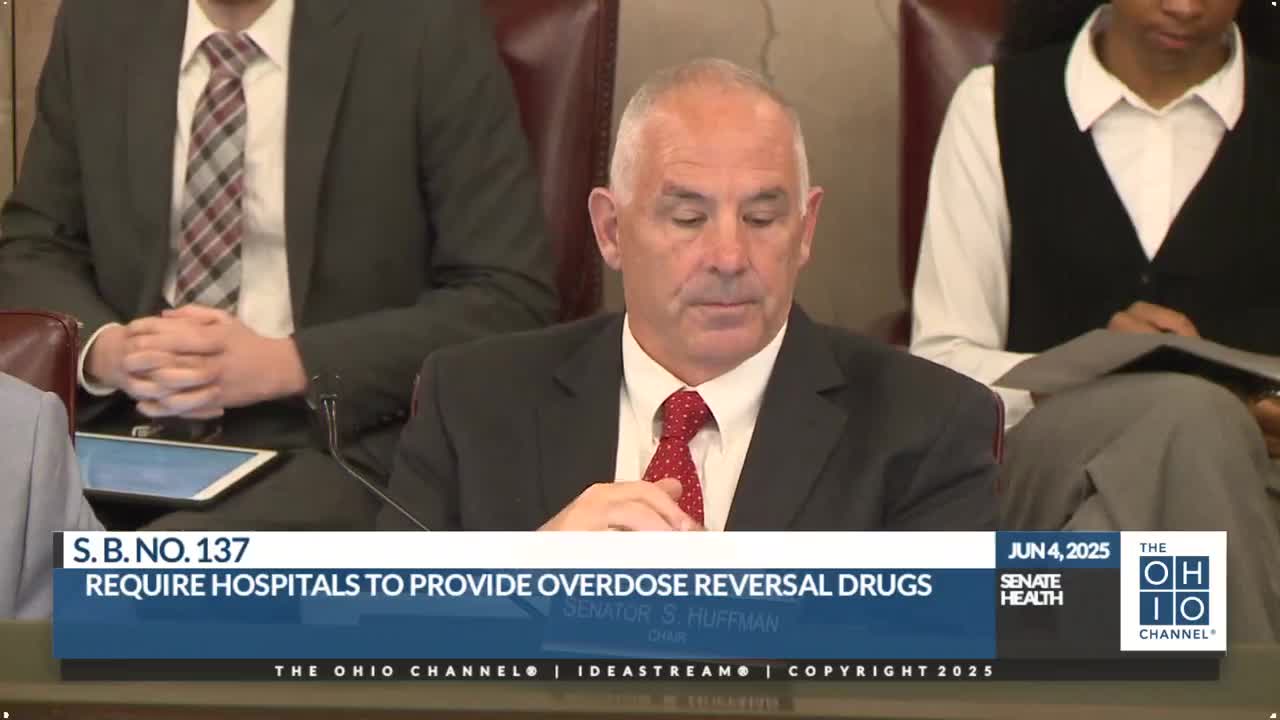
Senate Health Committee hears testimony on bill to require hospitals to provide naloxone at discharge
Summary
Proponents told the Senate Health Committee that Senate Bill 137 would make naloxone distribution from emergency departments standard practice statewide to reduce opioid overdose deaths, citing data that many prescriptions go unfilled.
The Senate Health Committee heard proponent testimony on Senate Bill 137, which would require hospitals to provide an overdose-reversal drug, naloxone, to patients discharged from emergency departments when they presented with signs of opioid overdose or opioid use disorder.
Supporters told the committee the change would cut barriers that leave at-risk patients without life-saving medication. Dr. Michael McCray, a past president of the Ohio chapter of the American College of Emergency Physicians, described a patient death that shaped his position: "It was this case that changed my practice forever, led to me championing Narcan kits at our hospital," he said.
Proponents said relying on prescriptions alone has not solved access problems. James Neuenschwander of the Ohio Naloxone Project said most naloxone prescriptions written in emergency departments go unfilled and that placing kits directly into patients' hands at discharge would remove cost, stigma and other barriers. "Naloxone has been proven to save lives of those overdosing from opioids and offers an important gateway to recovery," Neuenschwander said.
The witnesses cited data presented to the committee that about 98 percent of naloxone prescriptions from emergency departments go unfilled. Neuenschwander told the committee that out-of-pocket cost, stigma and chaotic circumstances around addiction contribute to that gap: "If they have $49, they're not going to a pharmacy and getting something that might keep them alive," he said.
Vice Chair Johnson, a committee member and practicing clinician, asked how the bill's language would change that gap. Neuenschwander responded that providing the kit at discharge and requiring reimbursement from insurers and Medicaid would overcome the primary barriers the witnesses identified.
Supporters asked the committee to make distribution a standard hospital practice rather than a grant-dependent exception. No vote or formal action occurred during the hearing; the committee took testimony and recorded written submissions from additional medical groups.
The hearing record includes statements from the Ohio chapter of the American College of Emergency Physicians and the Ohio Naloxone Project; several witnesses noted Ohio's continued high overdose death toll and called the bill a practical step to reduce preventable deaths.