Get Full Government Meeting Transcripts, Videos, & Alerts Forever!
Get email alerts on the Earned Wage Access topic
No spam. Unsubscribe anytime.
Senate committee hears clash over earned-wage-access products, advocates seek fee caps and tip limits
Summary
The Senate Financial Institutions, Insurance and Technology Committee held a third hearing on Senate Bill 117, where consumer advocates urged fee caps, default-zero tips and stricter oversight for earned-wage-access products while industry witnesses proposed real-time tracking to prevent "advance stacking."
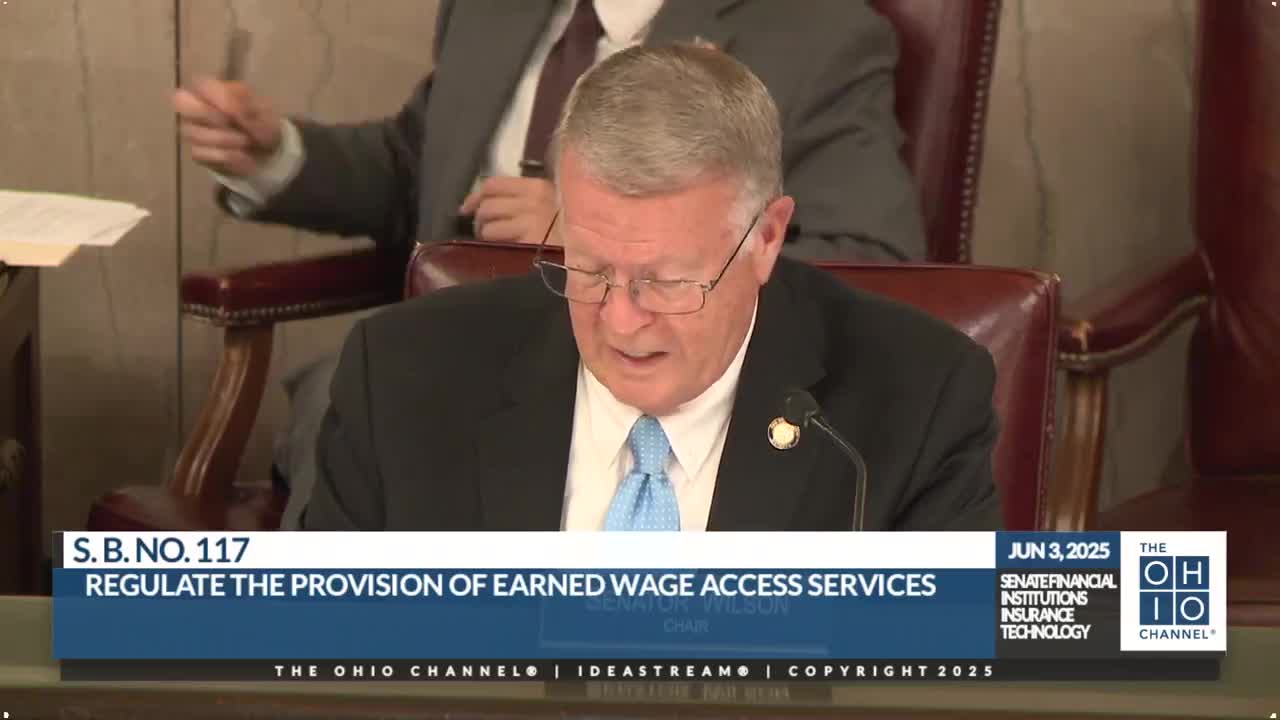
The Senate Financial Institutions, Insurance and Technology Committee held a lengthy third hearing on Senate Bill 117, a proposal to establish a regulatory framework for earned-wage-access (EWA) services. Witnesses for consumer groups and community development organizations urged the committee to add guardrails for direct-to-consumer and employer-integrated EWA products, while industry witnesses described technical solutions to prevent "advance stacking."
Monica Burks, policy counsel for the Center for Responsible Lending, testified that analysis of about 214,000 EWA transactions showed frequent repeat usage and high costs for frequent users. "Almost half of the consumers in that dataset were stacking these ... advances," Burks said, and she told the committee that in the dataset "about 40% of the people ... are responsible for 86% of the advances taken." Burks also said that some platforms’ default and encouraged tipping practices and expedite fees push users to pay to receive funds immediately: "Two-thirds of Americans are living paycheck to paycheck ... 90% of consumers who use these advances pay that expedite fee."
Tori Hollingsworth, executive director of the Ohio CDC Association, said the bill as drafted does not distinguish adequately between direct-to-consumer products and employer-sponsored offerings and urged the committee to delete language that treats EWA services as not being credit. She recommended fee caps and a default tip of $0, noting other states’ approaches: "Georgia caps fees at $5 per transaction. Kentucky caps fees on a sliding scale; Nevada and Maryland set the default tip to $0," she told the committee.
Danielle Deon Spires of the Ohio Poverty Law Center reiterated concerns about repeated use and loan stacking, referenced a Consumer Financial Protection Bureau interpretive action and recommended classifying advances as loans for consumer-protection purposes so Truth in Lending Act protections would apply.
John Barnes, vice president for government affairs at Catalyst Regulatory and Compliance, represented providers’ technical proposals and said direct-to-consumer products pose unique risks because they do not share employer payroll data. He described a centralized, real-time tracking system states can require so that a prospective advance is checked against existing outstanding advances on other platforms: "With a centralized tracking system, every EWA transaction is checked against current balances and ensures that it's in compliance with state law," Barnes said. He added that such a system can operate with a small per-transaction cost to fund compliance oversight.
Committee members asked questions about how tipping is collected, how fees vary by platform and whether direct-to-consumer advances can be prevented from overdrawing a consumer’s account. Burks and other advocates provided data points: DailyPay’s average advance was described as about $20 with an average fee of $5.99; advocates said some providers encourage tips that can amount to a substantial share of revenue and that some heavy users take dozens of advances per year. Industry witnesses and some senators noted employer-integrated products (where an employer offers EWA as a payroll-linked benefit) differ from direct-to-consumer products because employers can control payroll deductions and verify pay.
The hearing included advocacy groups’ recommended changes: fee caps per transaction, monthly caps on total fees paid, prohibition or default of $0 for suggested gratuities, consumer-disclosure requirements and a requirement that direct-to-consumer providers be regulated as lenders or be subject to comparable protections to prevent repeated, costly advances. Industry witnesses recommended real-time eligibility checks and a third-party transaction- tracking database to prevent stacking across platforms.
What happens next: The committee concluded the third hearing on SB 117 without a committee vote in this transcript. Sponsors and multiple stakeholders indicated they would continue discussions and provide additional data to the committee.