Get Full Government Meeting Transcripts, Videos, & Alerts Forever!
Get email alerts on the Disability Registry First Responders topic
No spam. Unsubscribe anytime.
Senate committee reviews voluntary statewide disability registry bill to aid first responders
Summary
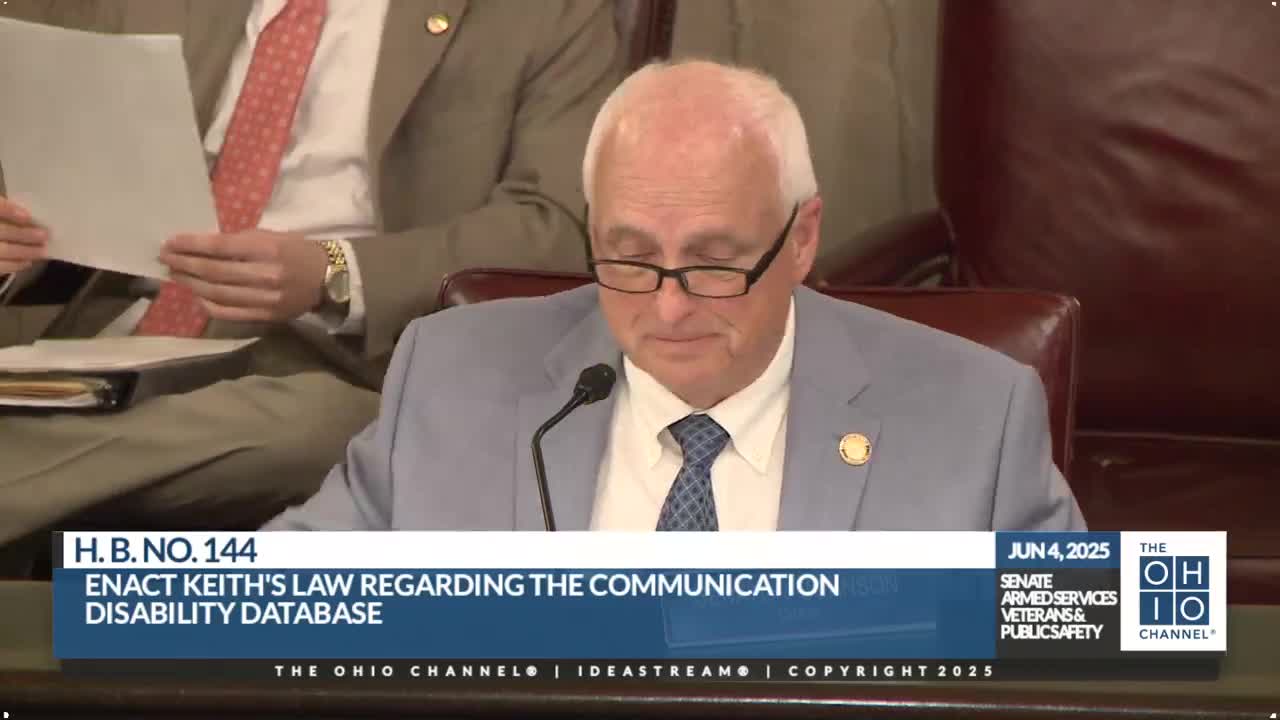
Representatives told the Ohio Senate committee that House Bill 144 ("Keith's law") would create a voluntary statewide database to provide 911 dispatchers and first responders with information about people with disabilities; sponsors emphasized the measure is permissive and LSC estimated de minimis cost.
Representatives Klick and Lorenz told the Ohio Senate Armed Services, Veterans Affairs and Public Safety Committee that House Bill 144 would create a voluntary statewide registry flagging people with disabilities so 911 dispatchers and first responders can be alerted to special‑needs conditions during calls.
Representative Klick said the registry would be voluntary and administered through the Department of Public Safety working with disability organizations. "It's all voluntary, and it will be set up through DPS, working with Ohioans with bridal disabilities and others to create this statewide database," Klick said. He described examples in which local registries have helped police and emergency personnel respond more safely and said the bill would standardize that practice across Ohio.
Representative Lorenz described personal experience: his son, Henry, who is on the autism spectrum, was pulled over and was helped by a school‑resource officer who knew him. Lorenz said local registries such as one in Delaware County improved outcomes by giving officers context during stops. "When we had testimony in the house, a friend of Henry's ... would testify and would say, when people stop me, they think that I'm drunk. When people talk to me, they think that I'm drunk. It's only because I'm slow," Lorenz said.
Senators asked practical questions. Senator Wilson asked about fiscal impact; sponsors said the Legislative Service Commission concluded the costs would be de minimis because existing personnel would perform related work. "LSC did say that the costs are de minimis because they will utilize personnel that are already hired," a sponsor said. Senator Schaeffer asked whether the registry would be broad; sponsors said the bill is broad and can be supported by a doctor’s verification if appropriate. Committee members also discussed existing training such as CIT (Crisis Intervention Team) offered by NAMI and the need to vet any last‑minute amendments with implementing agencies.
Sponsors stressed the measure is permissive and voluntary and framed it as a tool to reduce tragic encounters and to help first responders de‑escalate situations involving people with disabilities. Several senators expressed support and appreciation for the testimony. The hearing was sponsor testimony only; no committee vote on House Bill 144 was taken at the meeting.