Get Full Government Meeting Transcripts, Videos, & Alerts Forever!
Get email alerts on the Police Hiring Training topic
No spam. Unsubscribe anytime.
Committee hears bill to allow lateral police hires without civil-service exams, expand regional chief training
Summary
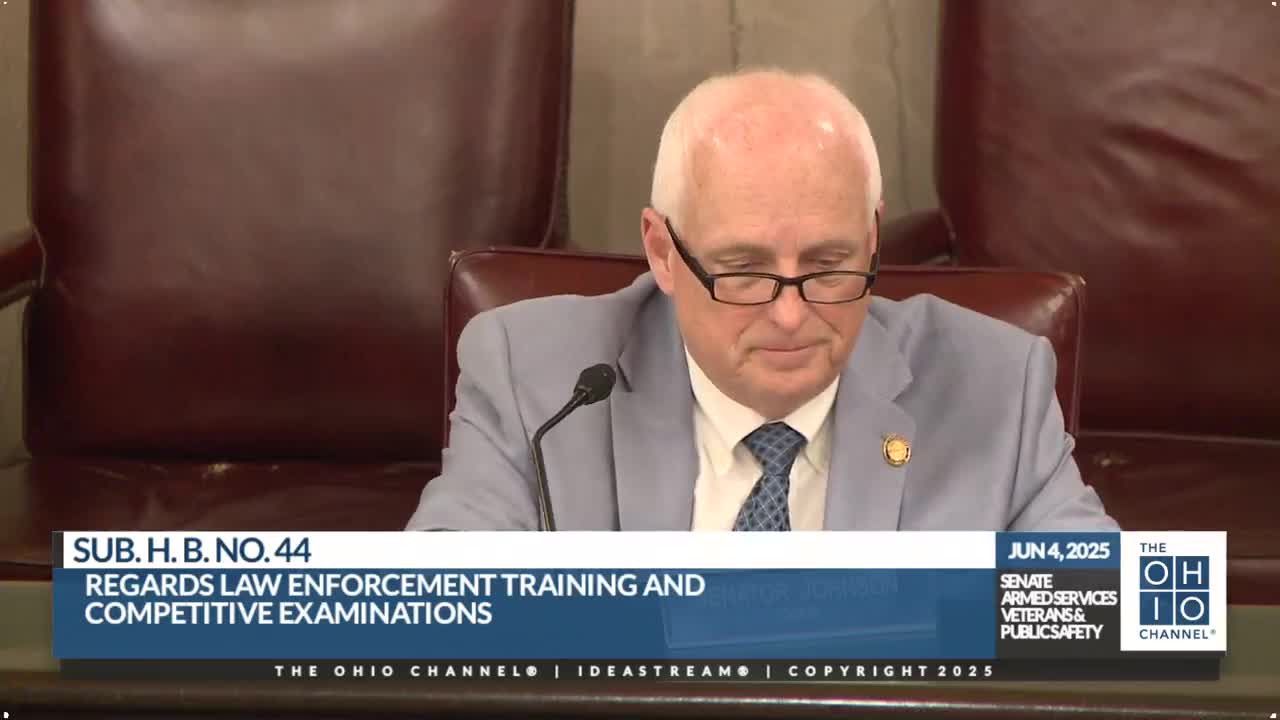
Sponsors told the Ohio Senate Armed Services, Veterans Affairs and Public Safety Committee that House Bill 44 would let municipal police departments bypass competitive civil‑service exams for lateral hires in some cases and permit regional training options for newly appointed chiefs.
House Bill 44, which the Ohio Senate Armed Services, Veterans Affairs and Public Safety Committee heard in sponsor testimony, would permit municipal police departments to fill certain vacant civil‑service positions without administering a competitive exam if the department presents evidence that a competitive examination is unnecessary and the applicant has “exceptional qualifications.”
The bill’s sponsors told the committee the measure is intended to treat statutory cities the same as charter cities by allowing immediate lateral hiring, to speed placement of trained officers into service and to authorize chiefs of police to run cadet training aligned with Ohio Peace Officer Training Academy standards. "It would grant police departments the power to fill vacant positions in civil service without an exam if the department can present evidence that a competitive component of exams is deemed unnecessary and the applicant has exceptional qualifications," a House sponsor said in testimony.
Sponsors said the civil‑service process remains useful to guard against nepotism but can be impractical for lateral transfers because of posting, testing and wait times. They described amendments that would allow localized new‑chief trainings at approved regional facilities rather than requiring travel to Columbus and set an eight‑hour maximum exemption for a new chief who submits evidence of prior training in the exempted topics. "So essentially they can stay, say, in their regions instead of having to travel and stay overnight here in the Columbus area," a sponsor said when describing the training amendment.
Committee members asked about stakeholder input. Sponsors said unions and law‑enforcement groups raised concerns that any exception be limited to lateral transfers, not used to circumvent supervisory promotional testing. "We did have some concerns that this was limited to lateral transfers. And we, have ensured that that's correct with the language," a sponsor told the committee. The sponsors also said the bill has drawn support from the Fraternal Order of Police, Buckeye Sheriffs and the attorney general’s office as the measure was amended.
The session on House Bill 44 was a first hearing for sponsor testimony; no committee vote on the bill occurred at the meeting. Committee members thanked the sponsors and moved on to other agenda items.
What’s next: House Bill 44 remains at the committee hearing stage; sponsors said the bill has passed prior House committees and received earlier hearings, and they offered to answer additional questions from the Senate committee.