Get Full Government Meeting Transcripts, Videos, & Alerts Forever!
Get email alerts on the Strategic Work Plan topic
No spam. Unsubscribe anytime.
University City manager lays out first-quarter work plan, timelines and priorities
Summary
City Manager Boas presented a consolidated first-quarter work plan to the University City City Council on May 27, 2025, outlining staffing hires, capital projects, public-safety proposals, and a schedule for quarterly updates; no formal approval was taken during the study session.
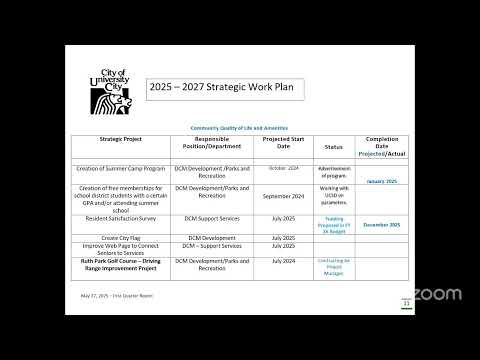
University City City Manager Boas presented a consolidated first-quarter strategic work plan to the City Council at a study session on Tuesday, May 27, 2025, and asked council members to consider placing the plan on a future consent agenda for formal approval. "We are looking at, trying to do a better job, in informing not just you, but also the public about how the organization is performing," Boas said as he opened the presentation.
The presentation grouped planned initiatives under economic development, capital projects, public safety and internal operations. Boas said the city hired an economic development manager in April to lead a quarterly economic development report and reestablish business-retention work. He said the city is actively recruiting a Third Ward revitalization coordinator and expects that person to be on board "within the next 30 days." "In April, we hired the economic development manager," Boas said.
On capital projects, Boas noted several start dates: a loop capital improvement project (CIP) that he said begins in July 2025, and other initiatives pushed to January 2026 because staff capacity is limited. He described road and sidewalk condition grading intended to create a schedule for overlays and rehabilitation so officials can tell residents when their streets or sidewalks are planned for work. Boas also said the city will identify sites for a satellite combined police and fire facility to the west of the city, and expects construction of a police/court facility to complete in mid-2026.
Public-safety items included a proposed quarter-cent sales tax for fire/paramedic services that the city would like to make a general sales tax if enabling state legislation does not materialize. "For the paramedic program, it requires the Missouri, state legislature to act," Boas said, adding that if the legislature does not pass enabling language the revenue could still be used for general fire and EMS equipment and programs. He also said the police department and human resources plan to run an active-shooter exercise at City Hall in September to test ingress/egress and staff roles.
Boas listed several administrative and operating projects: updating the zoning code (an 18-month effort led by the planning department and an outside firm), a property-maintenance code review (led by Planning and Development Director John Wagner), a stormwater master plan and an evaluation of University Heights' proposed storm ordinance (currently under review by the planning commission and a stormwater commission subcommittee). He proposed creation of an asset-management strategy to tag and track equipment and furnishings and said a purchasing manager recently was hired to lead that work.
Boas gave project-specific details when available: the city plans a summer camp pilot this year with about 16 participants; the city estimates its design-and-construction share for a long-running retention/river project with the U.S. Army Corps of Engineers at about $4,000,000; and the landlord/property-manager registration initiative originally slated for 2022 will be given a new start date. He said two employee surveys have been completed and a third begins in July with results expected in August, and that improvements to the nonuniform pension program have brought that plan to about 93% funded.
Council members asked for follow-up specifics on timing and scope. Council member Breiner asked, "How do we develop the strategic work plan? Like, who has input into it, and how do we decide what is important?" Boas described a process that begins with staff and department directors, moves to a council study session for council input and then, if the council approves, appears on the consent agenda for formal adoption. Council members also pressed for street-by-street detail for the street-maintenance program, schedules for playground projects at Rainy Park and Metcalfe Park, and clarification on the scope of the golf course driving-range improvements.
Boas said some projects were delayed because departments "took a bite that we couldn't quite handle" and that staff will seek more realistic timelines. He told the council the work-plan document and a separate capital-projects sheet will be provided as reference materials and that staff intends to present updates quarterly: "So every 3 months, we'll be presenting this document, to you." He said projects that are merely recommended by staff will not be official until the council takes formal action.
No formal votes or motions were taken during the study session. Boas said his intention is to bring the recommended work plan back for placement on a consent agenda so the council can make the list official and direct staff to track and report progress.
The study session included discussion of items that are contingent on outside approvals or additional funding, and Boas and council members noted those dependencies during the presentation. Council members asked staff to return with more-specific schedules and funding or procurement details for capital projects before formal adoption.