Get Full Government Meeting Transcripts, Videos, & Alerts Forever!
Get email alerts on the Film Production Tax Credit topic
No spam. Unsubscribe anytime.
Ohio academic urges $75 million, no-sunset motion-picture tax credit to build local film jobs
Summary
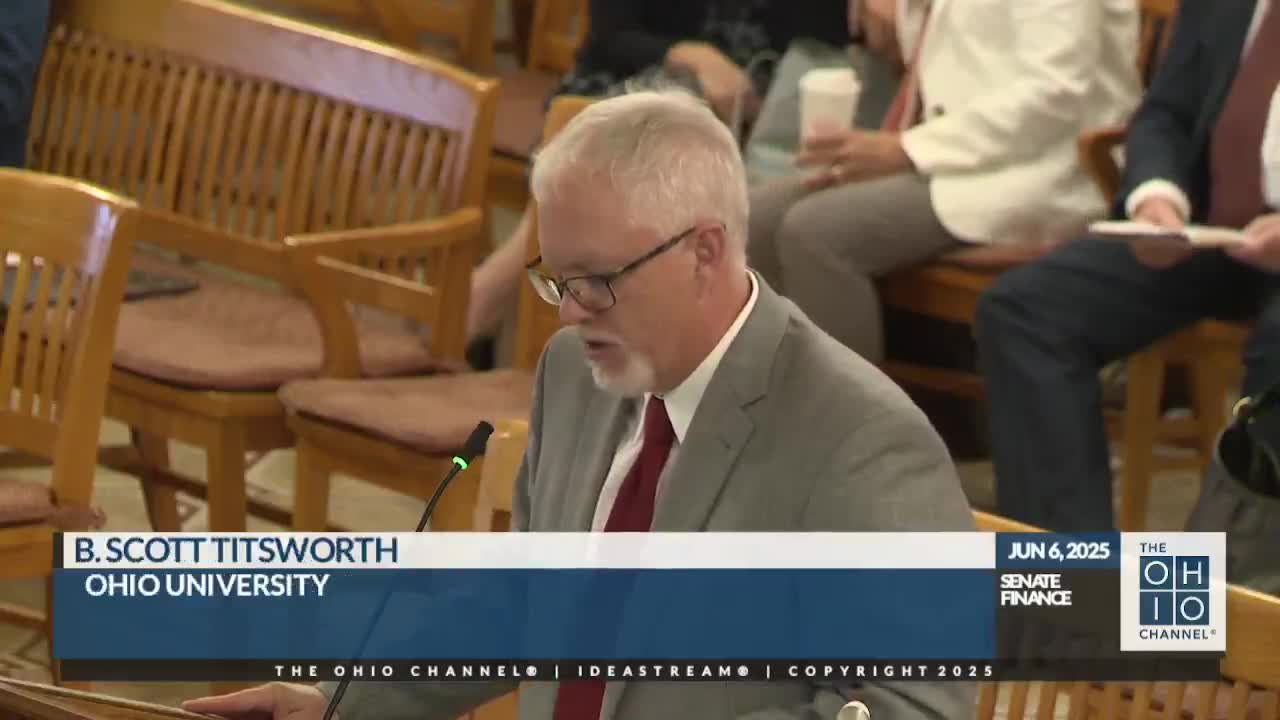
Scott Titsworth, dean at Ohio University’s Scripps College of Communication, testified in favor of raising the Ohio motion-picture and entertainment tax credit to $75 million and removing a sunset clause to attract studios and keep graduates in-state.
A dean from Ohio University urged the Senate Finance Committee on Wednesday to make the state’s motion-picture and entertainment tax credit more durable and raise the cap to $75 million with no sunset clause, arguing that permanent, larger incentives would signal to production companies to build infrastructure and locate long-term operations in Ohio.
"Higher tax credit could unlock that," said Scott Titsworth, dean of the Scripps College of Communication (speaking in a personal capacity). He pointed to Georgia’s experience as an example: a high or unlimited cap signaled long-term commitment and helped attract studios and ancillary businesses.
Titsworth said Ohio trains roughly 200 students a year in disciplines connected to motion pictures and that many alumni go to Los Angeles for work. He said a durable tax credit and workforce-development provisions could help retain graduates in Ohio and spur local infrastructure such as sound stages, post-production and other service companies.
Why it matters: Supporters argue that larger, durable incentives attract not only episodic productions but also encourage infrastructure and supply-chain development that produce sustained local jobs and training opportunities.
Discussion vs. decisions: Senators questioned the comparison with Georgia (which also invested in studio infrastructure) and raised concerns about technological change such as AI and whether incentives are the right signal for infrastructure investment. Titsworth responded that incentives are an important signal and that local workforce, post-production and studio development would follow a durable policy commitment.
Ending: Titsworth asked the Senate to adopt language in section 122.85 setting the entertainment-tax-credit cap at $75 million with no sunset and to preserve workforce provisions; the committee heard the testimony but took no formal action.